
Possible supernova remnant identified near Milky Way’s center
X-ray observations point to stellar debris in Sagittarius C, a busy star-forming region close to the Milky Way’s central black hole.
By Lucas Ferreira · Science & Environment Writer
3 min read
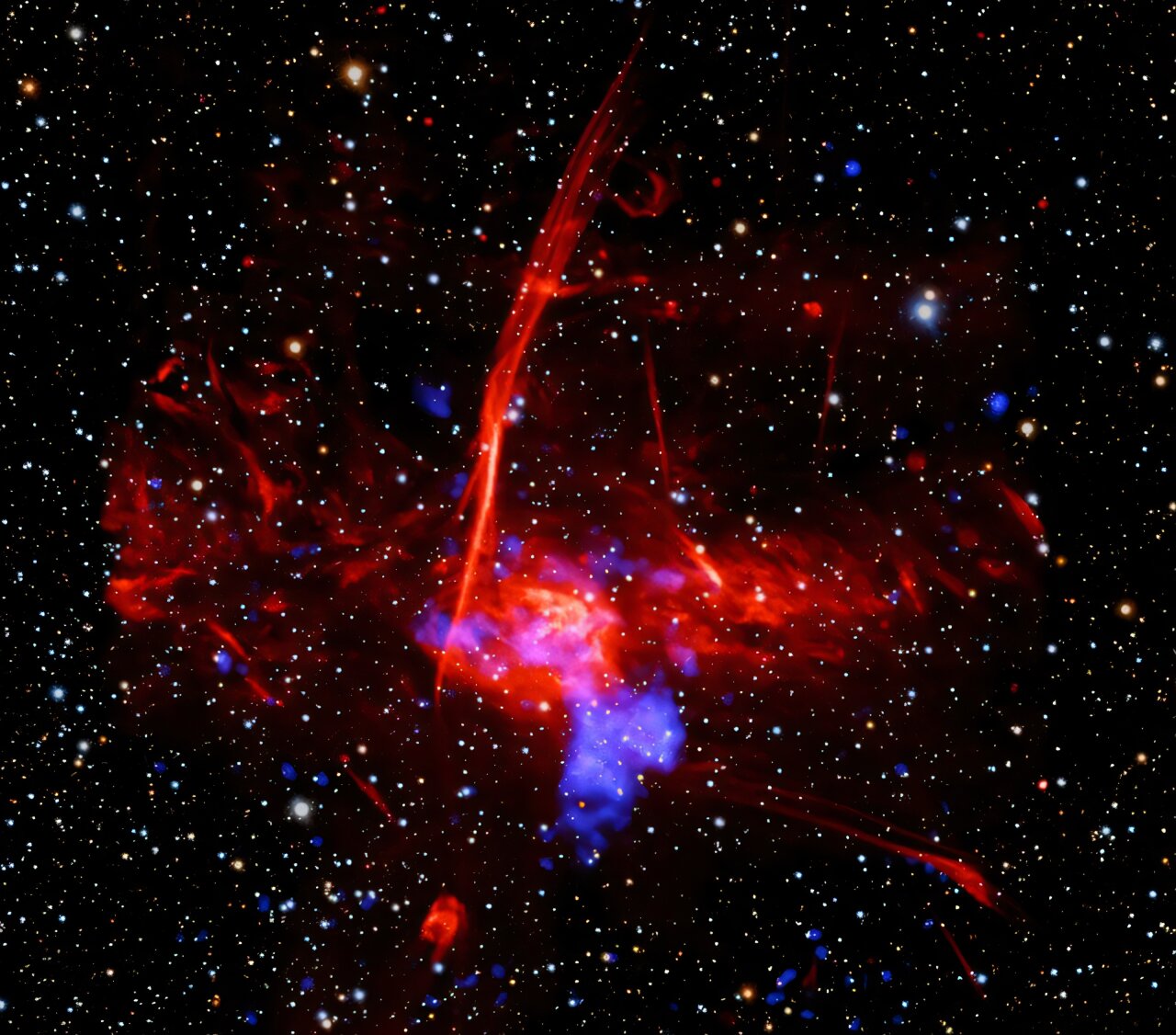
Astronomers may have found the remains of an exploded star near the center of the Milky Way, according to the Chandra X-ray Center. If confirmed, the object would rank among the nearest known supernova remnants to the galaxy’s central supermassive black hole.
The evidence comes from observations by NASA’s Chandra X-ray Observatory and the European Space Agency’s XMM-Newton mission, researchers reported in a paper published in The Astrophysical Journal. The suspected remnant lies about 26,000 light-years from Earth in the Sagittarius C complex, a star-forming region near the Galactic Center.
Supernova remnants are expanding clouds left behind after stars explode. The Chandra X-ray Center said such explosions distribute elements including iron, oxygen and silicon into space, supplying material that can later become part of new stars, planets and, in Earth’s case, life-supporting chemistry.
Researchers identified a compact patch of X-ray emission embedded in a broader cloud of expanding gas, according to the Chandra X-ray Center. The team interprets that X-ray feature as a possible remnant of a massive star that ended its life in a supernova.
The candidate sits inside an H II region, a bubble of gas where hydrogen atoms have been stripped of electrons, surrounding a young massive star. That radio-bright bubble is known as Sagittarius C.
Astronomers combined several observatories to study the area, the Chandra X-ray Center said. X-ray data from Chandra and XMM-Newton were paired with radio observations from South Africa’s MeerKAT telescope and optical imaging from the Pan-STARRS telescopes in Hawaii.
If the X-ray feature is a supernova remnant, the Chandra X-ray Center said it is expanding at about 3.2 million kilometers per hour, or 2 million miles per hour, and is at least about 1,700 years old. Earlier observations by NASA’s retired Stratospheric Observatory for Infrared Astronomy, known as SOFIA, had found signs of an expanding shell of gas around Sagittarius C, giving researchers another reason to look for evidence of a stellar explosion there.
The radio images also show long filaments, which the Chandra X-ray Center said are produced by energetic particles moving along magnetic fields. Those magnetic fields are mostly oriented perpendicular to the plane of the Milky Way.
The researchers searched the X-ray data for elevated levels of elements that a supernova would have cast into space, according to the Chandra X-ray Center. They did not find a clear enrichment signal, but the team said that result could mean the stellar debris has already mixed into nearby gas.
The study also considered whether the X-ray emission could come from hot gas associated with a group of massive stars in the region. The authors judged that explanation unlikely because the X-ray patch is more than 10 times brighter than emission from known large star clusters containing bright, massive stars, according to the Chandra X-ray Center.
NASA’s James Webb Space Telescope contributed additional infrared views of the same region, the Chandra X-ray Center said. In those data, infrared light traces gas in the H II region, while nearby X-rays are associated with the supernova remnant candidate and with gas that may have been heated to millions of degrees by material blown from massive stars.
The study was written by Zhenlin Zhu and Mark Morris of the University of California, Los Angeles; Gabriele Ponti of Italy’s National Institute for Astrophysics; and Ping Zhou of Nanjing University in China.
This story draws on original reporting from Phys.org.