
Osaka team designs elastomer that toughens itself in stages
A polymer design reported in Nature Communications uses three stress responses in sequence to help soft materials resist tearing.
By Priya Raghavan · Science Reporter
3 min read
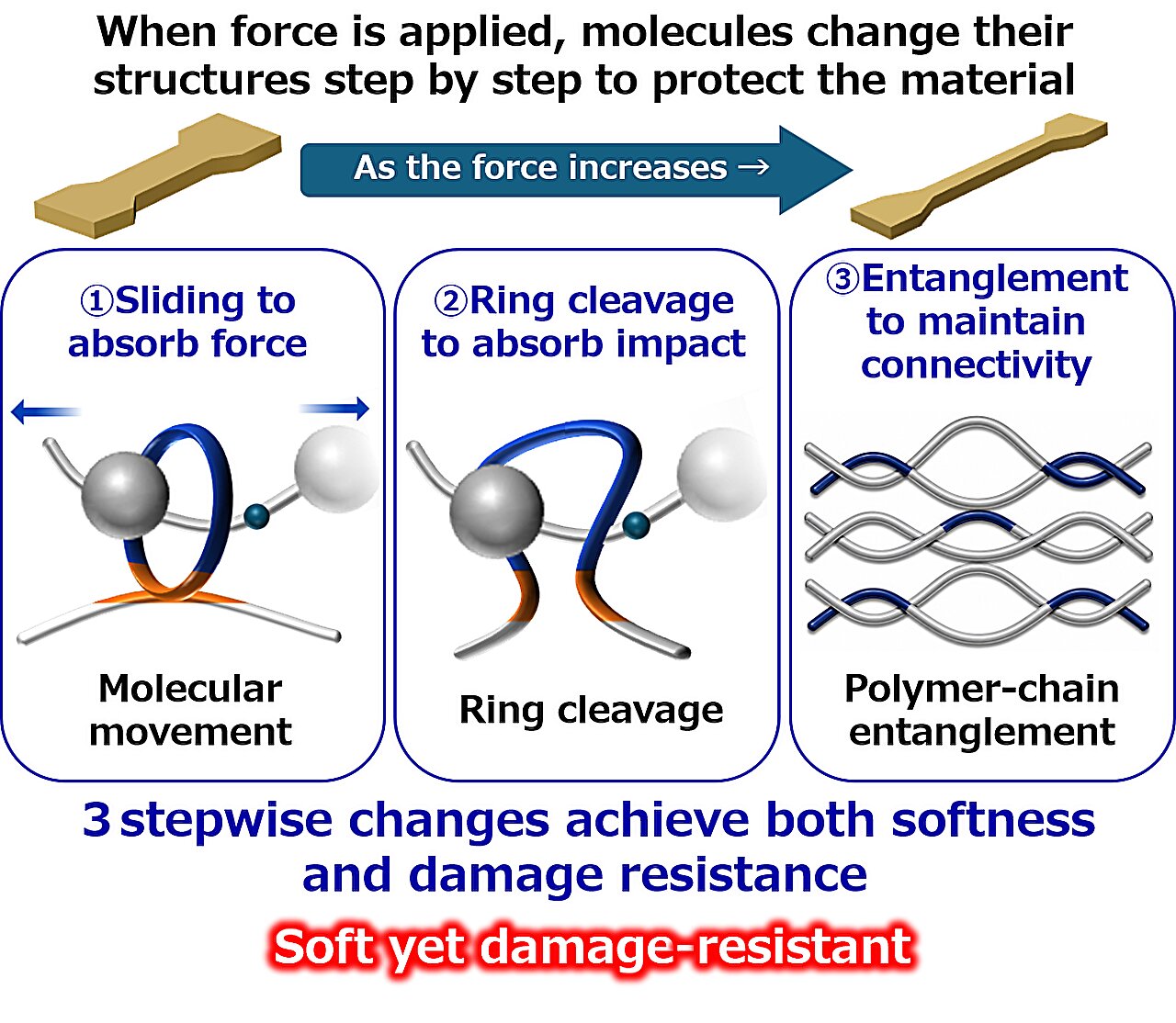
Researchers at the University of Osaka have developed an elastomer that responds to strain through a sequence of molecular changes, a design intended to make soft polymers harder to tear. The work matters for materials such as polyurethane, used in shock-absorbing sneaker soles, where elasticity and durability both affect performance.
The team reported the approach in Nature Communications, according to the University of Osaka. The study describes a “multipath” strategy that combines three known ways of dissipating mechanical energy inside one material and activates them as stress rises.
Elastomers can stretch under force and return to their original shape when that force is removed, the university said. Their weakness is toughness: small cracks can spread through conventional elastomers and cause tearing.
Materials scientists try to address that problem by giving the polymer network ways to absorb and disperse mechanical energy during deformation. The University of Osaka said existing strategies can improve toughness, but each has limits when used alone.
Three stress responses in one network
The researchers combined three mechanisms in a single elastomer, according to the university. One uses rotaxane molecules, whose ring-shaped parts can move under force, spreading stress through the network instead of concentrating it at one point.
A second mechanism relies on sacrificial bonds. These bonds are designed to break under applied stress, absorbing energy before damage reaches the main elastomer network, the university said.
The third mechanism uses chain entanglement. In that design, polymer chains can slide and rearrange under tension, helping redistribute force and maintain the material’s structure.
Previous work had placed multiple toughening features in one material, the University of Osaka said. The challenge was making those features cooperate by switching on one after another as strain increases.
“We integrated three energy dissipation pathways that become activated in sequence under increasing stress to prevent failure of the elastomer,” lead author Xue Li said in the university’s account of the study. Li said the design combines three toughening mechanisms in a synergistic way.
How the material changes under force
In the new elastomer, the researchers introduced ring molecules that contain sacrificial bonds, according to the University of Osaka. Under initial stress, the rings slide through the polymer network, helping the material absorb force.
As stress grows, the university said, the rings break open and become linear chains. Under still higher stress, those chains become entangled with other chains in the material.
That final stage helps preserve network connectivity while allowing energy to dissipate through chain movement, according to the university. The sequence is meant to delay material failure by giving the elastomer multiple ways to respond before tearing occurs.
The University of Osaka said infrared spectroscopic analysis showed molecular structural changes in the elastomer under force. The university also said the developed material showed higher toughness than a conventional elastomer in the study.
The researchers said the approach could support soft, durable materials for tires, gloves and adhesives. According to the University of Osaka, improving toughness could lengthen service life and reliability in such products.
The paper, titled “Toughening Elastomer via Sequentially Activated Multi-Pathway Energy Dissipation,” was published in Nature Communications in 2026.
This story draws on original reporting from Phys.org.