
Astronomers find sparse galaxy groups inside cosmic voids
A CAVITY survey study reports that even the universe’s emptiest regions can host small, loose galaxy groups, though most void galaxies remain alone.
By Priya Raghavan · Science Reporter
3 min read
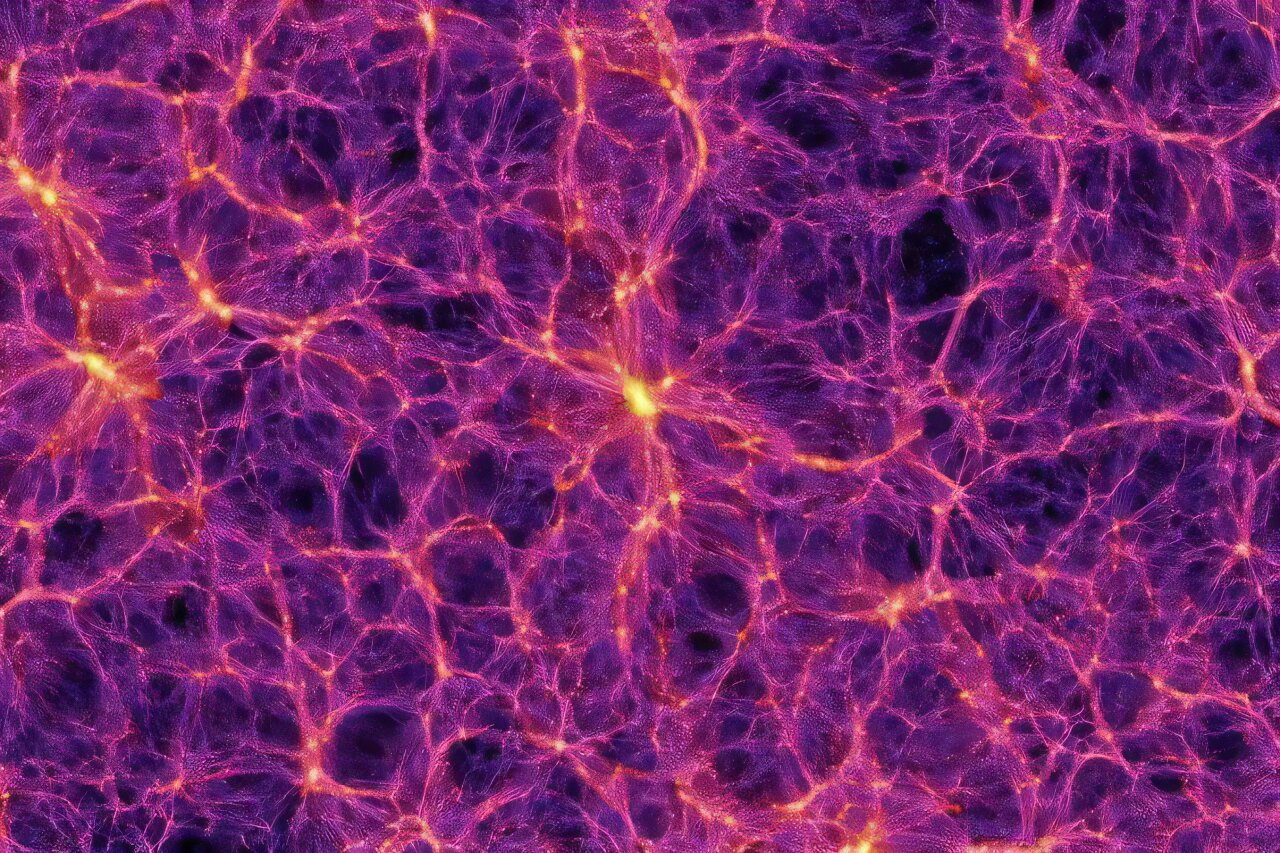
Astronomers have identified more than 1,300 galaxy groups inside cosmic voids, showing that the universe’s emptiest regions are not entirely isolated. The findings matter because they offer a closer look at how gravity builds structure in places where matter is scarce, according to a study posted to the arXiv preprint server.
The work, led by M. Argudo-Fernández and colleagues, uses data from the Calar Alto Void Integral field Treasury surveY, known as CAVITY. Universe Today reported that the project focuses on galaxies in voids, the large underdense regions between the filaments and walls of the cosmic web.
Cosmic voids form as matter gathers under gravity into denser structures elsewhere, leaving broad regions with far fewer galaxies than the cosmic average. The new study examines whether the galaxies that remain in those regions tend to stay isolated or assemble into small systems.
The research team studied a defined sample of void galaxies out to a redshift of 0.08, which Universe Today described as nearby on cosmological scales. To identify associations, the team used a “friends-of-friends” method, which links galaxies that are close enough in position and similar enough in motion to be treated as part of the same group.
That search found 1,367 bound groups inside voids, containing 3,040 galaxies in total, according to the study. The same analysis also identified 14,672 void galaxies with no nearby companions.
The contrast with less empty environments was clear. The researchers built a control sample of galaxies located outside both voids and dense clusters, and found that 60% of galaxies in that sample belonged to groups, according to Universe Today. In the void sample, 59% of galaxies were solitary.
The study also examined the properties of the galaxy groups that do form in voids. The researchers measured factors including group size, the relative speeds of member galaxies and the time a galaxy would need to cross the group, according to Universe Today.
The richest void groups in the sample contained six galaxies, the study found. That makes them small compared with the crowded structures found in denser parts of the universe, including clusters and filaments.
The void groups also appear less dynamically mature than galaxy groups in denser regions, according to the report. Universe Today said the measurements point to loose, young systems that have not settled into the more mixed and gravitationally relaxed configurations seen elsewhere.
One result was less straightforward: the richness of a void group did not depend on how empty the surrounding void was, according to the study. A deeper void could host a group much as a shallower void could.
The authors’ results suggest that voids can contain pockets where gravity still draws galaxies into small associations, even when the wider environment has little matter. The study remains a preprint on arXiv, where it is listed as “Galaxy groups within voids,” with DOI 10.48550/arxiv.2606.17676.
This story draws on original reporting from Phys.org.