
New model could improve simulations of flocks, crowds and cells
Dresden physicists say a mathematical workaround can describe one-way interactions in collective systems with greater precision.
By Priya Raghavan · Science Reporter
3 min read
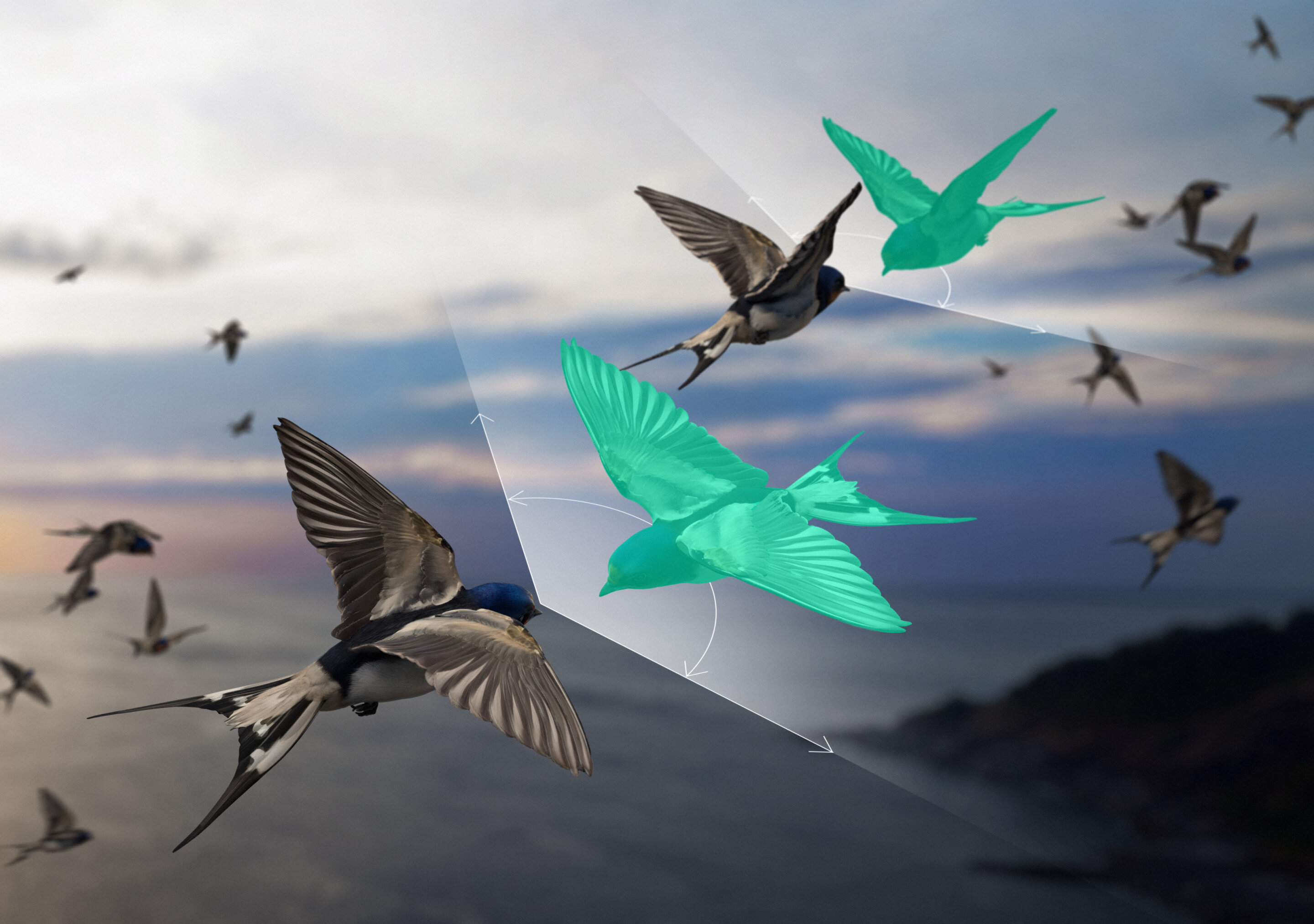
A Dresden physics team has developed a theory for modeling collective systems whose parts do not respond to one another in equal measure. The work could improve simulations of bird flocks, fish schools, bacterial swarms, crowds and tissue cells, according to the Würzburg-Dresdner Exzellenzcluster.
The findings were published in Nature Physics in a paper titled “Hamiltonian description of non-reciprocal interactions.” The research was carried out by a team working with Roderich Moessner, a founding member of the Würzburg-Dresden Cluster of Excellence ctd.qmat and director of the Max Planck Institute for the Physics of Complex Systems in Dresden.
Why some collective motion is hard to model
Newton’s third law says that forces come in equal and opposite pairs. In many living or active systems, however, the rule does not describe the practical interaction between individuals, the cluster said.
A bird in a flock may adjust to birds ahead or beside it, while paying no attention to a bird behind it. Similar one-way effects can appear in schools of fish, bacterial swarms, human crowds and cells in tissue, according to the research team.
Physicists call these cases nonreciprocal interactions. Because standard theory was built for reciprocal systems, researchers have lacked an efficient way to describe and simulate such behavior with full precision, according to the Dresden group.
A mathematical partner for each component
The team’s answer is to expand the usual action-reaction framework rather than discard it. Marín Bukov, a research group leader involved in the work, said the theory makes established tools from theoretical mechanics usable for systems where Newton’s third law does not apply.
Ricard Alert, a biophysicist on the team, described the method as adding an artificial partner for every real component in the system. These extra variables do not represent real birds, fish or cells; they are mathematical degrees of freedom that let the nonreciprocal system be rewritten in reciprocal form.
In the flock example, Alert said the model can be treated as if each real bird has a fictitious counterpart in front of it, pointing the other way. That construction lets researchers apply existing methods used for reciprocal many-body systems while still representing the one-way character of the original interaction.
The cluster said the use of auxiliary degrees of freedom is already familiar in physics. The advance here is that the added variables provide a route to more accurate simulations of nonreciprocal systems and connect them to a broad theoretical framework that researchers already use.
Possible uses beyond flocks
The team said better simulations could help researchers study motion in swarms and flocks as well as biological processes in greater detail. The work also has a basic physics goal: understanding how collective behavior changes when action and reaction are not paired in the classical way.
Moessner said researchers in Würzburg and Dresden also study quantum matter, where interactions among particles can produce phenomena such as magnetism or current flow without loss. He said an open question is whether exceptions to Newton’s law can lead to new forms of collective quantum behavior.
The publication lists Yu-Bo Shi and colleagues as authors. The paper appeared in Nature Physics with the DOI 10.1038/s41567-026-03317-0.
This story draws on original reporting from Phys.org.