
New fossil crocodile species linked to Lucy’s Ethiopian world
Researchers say Crocodylus lucivenator lived alongside Australopithecus afarensis and may have preyed on early human relatives in Ethiopia.
By Tom Brennan · Health & Medicine Correspondent
3 min read
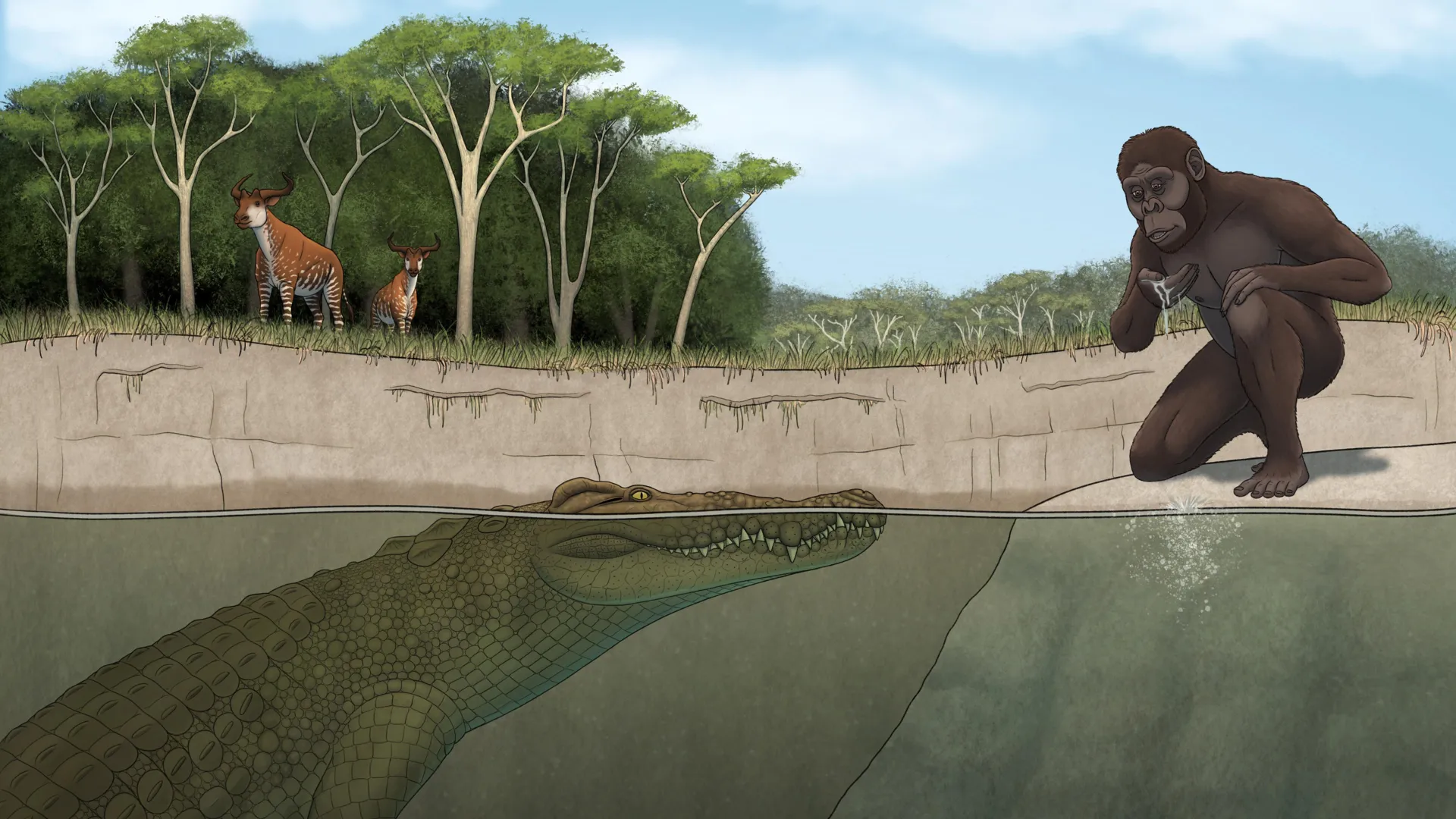
A University of Iowa-led research team has identified a previously unknown crocodile species from Ethiopia that lived at the same time and place as Lucy’s species. The finding adds a major predator to the picture of the Hadar ecosystem, where early human relatives moved through wetlands, rivers and wooded areas more than 3 million years ago.
The species, named Crocodylus lucivenator, is described in the Journal of Systematic Palaeontology, according to the University of Iowa. The name means “Lucy’s hunter,” reflecting its overlap with Australopithecus afarensis, the species that includes the famous Lucy fossil discovered in 1974.
Researchers place the crocodile in what is now Ethiopia between 3.4 million and 3 million years ago. The University of Iowa said the animal is the only crocodile currently known from the Hadar setting, a place that preserved fossils from a mix of shrublands, wetlands, rivers and tree-lined waterways.
Christopher Brochu, a University of Iowa professor and corresponding author of the study, said the crocodile likely ranked as the leading predator in that ecosystem, ahead of lions and hyenas. Brochu said the animal almost certainly would have hunted members of Lucy’s species, though researchers cannot know whether any individual crocodile ever attacked Lucy herself.
A large ambush predator
The team estimated the crocodile measured about 12 to 15 feet long and weighed roughly 600 to 1,300 pounds, according to the University of Iowa. Researchers described it as an ambush predator that would have waited in water for animals coming close enough to catch.
Brochu, who has studied ancient crocodilians for 35 years, first examined specimens of the species at a museum in Addis Ababa in 2016, the university said. He reported that the fossils showed an unusual mix of anatomical traits.
One standout feature was a raised area in the middle of the snout. The researchers said similar structures occur in American crocodiles but are absent in Africa’s Nile crocodiles, and they suggested the feature may have had a role in courtship display.
The species also had a snout extending farther past the nostrils than seen in other crocodiles of that time, according to the research team. The study authors said that trait is closer to the condition seen in modern crocodiles.
Fossils from Hadar
The researchers based the description on 121 cataloged fossil remains from the Hadar Formation in Ethiopia’s Afar region, including skull material, teeth and jaw fragments from many individuals. Because many fossils were incomplete, the scientists had to reconstruct parts of the animal’s anatomy, according to the University of Iowa.
One jaw specimen preserved partially healed injuries, which the team interpreted as evidence of a fight with another crocodile. Stephanie Drumheller, a University of Tennessee teaching associate professor and study co-author, said similar bite-related injuries are known across extinct crocodilian groups, showing that face-biting behavior has deep roots in the crocodile family tree.
Christopher Campisano of Arizona State University, another co-author, said Hadar during the Pliocene included lake and river systems along with open and closed woodlands, gallery forests, wet grasslands and shrublands. He said the newly named crocodile was among the few species that persisted there through changing local conditions.
The University of Iowa said co-authors also included Nathan Platt and Daniel Leaphart of the University of Iowa, Getahun Tekle and Tomas Getachew of the National Museum of Ethiopia, and Jason Head of the University of Cambridge. The research was funded by the U.S. National Science Foundation, the Leakey Foundation, the University of Iowa Office of International Programs, and the university’s College of Liberal Arts and Sciences.
This story draws on original reporting from ScienceDaily.