
NASA awards nearly $600 million for four commercial Moon landings
Astrobotic, Firefly and Intuitive Machines are slated to deliver NASA instruments to the lunar surface in late 2028.
By Priya Raghavan · Science Reporter
3 min read
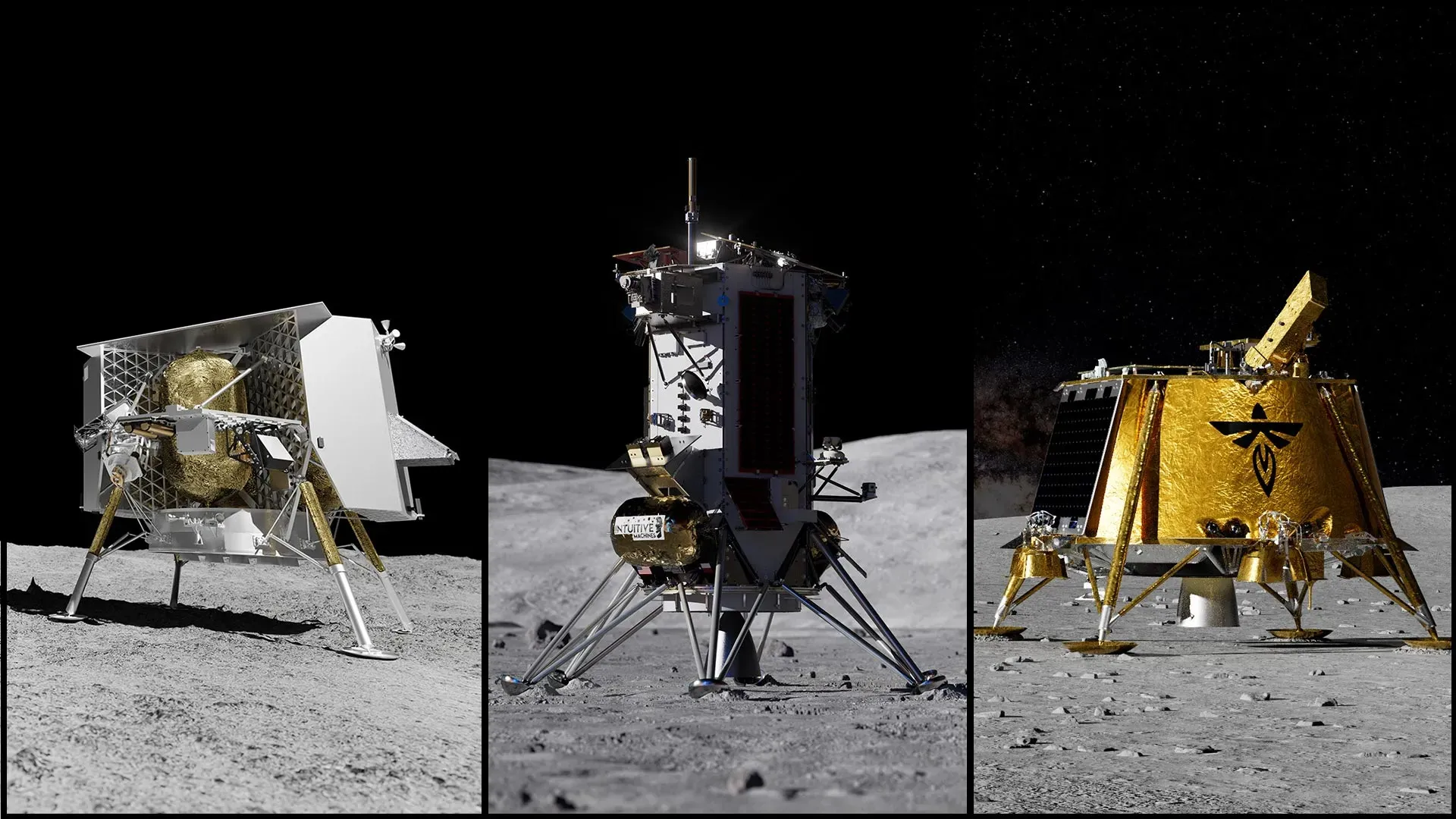
NASA has awarded nearly $600 million for four commercial Moon landing missions planned for late 2028, the agency said. The flights are meant to support NASA’s Moon Base Program by collecting data needed for safer landings, better positioning on the lunar surface and long-duration human activity.
The missions will be run through NASA’s Commercial Lunar Payload Services initiative, known as CLPS. NASA said Astrobotic, Firefly Aerospace and Intuitive Machines will use upgraded versions of landers that have flown on earlier missions.
Three companies split four awards
Astrobotic received $297.9 million for two lunar deliveries, NASA said. Firefly Aerospace was awarded $144.2 million for one mission, and Intuitive Machines received $148.3 million for one mission.
NASA said the awards, announced June 30, are part of a broader effort to build the operating base for sustained activity on the Moon. Lori Glaze, associate administrator for NASA’s Human Spaceflight Mission Directorate, said the contracts are intended to speed the agency’s work toward a long-term lunar presence and give its commercial partners more chances to test the skills needed there.
NASA said it now has 17 lunar surface deliveries planned with several commercial providers. Ryan Stephan, acting director of cargo landers for NASA’s Moon Base effort, said the agency wants a faster ordering and launch pace so it can test systems, learn from them and improve subsequent missions.
Same payloads will fly on each mission
Each of the four landers will carry the same three NASA instruments, according to the agency. Flying the instruments to several locations will let researchers compare measurements from different landing sites.
One payload, the Stereo Camera for Lunar Plume Surface Studies, or SCALPSS, uses four cameras to build 3D views of how a lander’s engine exhaust moves lunar dust and surface material during descent. NASA said the data will help improve models of dust erosion and debris movement as larger spacecraft and heavier equipment begin landing on the Moon.
The Laser Retroreflector Array will serve as a passive position marker on the lunar surface, NASA said. The small device, built with eight quartz corner cube prisms in a dome-shaped aluminum frame, reflects laser signals from spacecraft or landers and does not require power or maintenance.
The third instrument, the Linear Energy Transfer Spectrometer, will measure radiation at landing sites and during approaches to the Moon, NASA said. The agency said its silicon detector will help characterize the radiation environment future astronauts may face.
More Moon infrastructure under review
NASA said it is also considering whether the landers can carry additional payloads. Joel Kearns, deputy associate administrator for exploration in NASA’s Science Mission Directorate, said placing the same instruments at multiple sites would help identify landing hazards and expand a network of environmental measurements and location markers.
The agency also outlined possible future work with U.S. industry. NASA said it may send the Polar Rover for Observation, Mapping, and In-Situ Exploration, or PROMISE, a hybrid engineering development vehicle based on the Mars Perseverance and Curiosity rovers, to study the lunar surface and subsurface and search for useful resources.
NASA said it also plans to seek proposals for more lunar landers, a power and avionics technology demonstration, additional science instruments, a South Pole optical imager, Moon Base technology demonstrations and a lunar communications and navigation relay constellation linking lunar systems with Earth.
This story draws on original reporting from ScienceDaily.