
Embedded tooth links duckbill fossil to Tyrannosaurus bite
A Montana Edmontosaurus skull with a tyrannosaur tooth in its face offers evidence of how Tyrannosaurus may have attacked prey.
By Priya Raghavan · Science Reporter
3 min read
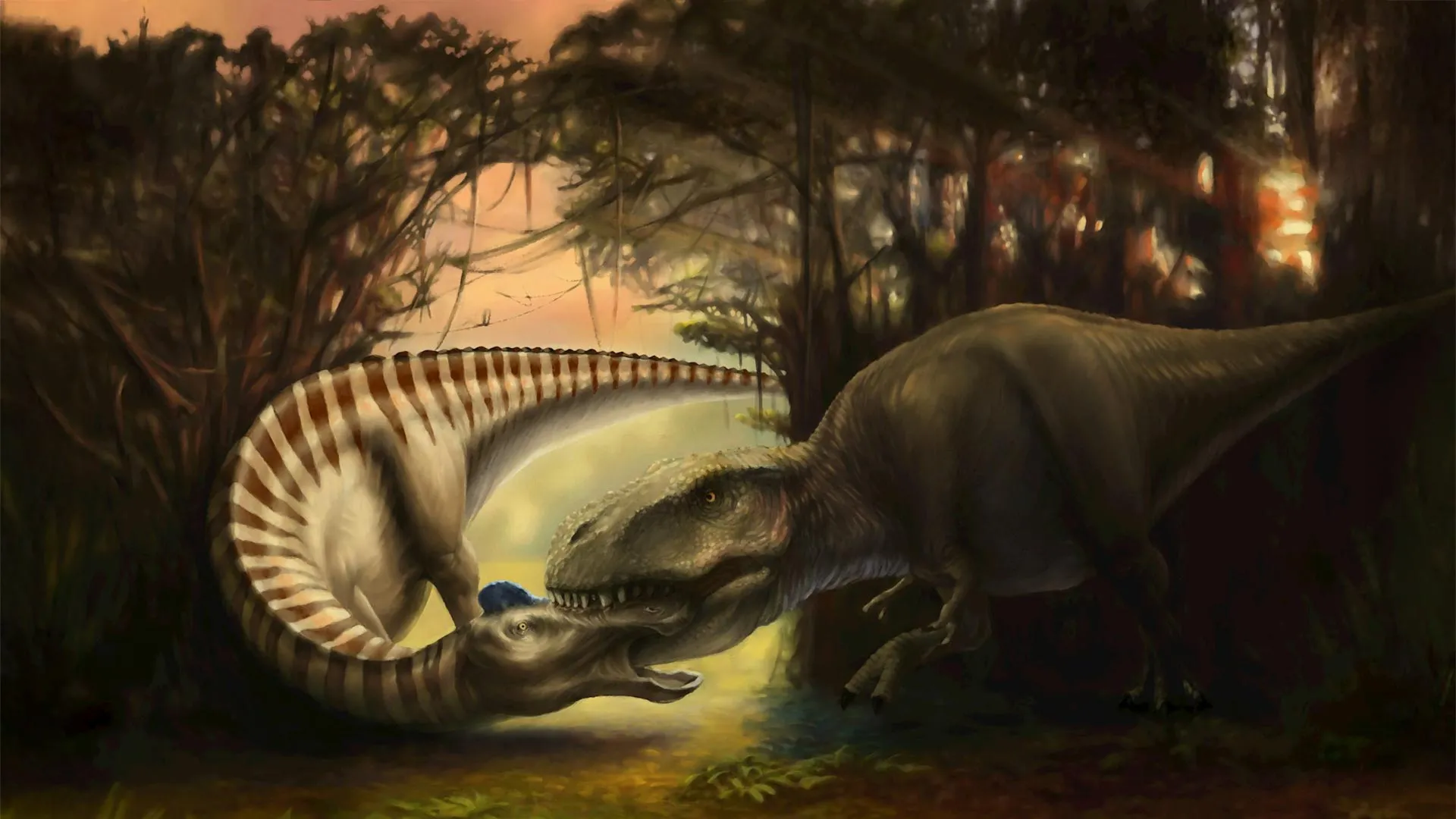
A fossil skull from Montana has preserved a tyrannosaur tooth lodged in the face of an Edmontosaurus, giving researchers a direct trace of a predator-prey encounter from about 66 million years ago. Montana State University said the specimen could help scientists study how Tyrannosaurus used its bite against large plant-eating dinosaurs.
The fossil, a nearly complete Edmontosaurus skull, was found in 2005 in the Hell Creek Formation of eastern Montana on land managed by the Bureau of Land Management, according to Montana State University. It is held by the Museum of the Rockies and is on display in the museum’s Hall of Horns and Teeth.
Researchers from Montana State University and the University of Alberta examined the skull in a study published in PeerJ. The work was led by University of Alberta doctoral student Taia Wyenberg-Henzler and John Scannella, curator of paleontology at the Museum of the Rockies.
Tooth points to Tyrannosaurus
The team compared the broken tooth with teeth from known meat-eating dinosaurs from the Hell Creek Formation, Montana State University said. That comparison identified the biter as Tyrannosaurus.
Wyenberg-Henzler said bite marks on fossil bones are not unusual, but a tooth left inside the bone is far less common. “The great thing about an embedded tooth, particularly in a skull, is it gives you the identity of not only who was bitten but also who did the biting,” she said, according to Montana State University.
The Hell Creek ecosystem near the end of the dinosaur age included Tyrannosaurus, Triceratops and the duck-billed herbivore Edmontosaurus, the university said. The lodged tooth ties two of those animals to the same violent event, though the researchers said the fossil does not show whether the Edmontosaurus was already dead or died because of the bite.
Scannella said the skull shows no healing around the tooth. “The skull shows no signs of healing around the tyrannosaur tooth, so it may have already been dead when it was bitten, or it may be dead because it was bitten,” he said, according to Montana State University.
Scans show how the bite struck
The researchers used CT scans at Advanced Medical Imaging at Bozeman Health Deaconess Hospital to examine the tooth and surrounding bone, Montana State University said. The scans helped the team study how the tooth was trapped in the skull.
According to Wyenberg-Henzler, the tooth’s location in the Edmontosaurus’ nose suggests the animals met head-on. She said that kind of position is consistent with a predator killing prey, and the force needed to snap a tooth off in bone points to a powerful bite.
The study adds evidence to a long-running scientific discussion about Tyrannosaurus feeding and hunting behavior, Montana State University said. Researchers have debated how the large carnivore caught, killed or fed on animals in its environment, and the Edmontosaurus skull supplies a direct fossil record of one bite.
The paper, “Behavioral implications of an embedded tyrannosaurid tooth and associated tooth marks on an articulated skull of Edmontosaurus from the Hell Creek Formation, Montana,” was written by Wyenberg-Henzler and Scannella and published in PeerJ.
This story draws on original reporting from ScienceDaily.