
Perseverance rover logs a marathon distance on Mars
NASA says the rover reached 26.2 miles of driving on Mars in five years and four months, far faster than Opportunity did.
By Tom Brennan · Health & Medicine Correspondent
2 min read
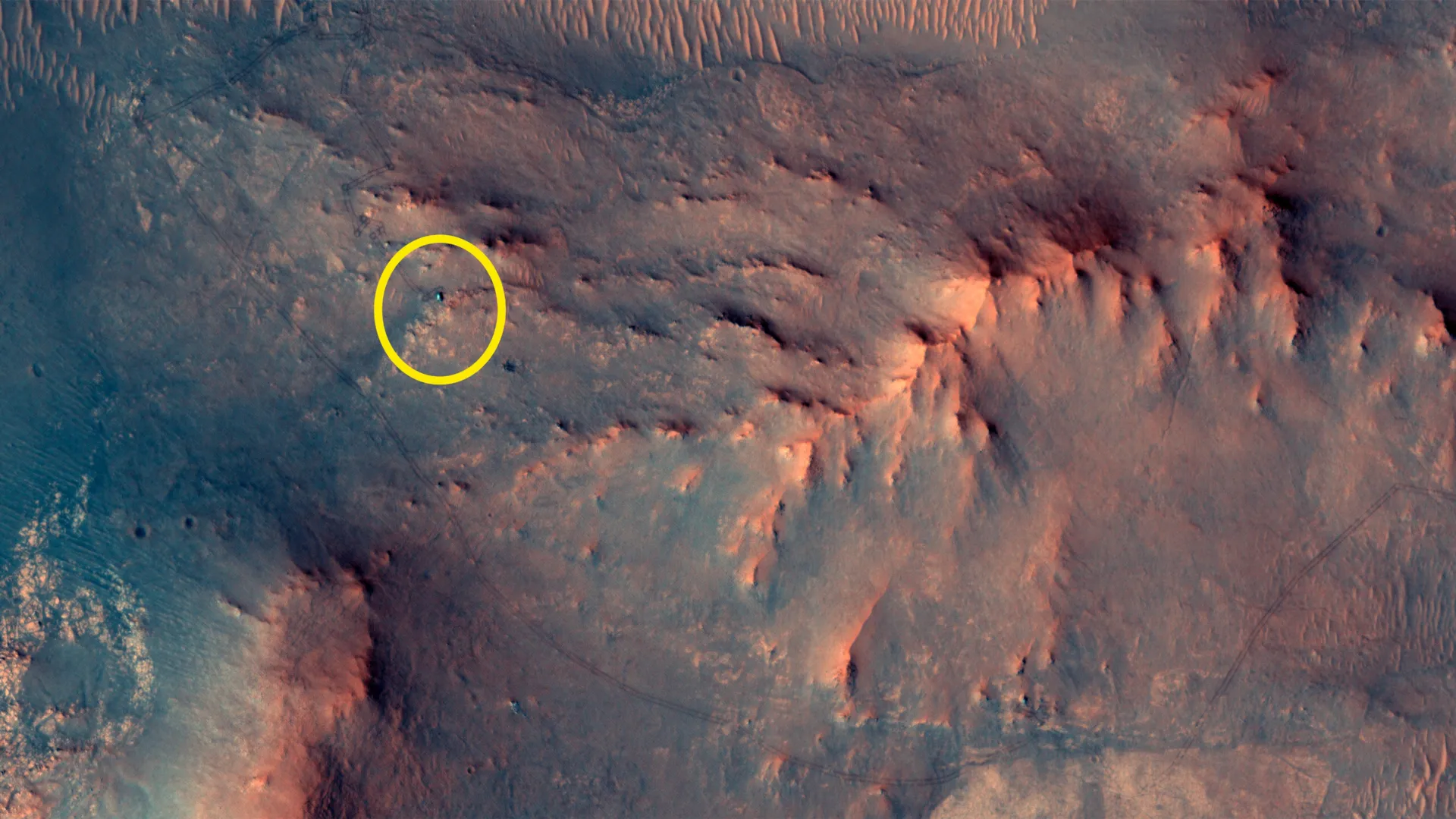
NASA’s Perseverance rover has driven the equivalent of a marathon on Mars, reaching 26.2 miles, or 42.195 kilometers, across the planet’s surface. The milestone adds a new measure of endurance to a mission that is still operating years after landing in Jezero Crater.
NASA said Perseverance reached the distance on the 1,890th Martian day, or sol, of its mission after five years and four months of driving. The agency said the rover hit the same distance in less than half the time required by Opportunity, the earlier NASA rover that took 11 years and two months to travel 26.2 miles.
A new orbital view shows the route Perseverance has taken, according to NASA. The image was captured on June 13, 2026, one day before the rover officially crossed the marathon-distance mark, and shows Perseverance as a small green speck on the Martian terrain.
Orbiter image shows the rover’s path
NASA said the image came from the Mars Reconnaissance Orbiter, which photographed the area with its High-Resolution Imaging Science Experiment camera, known as HiRISE. The view also shows the tracks left by the rover as it has driven across the surface.
At the time the image was taken, Perseverance was working west of Jezero Crater, NASA said. The mission science team has given that area the nickname “Arbot.”
Jezero Crater has been the center of Perseverance’s mission since the rover’s arrival on Mars. NASA’s latest distance marker does not change the rover’s science goals, but it gives the agency a clear benchmark for how far the vehicle has traveled while carrying out surface operations.
Multiple teams support the mission
NASA’s Jet Propulsion Laboratory in Southern California manages Perseverance operations for the agency’s Science Mission Directorate as part of the Mars Exploration Program. JPL, which Caltech manages for NASA, also oversees the Mars Reconnaissance Orbiter mission, according to the agency.
NASA said Lockheed Martin Space in Denver built the Mars Reconnaissance Orbiter and continues to support the spacecraft’s operations. The University of Arizona in Tucson operates the HiRISE camera, which NASA said was built by BAE Systems in Boulder, Colorado.
The rover’s accumulated distance reflects years of incremental drives rather than a continuous trip. NASA’s comparison with Opportunity highlights both the longevity of Mars surface missions and the steady progress Perseverance has made while exploring terrain around and beyond Jezero Crater.
This story draws on original reporting from ScienceDaily.