
MIT team improves alloy simulations by refining atomic training data
Researchers say an information-theory method helps machine-learning models predict alloy behavior without costly brute-force data generation.
By Priya Raghavan · Science Reporter
3 min read
MIT researchers have developed a machine-learning approach that they say can model metal alloys more accurately by capturing chemical patterns that standard training data can miss. The work matters for materials design because companies in aerospace, energy and computing often must build and test candidate materials before knowing how they will perform.
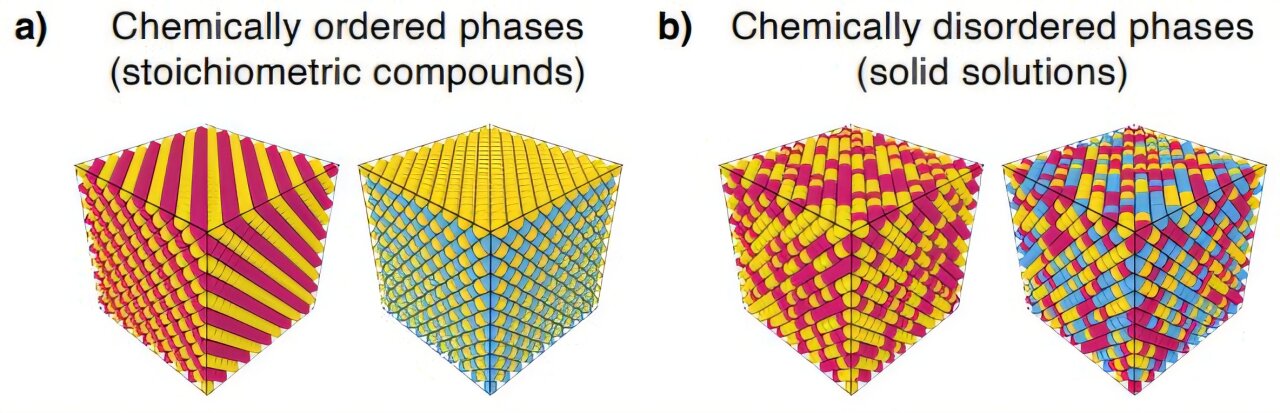
The method is described in a peer-reviewed paper in Science Advances by Killian Sheriff, Rodrigo Freitas and co-authors at MIT and the University of Sheffield. According to MIT, the approach targets a long-running problem in atom-by-atom simulations: chemically disordered materials contain many local atomic arrangements, making them hard for machine-learning models to learn from limited examples.
Why disordered alloys are hard to model
MIT said a material’s properties depend heavily on how its elements are arranged internally. Two alloys can contain the same elements but behave differently if their atoms are organized in different ways, including differences that affect whether a material breaks or deforms.
Researchers use atom-scale models to describe how atoms interact, and machine learning has become a leading way to build those models, according to MIT. Freitas, MIT’s TDK Career Development Professor in Materials Science and Engineering, said the hardest cases are chemically disordered phases, where local atomic environments vary widely across the material.
MIT said current leading methods for producing training data often rely on brute-force computation and can require more than 100,000 hours of computing for a single material. The university said those data sets also may not transfer well when scientists change an alloy’s composition.
Training data built for variety
The team built on earlier work from Freitas’ group that measured chemical complexity in solids by examining the frequency and spacing of small groups of atoms, according to MIT. In the new study, the researchers used information theory to create training data sets that include a broader range of local chemical environments.
MIT said the method swaps atoms in sample structures to reduce repeated examples and add arrangements the model has not already seen. Freitas said the goal was to make each training example more useful by replacing redundant local environments with more informative ones.
When the researchers trained machine-learning models on the new data sets, the models predicted material properties more accurately than models trained with random sampling or another commonly used sampling method, according to MIT. The team also reported that its models outperformed much larger models produced by companies including Google and Microsoft for the alloy tests described by MIT.
The authors applied the technique to chemically diverse metal alloys, according to MIT. Sheriff worked with MIT Ph.D. students Daniel Xiao and Yifan Cao to test different alloys and properties, while University of Sheffield senior lecturer Lewis R. Owen contributed experimental data used to compare simulations with measured atomic ordering in alloys.
Potential use in materials design
MIT said the method captures small energetic preferences for certain local chemical arrangements. According to the researchers, those differences help determine which phases form in an alloy, how phases shift with temperature and composition, and what properties the final material has.
In one test described by MIT, Xiao led simulations that predicted phase diagrams matching experimental data closely. Phase diagrams show which phases remain stable under different temperatures and compositions, and MIT said they are widely used in alloy processing decisions such as welding, casting and heat treatment.
Freitas said the approach is not limited to metal alloys and could be adapted to other materials, including semiconductors. MIT said the researchers are now using it to study how alloy composition affects mechanical behavior and radiation tolerance, with an eye toward materials that can stay strong and resist damage in harsh conditions.
The team is also working to make the method easier to use in tools and workflows already used by materials engineers, according to MIT. Freitas said industry adoption will depend on whether the predictions fit into how materials decisions are made.
This story draws on original reporting from Phys.org.