
New models suggest Earth could survive the Sun’s red giant phase
Researchers say improved tidal models and mass-loss estimates leave open a chance that Earth will avoid being swallowed by the aging Sun.
By Priya Raghavan · Science Reporter
3 min read
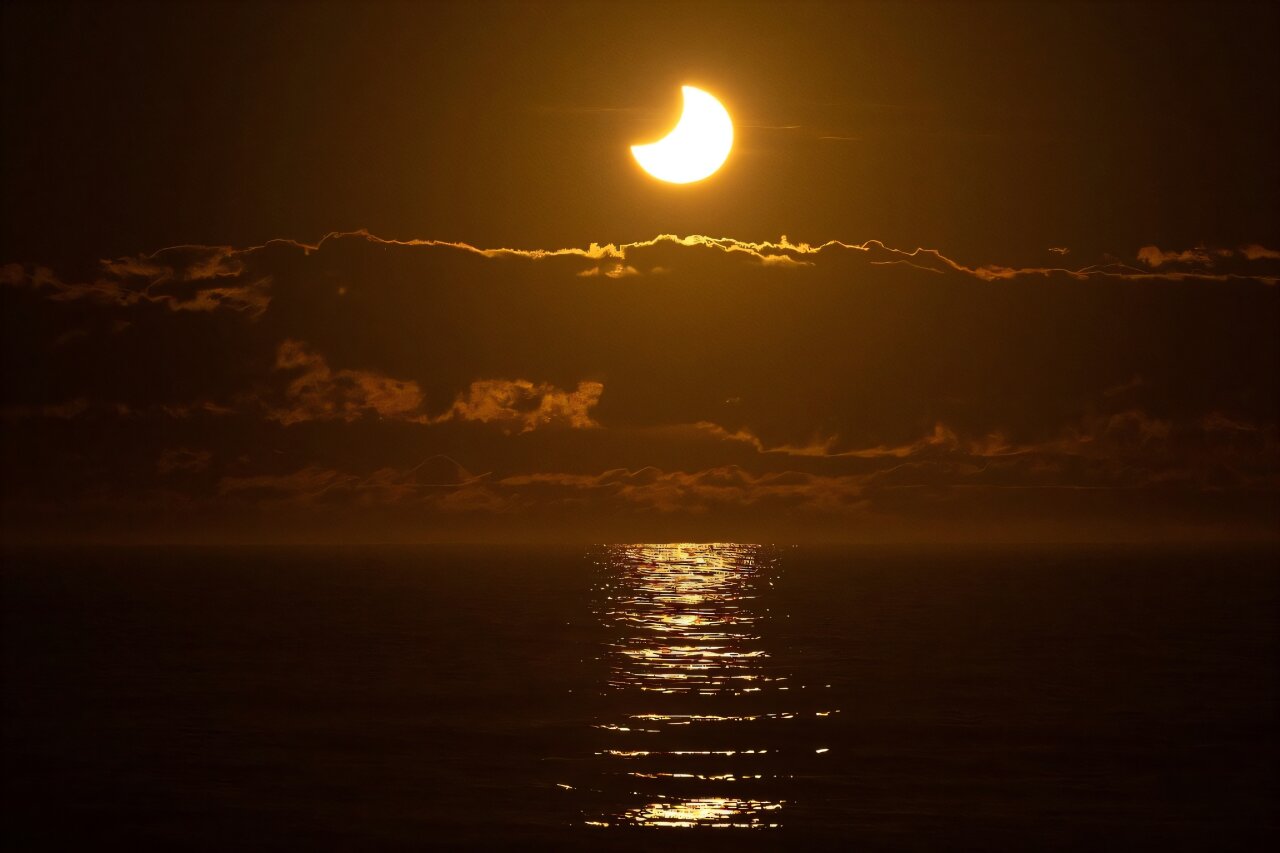
Earth may not be consumed by the Sun when the star swells late in its life, according to researchers behind a new study in Astronomy & Astrophysics. The finding revises a long-running expectation about the planet’s distant fate, though the event is not projected for another 5 billion years, after life on Earth would already be gone, scientists said.
The Sun will change dramatically after it exhausts the hydrogen in its core. According to the study, it will first expand into a red giant and later enter another swollen phase known as an asymptotic giant branch, or AGB, star after using up its helium.
Those stages set up two competing forces that determine whether Earth falls inward or drifts out of reach. Mats Esseldeurs, lead author of the study and an astrophysicist at Belgium’s University of Leuven, said in a statement that Earth’s outcome depends on the balance between tidal forces and the Sun’s loss of mass.
As the Sun grows, tidal interactions can drag Earth toward the star. The same broad physics now shapes the Earth-moon system: ocean tides dissipate energy, slow Earth’s rotation and gradually push the moon farther away, according to the researchers.
In the Sun’s giant phases, tides inside the enlarged star would be stirred by Earth’s gravity. If that tidal energy dissipates strongly enough, the researchers said, Earth would spiral into the Sun.
The opposite effect comes from stellar wind. As the aging Sun sheds material, its gravitational grip weakens, which can allow planets to move into wider orbits, according to the study.
Updated tidal physics changes the calculation
Earlier work had tended to favor Earth being engulfed, the researchers said. Stéphane Mathis, an astrophysicist at the CEA Paris-Saclay center in France and a co-author of the study, told AFP that those older estimates used comparatively basic treatments of how tides dissipate inside giant stars.
Mathis said advances in tidal modeling over the past 15 years led the team to find lower dissipation than previous calculations had assumed. With weaker tidal drag, the outward push from the Sun’s mass loss becomes more competitive.
To improve their estimate of how much mass the Sun may shed, the team studied L2 Puppis, a nearby star described by Mathis as an older cousin of the Sun. The researchers used that work alongside the newer tidal models to reassess the solar system’s future.
Mathis told AFP that current knowledge now allows the team to say Earth could move away from the Sun rather than fall into it, contrary to earlier predictions. The authors did not frame that outcome as certain, instead saying the revised models leave open the possibility of escape.
The study also finds that Mars would avoid being swallowed during the Sun’s giant phases. Mercury and Venus, the two planets closest to the Sun, would be engulfed by the expanding star, according to the researchers.
After those stages, the Sun is expected to become a white dwarf, an extremely dense stellar remnant. Without fusion reactions, it would then fade and cool over time, the study said.
This story draws on original reporting from Phys.org.