
Lithium placement boosts optical response in carbon nanoring model
Computer simulations found that a lithium atom outside a 12-ring carbon hoop sharply increased a key measure for nonlinear optical materials.
By Lucas Ferreira · Science & Environment Writer
3 min read
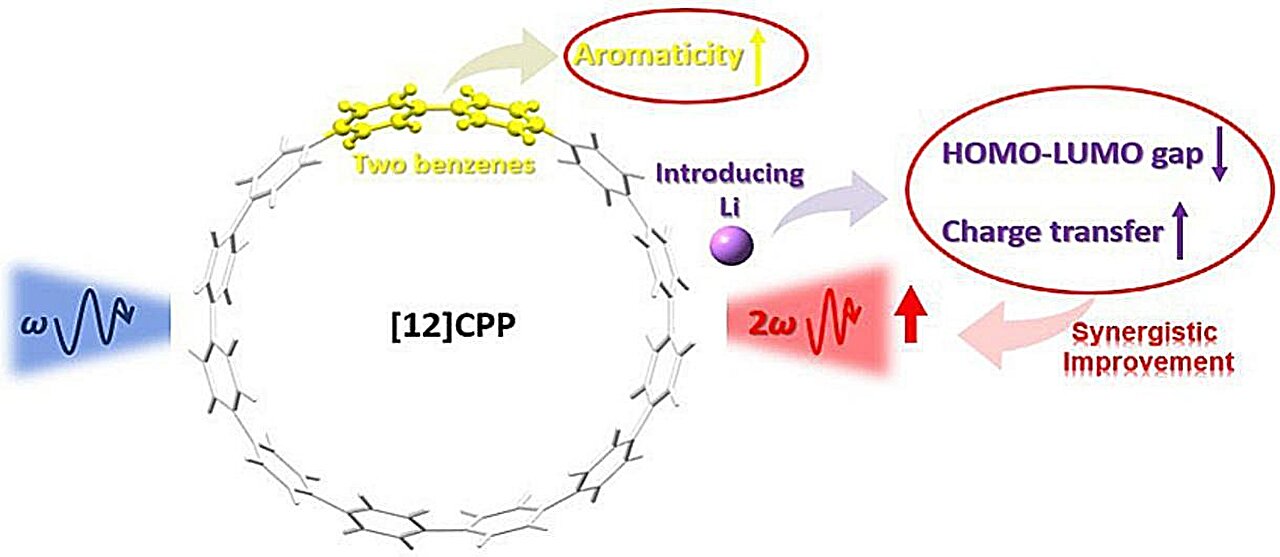
Researchers have used computer modeling to identify a lithium-doped carbon nanoring with a strong simulated optical response, a finding that could guide future work on organic materials for photonics. The study, published in Chemical Physics, points to the outside placement of a lithium atom on a 12-benzene-ring molecule as the most effective configuration tested.
The work focused on nonlinear optical materials, which are used in areas including lasers, optical switching and telecommunications, according to the National Institutes of Natural Sciences. Carbon-based organic molecules are of interest for those uses because their electronic behavior can be adjusted through molecular design.
The molecule examined in the study is [12]cycloparaphenylene, a hoop-shaped structure made from 12 benzene units. The research team compared lithium placement inside and outside the ring and also looked at related 12-benzene structures, including carbon nanobelts, according to the institute.
Outside lithium gave the strongest result
The simulations found that attaching a lithium atom to the exterior of the [12]cycloparaphenylene ring produced a large increase in first hyperpolarizability, a standard measure used to assess nonlinear optical strength. The reported value was 385.70 x 10⁻³⁰ in the study’s unit of measurement, higher than the smaller lithium-doped 10-benzene-ring version and other lithium-doped carbon systems cited by the researchers.
The institute said the open-ring structure of [12]cycloparaphenylene responded more strongly to exterior lithium doping than comparable compounds with fused edges. That comparison helped separate the role of ring shape from the effect of adding lithium.
According to the study, the enhanced response came from two linked effects. The carbon ring supplies aromaticity, a stability associated with shared electrons, while the lithium atom promotes charge transfer by lowering the energy gap needed for electrons to move.
The researchers also found that the simulated optical response was concentrated mainly within the plane of the carbon framework rather than on the lithium atom itself, according to the institute. That result suggests the lithium changes how the carbon structure behaves under light rather than acting as the main optical center.
Design rules for carbon-based photonics
Previous work had shown that adding lithium to a 10-benzene cycloparaphenylene ring could improve optical activity, but the reasons for that improvement and the effect of ring size were unresolved, according to the institute. The new study used the larger 12-ring system to test how molecular size, shape and charge transfer work together.
The models also showed a trade-off between stability and optical performance. The lithium atom was thermodynamically more stable inside the ring, according to the researchers, but it could move to the more optically active outside position at room temperature.
The National Institutes of Natural Sciences said the findings offer design guidance for carbon-based optical components, especially materials that combine aromatic carbon frameworks with controlled charge transfer. The results remain computational, so the study establishes a target and design logic rather than reporting a manufactured device.
The paper is titled “Synergistic effects of intrinsic aromaticity and Li-driven charge transfer on the enhanced second-order nonlinear optical response of [12]cycloparaphenylene.” Its authors include Yaoxiao Zhao and colleagues, according to Chemical Physics.
This story draws on original reporting from Phys.org.