
Light-based superfluid experiment sends tiny impurity upstream
Researchers report that a mobile obstacle in a two-dimensional superfluid of light can move against the current under specific conditions.
By Priya Raghavan · Science Reporter
3 min read
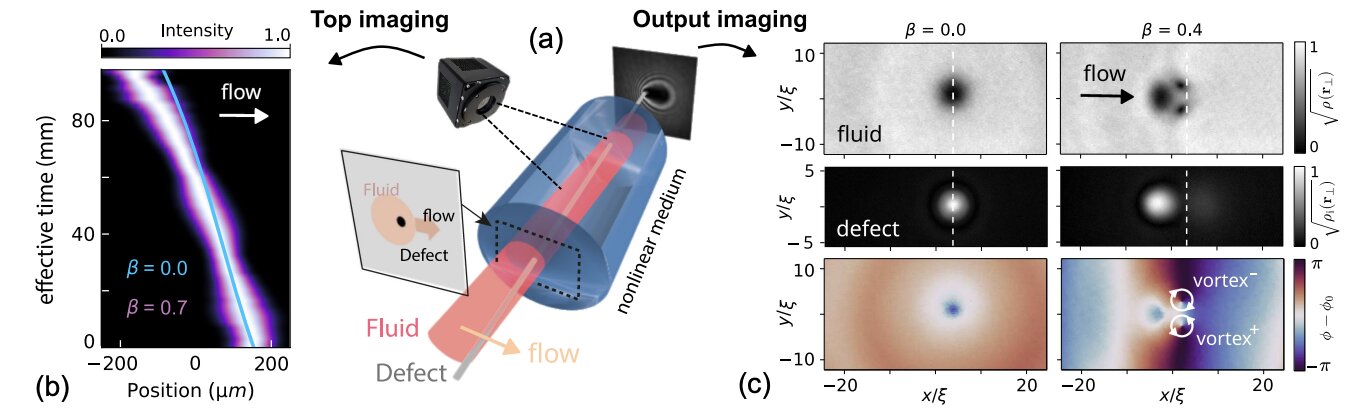
A tiny impurity placed inside a flowing superfluid of light moved upstream instead of drifting with the flow, researchers report in Physical Review Letters. The finding matters because it links superfluid breakdown, vortex formation and passive self-propulsion in a controllable optical system.
The study was carried out by researchers at Sorbonne University, the University of Porto, Côte d'Azur University and Paris-Saclay University, according to Phys.org. The work focused on a two-dimensional quantum fluid of light, a system in which light in a nonlinear medium behaves in ways that resemble a frictionless fluid.
In ordinary superfluid experiments, a fixed obstacle produces little or no drag when the flow remains below a critical speed. Above that threshold, the superfluid response changes: ripples and vortices can appear, and energy from the flow is dissipated, according to the researchers.
The team set out to examine that critical-velocity behavior in an optical experiment. Quentin Glorieux, a co-senior author, told Phys.org that the collaboration grew from discussions between theorists and experimentalists after Pierre-Élie Larré, now at LPTMS in Paris-Saclay, visited the laboratory in 2022.
How the optical fluid was made
The experiment used a laser beam traveling through a warm vapor of rubidium-87 atoms, according to the paper. Near selected optical resonances, the vapor's refractive index becomes nonlinear, creating an effective interaction between photons that lets the light act as a two-dimensional superfluid.
The impurity was not a material particle dropped into the fluid. Glorieux and Larré told Phys.org that the team created it with a second laser beam, which locally changed the linear part of the medium's refractive index.
The researchers then used optical imaging methods to observe both the superfluid and the impurity after the light passed through the rubidium cell. They recorded the system in real space and in momentum space, according to the authors.
During the experiments, the impurity did not behave as earlier studies of related systems had led the team to expect. Instead of being carried downstream, the mobile obstacle moved against the incident flow, according to Phys.org.
Larré told Phys.org that the observation shifted the study away from a standard test of critical velocity and toward explaining the upstream motion. The team tracked vortex formation, the impurity's path and momentum maps of the superflow to characterize the effect.
Vortices may provide the push
The researchers describe the upstream motion as self-propulsion through vortex-antivortex shedding in a quantum fluid of light. In their interpretation, quantized vortices forming behind the obstacle act as carriers of momentum, allowing the impurity to draw motion from the wake.
The paper also presents a theoretical model for the mechanism. According to the authors, vortex windings in the wake produce local density gradients, which create a hydrodynamic force acting opposite to the incoming flow and pulling the impurity upstream.
Glorieux and Larré told Phys.org that the phenomenon connects quantum hydrodynamics, classical fluid dynamics and active matter physics. The researchers also said the result may point to similarities between energy dissipation in quantum fluids and self-propulsion effects studied in biological systems.
The authors suggest the work could help future designs for small light-driven optical devices that move through nonlinear optical fields without outside steering by lasers, electric or magnetic fields, or mechanical systems. Phys.org reported that possible examples include particles in optical circuits and self-steering components for quantum technologies.
The team plans to study quantum fluctuations in supercurrents, especially in systems kept out of equilibrium, according to Glorieux and Larré. They said the experimental and theoretical groups at LKB and LPTMS are pursuing that line of work using tunable optical platforms.
The study, “Swimming against a Superfluid Flow: Self-Propulsion via Vortex-Antivortex Shedding in a Quantum Fluid of Light,” was published in Physical Review Letters in 2026.
This story draws on original reporting from Phys.org.