
Japan’s 2011 quake sent waves to Earth’s core, study finds
Researchers say reflected seismic waves triggered broad fault slip and shifted Japan eastward by up to 6 millimeters.
By Tom Brennan · Health & Medicine Correspondent
3 min read
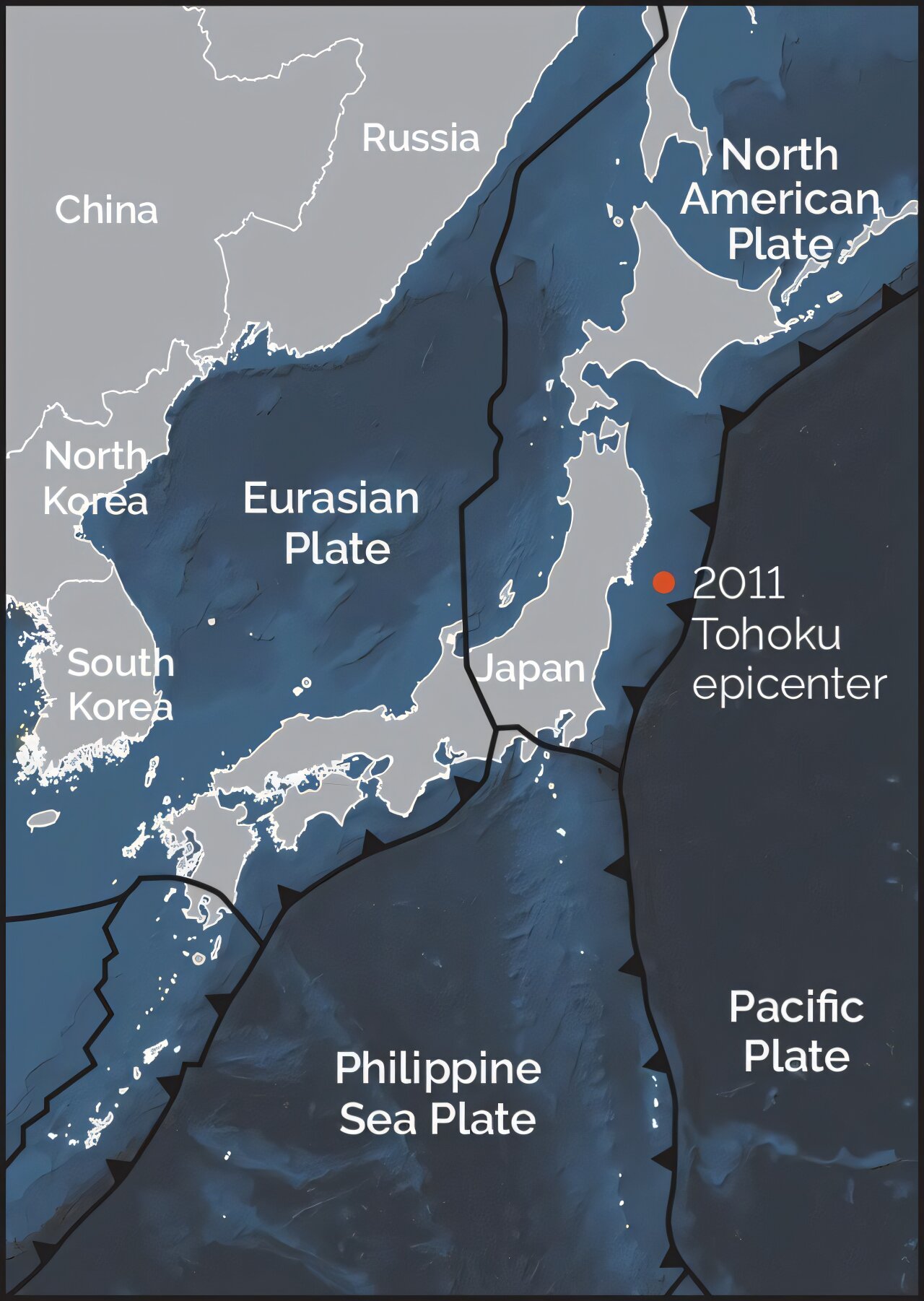
A delayed seismic pulse from Japan’s 2011 magnitude 9.0 Tohoku-Oki earthquake traveled to Earth’s core, rebounded and helped move Japan eastward, according to a new study. The finding points to a way that very large earthquakes may keep stressing major faults after the main shaking has ended.
The study, led by University of Chicago geophysicist Sunyoung Park and published June 18 in Science, reexamined GPS and seismic records from one of the best-instrumented earthquakes on record. Park and collaborators Hiroo Kanamori of Caltech and Luis Rivera of the University of Strasbourg concluded that reflected waves triggered additional slip along plate boundaries near Japan.
A signal after the main quake
The 2011 quake struck off Japan’s Tohoku region and, together with the tsunami it generated, killed 20,000 people, according to the University of Chicago. Japan’s dense monitoring network captured extensive data from the event, which has been studied in hundreds of scientific papers.
Park focused on an unusual signal that appeared after the main earthquake but before the major aftershocks, the university said. GPS stations across Japan recorded a sudden eastward shift at nearly the same time, even though no known aftershock at the surface matched the timing.
The movement amounted to as much as 6 millimeters and affected the country broadly, according to the study. The team said the pattern did not fit explanations such as an undersea landslide or a slow fault slide, because those mechanisms would have produced a more localized signal.
Waves bounced off the core
The researchers instead linked the shift to seismic energy that moved downward through Earth after the main rupture. According to the study, the waves reached the planet’s liquid outer core, reflected upward and arrived back near the surface roughly 15 minutes later.
The round trip covered about 3,600 miles, or 5,800 kilometers, the University of Chicago said. When the waves returned to the crust, the researchers reported, they triggered slip along two major plate-boundary zones around Japan.
Seismologists have long known that waves from major earthquakes can pass through Earth and reflect off the core, Park said through the university. The new work identifies that process as a cause of shallow tectonic slip near the surface, which the researchers described as a previously unrecognized seismic hazard.
A broad event across plate boundaries
The newly identified slip extended across about 1,800 miles, or 3,000 kilometers, making it the broadest seismic event recorded, according to the study. The researchers estimated that it released energy comparable to a magnitude 7.5 earthquake.
The event also involved more than one major plate boundary, the team reported. Slip occurred at the Pacific-Okhotsk plate interface and at the boundary between the Philippine Sea and Eurasian plates.
Park said the original earthquake’s violent shaking may have weakened the plate boundaries, leaving them more prone to movement when the reflected waves arrived. The researchers said the signal was difficult to spot because standard seismic monitoring often emphasizes shorter, higher-frequency motion, and the aftermath of the magnitude 9.0 quake was noisy.
The authors said the work adds a new factor to the study of earthquake hazards around subduction zones. Large quakes, they reported, can influence faults well after the first rupture and across far wider areas than the immediate damage zone.
This story draws on original reporting from Phys.org.