
Laser trap for calcium hydride points toward ultracold hydrogen
Researchers cooled and confined calcium monohydride molecules, a step toward making ultracold hydrogen for precision physics tests.
By Tom Brennan · Health & Medicine Correspondent
3 min read
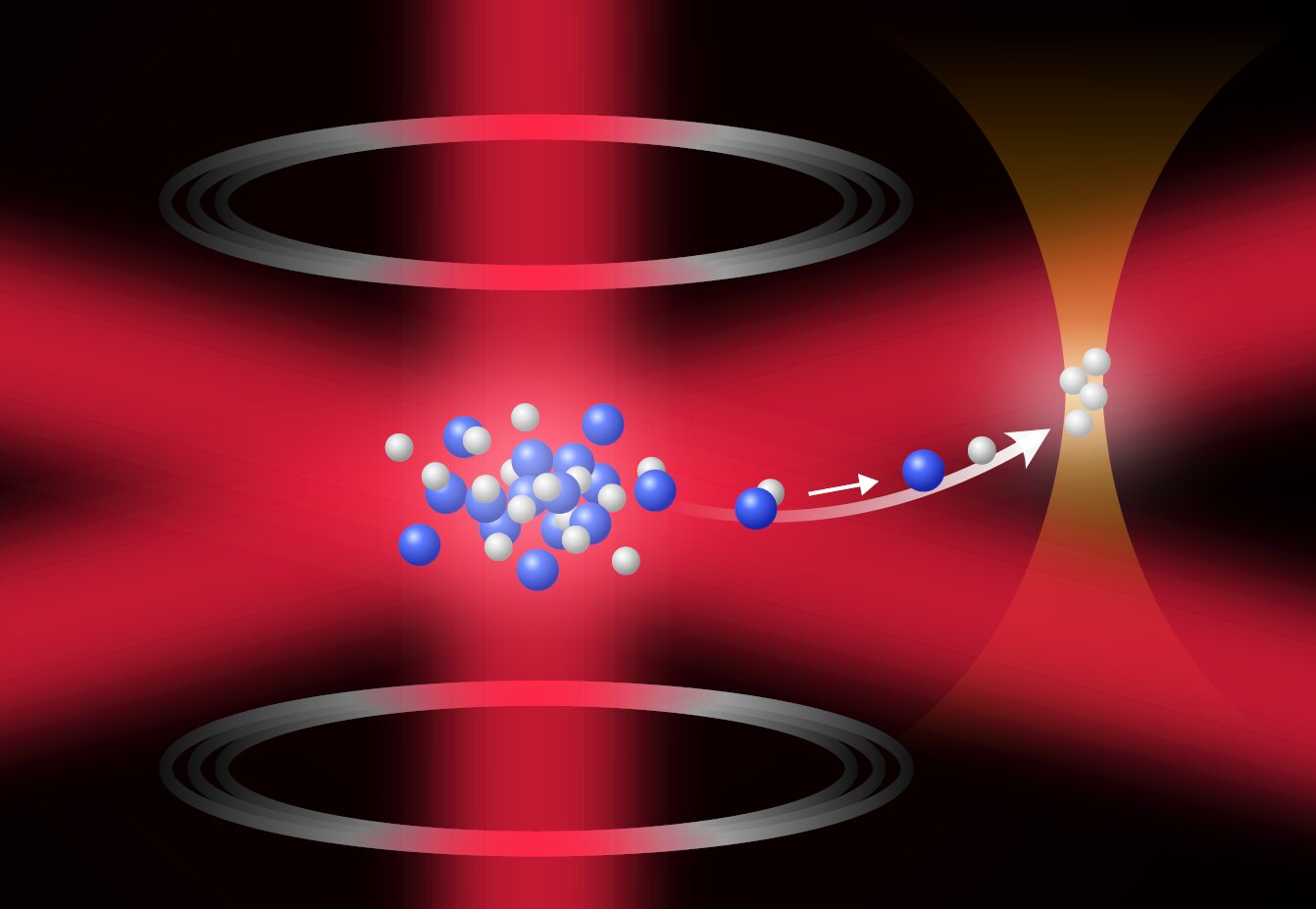
Researchers have used laser light and magnetic fields to cool and hold calcium monohydride molecules, showing that a metal hydride can be trapped in the ultracold regime. The work matters because the molecule could become a route to ultracold hydrogen atoms, a target for precision tests of basic physics.
The demonstration, by teams at Columbia University and Indiana University Bloomington, was reported in Physical Review Letters. According to Phys.org, the researchers trapped about 230 calcium monohydride, or CaH, molecules and cooled them to below 1 millikelvin.
Laser trapping is routine for many atoms but harder for molecules, according to Phys.org. Molecules can rotate and vibrate in ways that complicate the cooling process, making it more difficult to use light to slow and confine them.
How the trap worked
The researchers used a three-dimensional magneto-optical trap, a device that combines arranged laser beams with magnetic fields to reduce particle motion and hold particles in place. In this case, the target was CaH, made of one calcium atom bound to one hydrogen atom.
Jinyu Dai, the paper’s first author, told Phys.org that the experiment’s main goal was to create ultracold hydrogen atoms in optical dipole traps for precision spectroscopy. Dai said hydrogen, as nature’s simplest atom, offers a useful system for highly precise tests of fundamental physics.
The team first made a beam of CaH molecules, then slowed and cooled it with direct laser cooling, a method Phys.org said has been used in ultracold molecule research over the past decade. For this molecule, Dai said the researchers developed a cryogenic buffer-gas beam source and changed the cooling scheme to reduce a predissociative loss channel specific to CaH.
That loss channel is one reason metal hydrides have been challenging candidates for this kind of experiment. Dai told Phys.org that laser cooling gave the group control over the molecules’ internal and external motion, allowing the fast beam to be brought close to rest before trapping.
Why hydrogen is the target
The researchers see trapped CaH as more than a molecule-control milestone. According to Dai, one possible next step is to split the ultracold molecule near its dissociation threshold, producing ultracold atomic hydrogen.
Such hydrogen could support precision spectroscopy experiments, Dai told Phys.org. He said it may help with high-precision tests of the Standard Model and measurements of fundamental constants.
The result also broadens the set of molecules available for ultracold quantum chemistry, according to the researchers. Dai said the work shows that metal hydrides can be laser cooled and trapped despite difficulties in making bright molecular beams and despite added predissociative loss routes.
The paper lists the study as “Magneto-Optical Trapping of a Metal Hydride Molecule,” with Jinyu Dai and colleagues as authors. Phys.org reported that the work may help guide future controllable molecular systems and precision measurement tools.
Dai said the group is now working on additional cooling and trapping to reach higher phase-space densities. He told Phys.org that dissociation spectroscopy is a planned next step for studying ultracold chemistry and producing ultracold hydrogen.
This story draws on original reporting from Phys.org.