
Researchers spin molecules inside superfluid helium with laser centrifuge
A UBC-led team says the method can control molecular rotation in helium nanodroplets, opening a way to test where superfluid behavior fails.
By Priya Raghavan · Science Reporter
3 min read
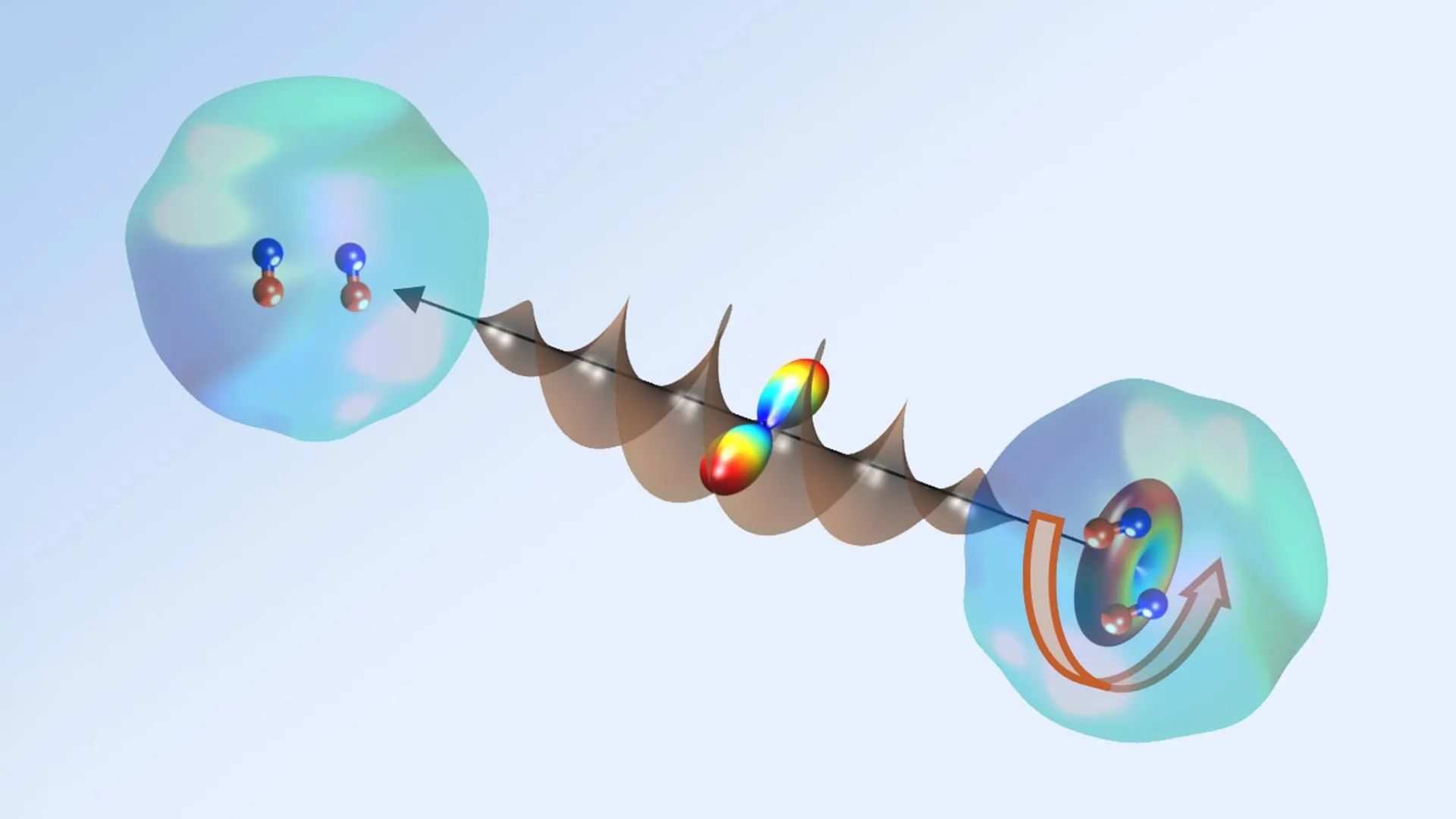
Physicists led by the University of British Columbia have used a redesigned optical centrifuge to control how molecules rotate inside superfluid helium. The result matters because it gives researchers a way to probe, at molecular scale, how a frictionless quantum liquid interacts with an object dissolved inside it.
The work, conducted with collaborators at the University of Freiburg, was published in Physical Review Letters, according to UBC. The team says it is the first demonstration of controlled molecular rotation inside a superfluid.
Superfluids such as liquid helium near absolute zero can flow without viscosity, UBC said. They can still serve as solvents, meaning molecules can be placed inside them and studied as they interact with the surrounding quantum fluid.
Valery Milner, an associate professor in UBC’s Department of Physics and Astronomy and an author of the paper, said controlling a molecule’s rotation in any liquid is difficult because the molecule couples to the particles around it. He compared the effect to a snowball that becomes harder to move as more snow sticks to it.
That surrounding material effectively makes the dissolved molecule behave as if it is larger, according to UBC. In a superfluid, that interaction is especially useful to study because the liquid has no internal friction in the usual sense, yet still changes the motion of a molecule inside it.
How the centrifuge works
Optical centrifuges use laser pulses whose electric field rotates, causing molecules to align with the field and spin, UBC said. The technique has been used for molecules in gases, but had not previously worked for molecules submerged in a superfluid.
Milner’s team sent the optical centrifuge beam into helium nanodroplets that had been doped with dimers of nitric oxide, according to UBC. The researchers changed the timing of the laser pulses by adding a short delay, producing interference that created a slower and steadier rotation rate.
That lower rotation rate made it easier to spin the dissolved molecules, UBC said. The method lets scientists set both the speed and direction of molecular rotation, giving them a controlled way to test how the molecule and the helium environment influence each other at different frequencies.
Testing the limits of superfluidity
UBC said the next goal is to vary the rotation frequency and look for a point where the molecule’s rotation slows sharply. Researchers expect that behavior could mark the breakdown of superfluidity around the rotating molecule at atomic scale.
Milner said researchers do not yet understand when that transition occurs, including the frequency at which it may appear. He said that question is now the team’s main focus.
The research was supported by the Natural Sciences and Engineering Research Council of Canada, the Canada Foundation for Innovation and the BC Knowledge Development Fund, according to UBC. The paper, “Control of Molecular Rotation in Helium Nanodroplets with an Optical Centrifuge,” lists Ian MacPhail-Bartley, Alexander A. Milner, Frank Stienkemeier and Valery Milner as authors.
This story draws on original reporting from ScienceDaily.