
Information theory strategy solves 99% of Wordle puzzles in simulations
Binghamton University researchers used Shannon entropy to build a Wordle solver that favors informative guesses over likely answers.
By Tom Brennan · Health & Medicine Correspondent
3 min read
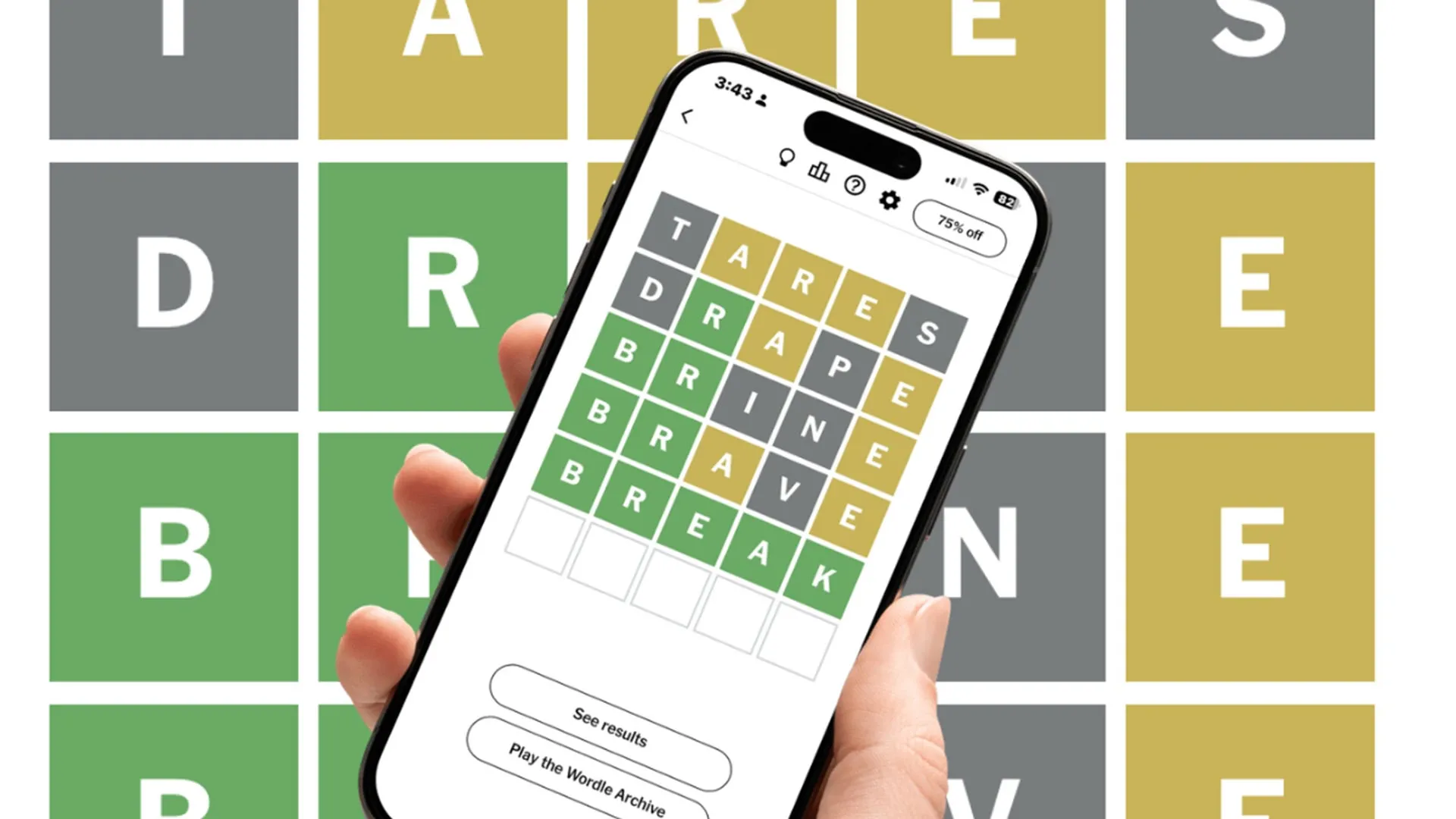
A Binghamton University research team says it has built a Wordle strategy that solved 99% of puzzles in computer simulations. The work shows how information theory can outperform common play patterns in the New York Times word game.
The method was developed by researchers at Binghamton University, State University of New York, and led by Congyu “Peter” Wu, an assistant professor in the Thomas J. Watson College of Engineering and Applied Science’s School of Systems Science and Industrial Engineering, according to the university.
Wordle gives players six attempts to identify a hidden five-letter word. After each guess, the game marks letters as gray if they are absent, yellow if they are present but misplaced, and green if they are correct and in the right position.
How the strategy works
According to Binghamton University, the researchers used Shannon entropy, a mathematical measure of uncertainty, to choose guesses that reduce the remaining possibilities as quickly as possible. The approach does not mainly ask which word is most likely to be the answer.
Instead, the system looks for a word that is expected to provide the most useful feedback. Binghamton doctoral student Donald Stephens said the paper’s point is that a guess can be valuable even when it is unlikely to be correct, because it can cut uncertainty and lead to fewer attempts.
That can make the recommended guesses appear unusual to a human player, according to the university. A player using the method would run a separate program, enter Wordle’s color-coded response after each guess and then use the program’s next suggested word.
The researchers compared their entropy-based method with a more conventional strategy that gives priority to commonly used letters such as A, E and R, Binghamton University said. In simulations, the information-based strategy solved 99% of puzzles, while the more traditional approach solved about 90%.
From class work to journal paper
The project began as a class assignment rather than as a formal research plan, according to Binghamton University. Wu asked students to show how information theory could be applied to a practical problem, and the Wordle solver later became a published paper.
Co-author Talal Aladaileh said the project reflected how courses in Binghamton’s School of Systems Science and Industrial Engineering push students to apply ideas beyond classroom examples, according to the university.
Wu said the work turned Shannon entropy from a static measurement into a dynamic tool for improving performance on a popular task, according to Binghamton University.
The study, “Solving Wordle Using Information Theory,” was published in the Northeast Journal of Complex Systems. Its authors are Talal Aladaileh, Donald Stephens, Mallak Alqaisi and Congyu Wu.
This story draws on original reporting from ScienceDaily.