
Distant dust-shrouded galaxy points to star-powered neutrino source
ALMA observations tied a high-energy neutrino event to a starburst galaxy, suggesting some cosmic neutrinos may come from intense star formation.
By Lucas Ferreira · Science & Environment Writer
3 min read
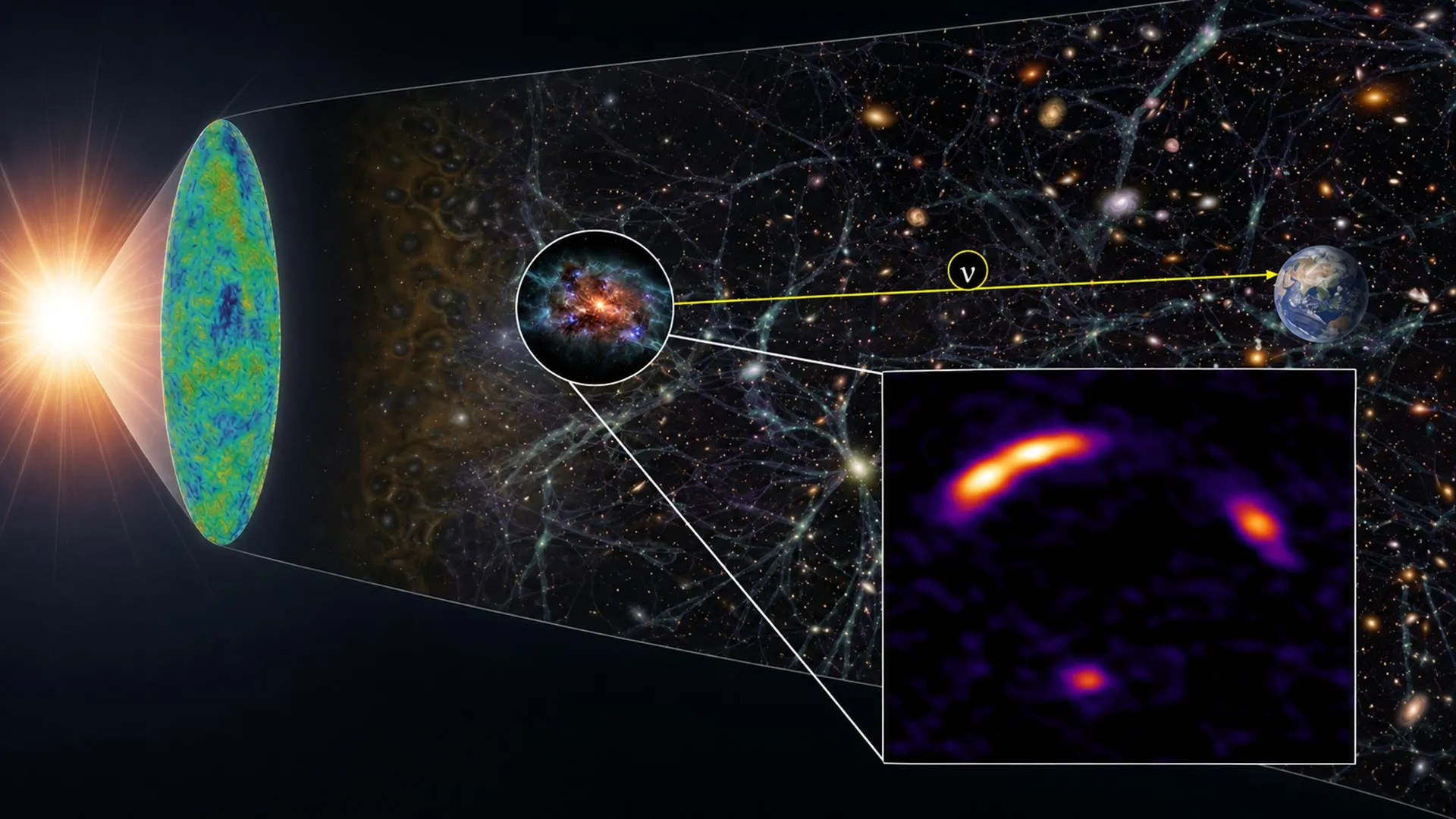
Astronomers have linked a high-energy neutrino detected at the South Pole to a distant, dust-filled galaxy whose power appears to come from rapid star formation rather than a supermassive black hole. The finding matters because known neutrino sources do not yet explain the many high-energy neutrinos seen across the universe.
The National Institutes of Natural Sciences said an international team used the Atacama Large Millimeter/submillimeter Array, or ALMA, and other telescopes to study the neutrino event IC 210922A, first detected by the IceCube Neutrino Observatory. The work was published in Nature Astronomy by Yuji Urata and colleagues.
The team traced the event to an exceptionally bright galaxy cataloged as JCMT0402−0424, about 11 billion light-years from Earth, according to the institute. Researchers nicknamed the galaxy “Shadow Blaster” because dust blocks much of its visible light while it shines strongly at submillimeter wavelengths.
Black hole signal was missing
Scientists have previously tied several neutrino-producing galaxies to activity around supermassive black holes, the institute said. That made a black hole a likely suspect in this case, given the galaxy’s brightness and its apparent connection to a powerful neutrino.
ALMA’s observations did not show the emissions expected from an active, powerful black hole, according to the research team. Instead, the data indicated that gas and dust across the galaxy are being heated mainly by intense star formation.
Neutrinos are difficult to study because they rarely interact with matter, passing through planets and stars with little effect. IceCube detects some of the highest-energy examples when they interact in Antarctic ice, but astronomers have identified only a limited set of astrophysical sources that can produce them.
A cosmic lens sharpened the view
The study benefited from a chance alignment with another galaxy between Shadow Blaster and Earth, the institute said. Gravity from the foreground galaxy bent and magnified radio waves from the more distant galaxy, creating a gravitational lens that acted like a natural telescope.
That lensing effect produced four distorted images of Shadow Blaster in ALMA data, according to the institute. The magnification let astronomers examine the distant galaxy in greater detail than would otherwise have been possible.
The team found a compact central region packed with gas and dust, measuring about 1,500 light-years across, according to the institute. Researchers said that dense core and the galaxy’s rapid star formation provide conditions capable of producing high-energy neutrinos.
Starburst galaxies may add to the neutrino background
The results point to compact, dusty starburst galaxies as a possible contributor to the universe’s high-energy neutrino population, the institute said. The team’s analysis indicates that such galaxies could account for as much as 20% of the high-energy neutrinos observed across the universe.
The study does not remove black holes from the list of neutrino sources. It adds another pathway: hidden galaxies where extreme star formation, concentrated behind thick dust, can accelerate particles and generate neutrinos that later reach Earth.
Further observations will be needed to test how common this mechanism is, according to the institute. If more neutrino events can be tied to similar dusty starbursts, astronomers would have a clearer accounting of where some of the universe’s most elusive high-energy particles originate.
This story draws on original reporting from ScienceDaily.