
Impurities help carbon coatings reach very low friction, study finds
Simulations suggest hydrogen and oxygen can help amorphous carbon form graphene-like sliding layers under stress.
By Lucas Ferreira · Science & Environment Writer
3 min read
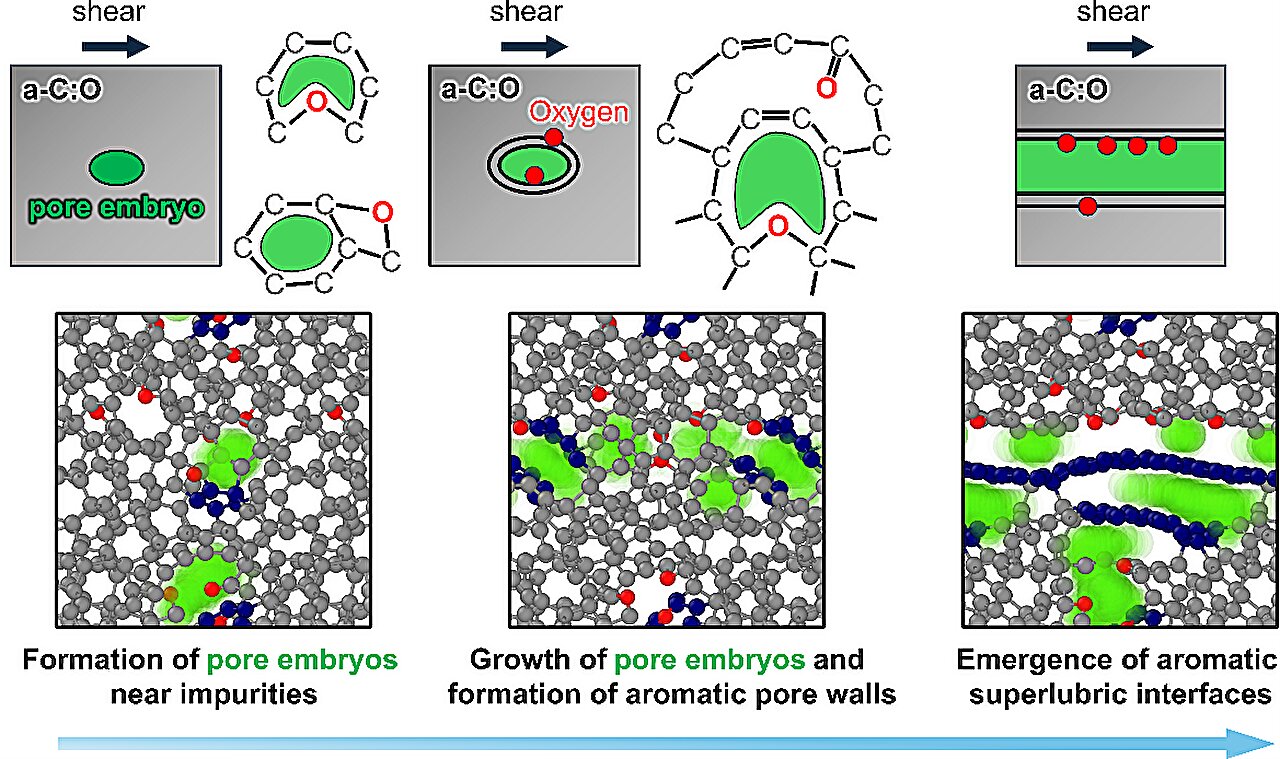
Chemical impurities may help some carbon surfaces become far more slippery, according to researchers at Osaka Metropolitan University and the Fraunhofer Institute for Mechanics of Materials IWM. The finding could aid the design of carbon coatings that reduce wear and energy loss in machinery.
The team reported the work in Advanced Science. Osaka Metropolitan University said the study challenges the common engineering instinct to remove impurities from materials to improve performance.
Friction lets tires grip roads and brakes slow vehicles, but it also damages moving parts and wastes energy in mechanical systems. Researchers have long sought superlubricity, a state in which surfaces slide with very little resistance.
Carbon is a useful test case because it appears in several forms with different friction behavior, according to the researchers. Graphite consists of stacked graphene sheets that can slide over one another easily, while diamond’s three-dimensional bonding makes it hard and resistant to sliding. Amorphous carbon, by contrast, has no regular atomic order.
The new study focused on amorphous carbon because it can rearrange at contact points when surfaces slide. Under shear stress, the material can form aromatic, graphitic structures that resemble graphene or graphite, a process known as shear-induced aromatization.
Takuya Kuwahara, a lecturer at Osaka Metropolitan University’s Graduate School of Engineering and lead author of the study, said graphene- and graphite-like structures are known to allow near-frictionless motion, but making and preserving those structures in practical systems remains difficult.
To examine why the transformation happens in some cases and fails in others, the researchers ran a large computational study using quantum-mechanical molecular dynamics simulations. The team said it carried out 1,000 simulations of sheared amorphous carbon containing different impurity elements.
The simulations showed that impurities with low valency, meaning atoms that form fewer than four chemical bonds, repeatedly encouraged the formation of graphitic, aromatic structures, according to the researchers. Hydrogen and oxygen were especially effective in producing stable low-friction interfaces.
By contrast, the team said pure carbon and silicon-doped systems did not develop the same structures. The paper attributes the difference to the way certain impurities stabilize nanoscale voids inside the carbon network.
As sliding stress continues, nearby carbon atoms can rearrange into ring-shaped aromatic structures, the researchers reported. The impurities also help keep the material from returning to harder, diamond-like arrangements, allowing the low-friction interface to remain.
The result points to a possible materials strategy in which engineers tune the type and amount of impurities in carbon coatings so the surface changes under load, according to Osaka Metropolitan University. Such coatings could form low-friction layers during use rather than relying only on added lubricants or pre-made graphitic surfaces.
The researchers said more work is needed before the mechanism can be applied broadly. They plan to study mixed impurity elements and conditions closer to real operation, including changes in pressure and temperature. Experimental confirmation of the atomic-scale behavior predicted by the simulations is also planned.
Kuwahara said the long-term goal is to help create carbon-based materials that can form and maintain ultralow-friction interfaces under real-world conditions. Such materials could reduce wear, improve durability and lower energy loss across a range of mechanical technologies, according to the research team.
This story draws on original reporting from Phys.org.