
Hubble image shows Messier 3’s half-million ancient stars
NASA released a Hubble portrait of Messier 3, a globular cluster whose rare stars may help trace the Milky Way’s history.
By Priya Raghavan · Science Reporter
3 min read
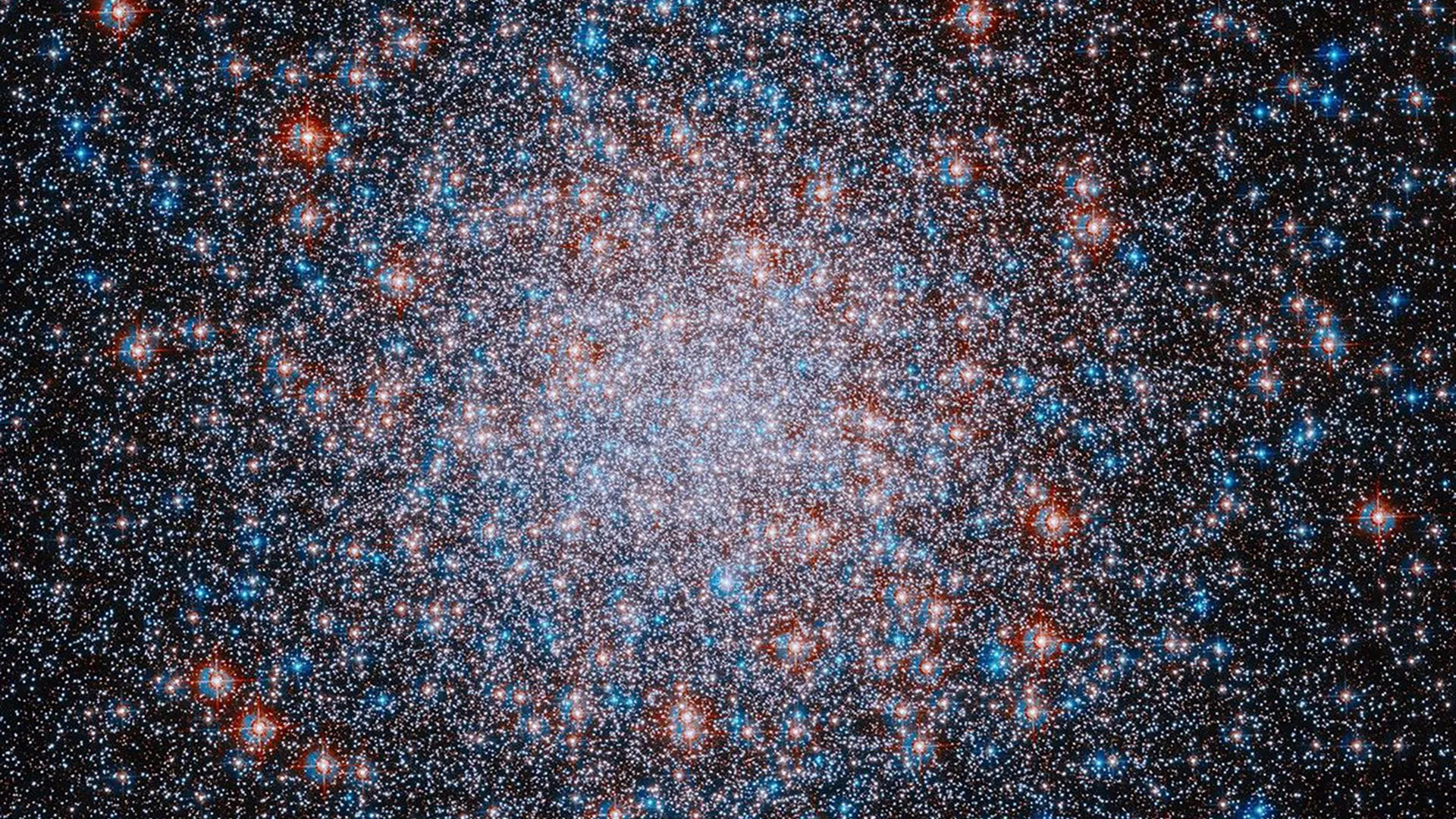
NASA has released a new Hubble Space Telescope image of Messier 3, a dense globular cluster containing more than 500,000 stars. The agency said the portrait, issued for the United States’ 250th anniversary, gives astronomers another view of an old stellar system that may preserve clues to how the Milky Way took shape.
Messier 3, also cataloged as NGC 5272, is one of the larger globular clusters in the Milky Way, according to NASA. The image shows stars in red, white and blue tones, with those colors tied to the wavelengths recorded by Hubble’s instruments and the temperatures of the stars.
An old cluster on the galaxy’s outskirts
Globular clusters are compact, round groupings of stars held together by gravity. NASA said their stars generally formed from the same cloud of gas at about the same time billions of years ago, making the clusters useful records of early galactic history.
Astronomers have identified about 150 globular clusters around the outer regions of the Milky Way, according to NASA. Messier 3 stands out because of its size, its distance from the galactic center and its collection of rare types of stars.
NASA said Hubble has observed Messier 3 multiple times, allowing scientists to study the cluster’s structure and unusual stellar population in more detail. The new image is part of a Hubble Treasury program examining about half of the Milky Way’s known globular clusters.
Variable stars help measure distance
Messier 3 contains more than 240 RR Lyrae variable stars, more than any other known globular cluster in the Milky Way, NASA said. These old stars brighten and fade on a regular cycle.
That pattern makes RR Lyrae stars valuable to astronomers. NASA said researchers can determine the stars’ true brightness, compare it with their apparent brightness from Earth and calculate their distance.
The cluster also contains about 70 identified candidates for blue straggler stars. These stars appear hotter, brighter and bluer than many of the older red stars around them, even though NASA said they are thought to be the same age as their neighbors.
Messier 3 was the first place where astronomers found blue stragglers, according to NASA. Scientists think such stars may have gained material from companion stars through gravitational interactions, adding mass that changed how they shine.
Possible sign of an ancient merger
NASA said Messier 3 contains two distinct groups of stars, a feature that has led astronomers to suspect the cluster may have formed from the merger of two globular clusters. Those earlier clusters may once have belonged to a dwarf galaxy that was later absorbed by the Milky Way.
The color processing in the Hubble image reflects the light captured through the telescope’s filters. NASA said blue corresponds to shorter visible wavelengths, while red shows longer visible wavelengths and some near-infrared light; because color is linked to temperature, the blue stars are hotter and the red stars are cooler.
NASA said the Hubble program is intended to help researchers compare ancient clusters and build a clearer timeline of the Milky Way’s formation and development. Hubble continues to operate alongside the James Webb Space Telescope, while the Nancy Grace Roman Space Telescope is planned as another observatory for future work.
This story draws on original reporting from ScienceDaily.