
Hubble image shows Messier 3, a dense Milky Way star cluster
NASA says the Hubble view features M3, one of the Milky Way’s most massive globular clusters, made of ancient stars bound by gravity.
By Tom Brennan · Health & Medicine Correspondent
2 min read
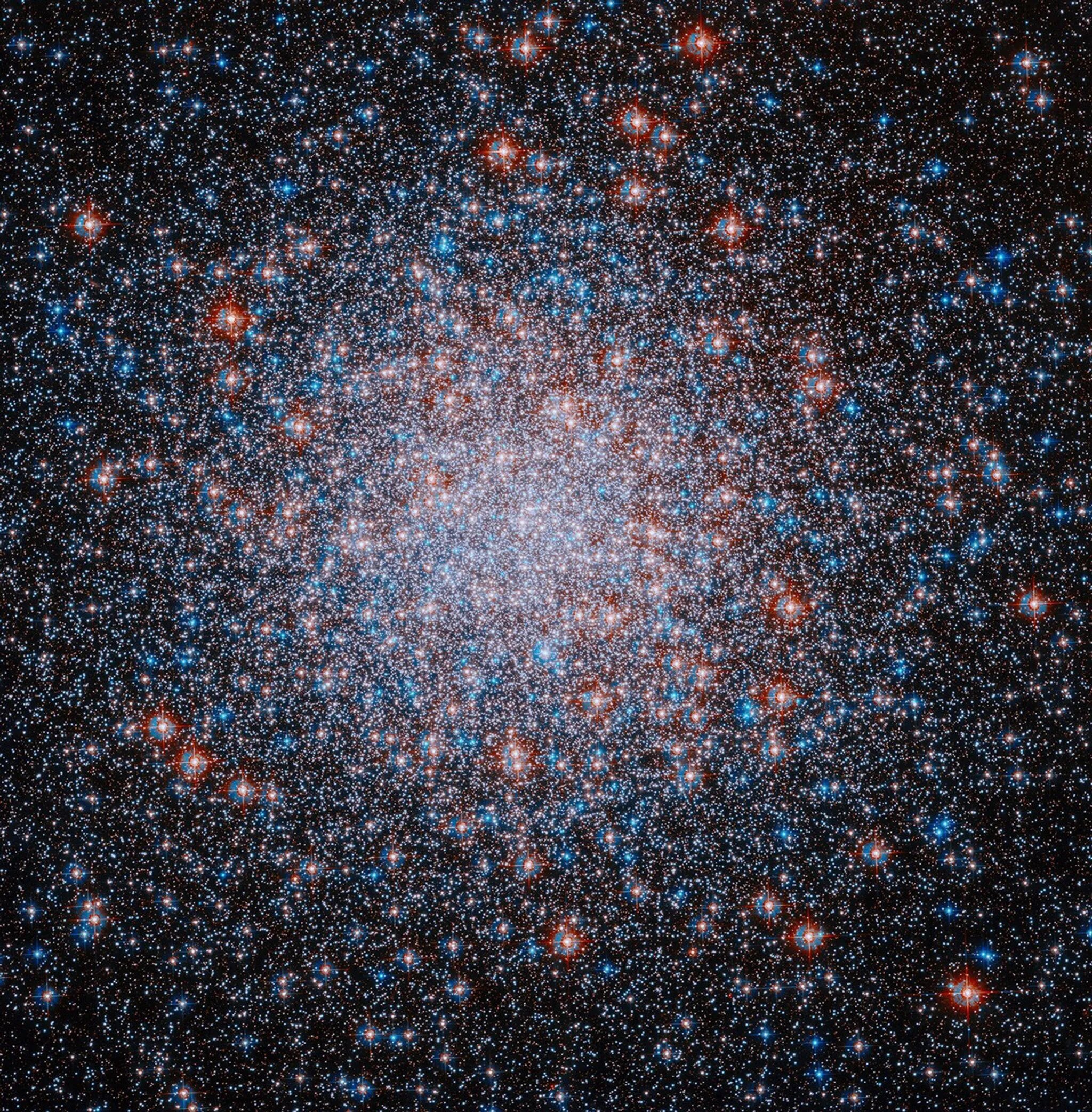
A NASA image from the Hubble Space Telescope shows Messier 3, or M3, a bright globular cluster within the Milky Way. NASA describes M3 as one of the galaxy’s most massive examples of this type of star cluster.
Globular clusters are spherical groups of stars held together by gravity, according to NASA. The agency says their stars are ancient and formed at about the same time from the same cloud of gas, leaving them with similar ages.
The Hubble view presents M3 as a tightly packed field of stars, reflecting the dense structure that defines globular clusters. NASA said such clusters are found in the outer regions of the Milky Way, where about 150 are known.
What the image shows
The image is credited to NASA, the European Space Agency and A. Sarajedini of Florida Atlantic University. NASA also credited Gladys Kober of NASA and the Catholic University of America for image processing.
NASA’s description places M3 among the Milky Way’s large globular clusters, a category that differs from loose groupings of younger stars because its members share a common origin and are gravitationally bound in a rounded form.
The agency’s note did not give M3’s distance from Earth, its number of stars or the date of the Hubble observation. It focused on the cluster’s identity, its place in the Milky Way and the broader nature of globular clusters.
Why globular clusters matter
NASA says globular clusters contain old stars that formed from the same gas cloud at roughly the same time. That shared history makes them useful objects for understanding populations of stars with similar ages, though NASA’s brief description did not outline any specific research tied to this image.
Hubble, a joint project associated with NASA and ESA in the image credit, has long been used to produce detailed views of star fields and clusters. In this case, the telescope’s image highlights a compact stellar system in the Milky Way’s outer regions, where NASA says known globular clusters are scattered.
The M3 image adds another view of a class of objects that NASA defines by age, shape and gravity: ancient stars gathered in a sphere and held together over time.
This story draws on original reporting from Phys.org.