
Hubble image shows galaxy cluster bending early-universe light
NASA says Hubble’s view of MACS0329-0211 shows a dense galaxy cluster whose gravity magnifies and distorts more distant galaxies.
By Tom Brennan · Health & Medicine Correspondent
2 min read
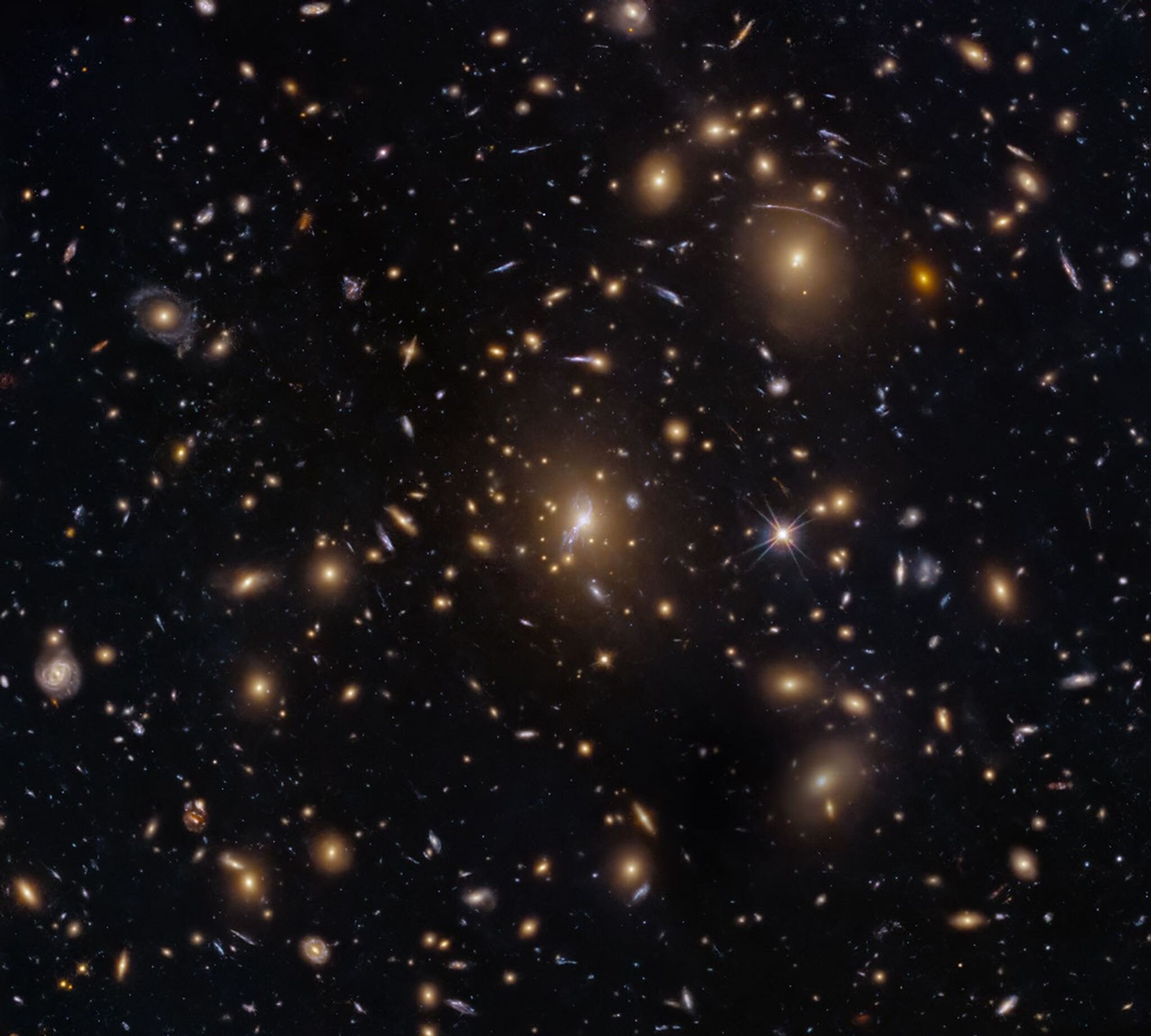
NASA has released a Hubble Space Telescope view of the galaxy cluster MACS0329-0211, showing a crowded field of galaxies and faint arcs made by gravitational lensing. The image matters because NASA says clusters such as this one help astronomers study how large-scale structure in the universe developed.
According to NASA, MACS0329-0211 acts as a natural lens. Its gravity bends light from galaxies far behind it, bringing objects from the early stages of the universe into Hubble’s view and stretching some of them into curved shapes.
The cluster appears packed with galaxies of different forms, NASA said. In the image, large oval elliptical galaxies sit among thinner spiral and lenticular galaxies seen edge-on, while other spiral galaxies face Hubble directly enough for their arms to be visible.
NASA said the upper-right part of the image contains faint arcs from distant background galaxies whose light has been warped by the cluster’s gravity. The most prominent arc appears above the bright oval outline of a giant elliptical galaxy.
Near the center of the image, NASA said several bright white curves cross one another in a shape resembling a distorted eight. NASA said that feature may be another faraway galaxy whose light has been amplified and reshaped by the cluster.
How Hubble observed the cluster
NASA said Hubble observed MACS0329-0211 through a program focused on galaxy clusters that are bright in X-rays. The telescope used its Advanced Camera for Surveys and Wide Field Camera 3, its two main cameras, to collect data from the cluster.
Those observations covered visible and infrared light, according to NASA. The agency said Hubble’s ability to observe across that range makes it useful for studying the nature of galaxy clusters such as MACS0329-0211.
Galaxy clusters are among the largest assembled structures astronomers observe, and NASA described them as markers in the history of cosmic structure. In this case, the cluster also serves as a viewing aid, using gravity to reveal galaxies that would otherwise be harder to study.
The image was credited by NASA to NASA, ESA and M. Postman of the Space Telescope Science Institute, with image processing by G. Kober of NASA and the Catholic University of America. NASA provided the image and description on June 12, 2026.
This story draws on original reporting from Phys.org.