
Hubble image shows ancient star cluster in red, white and blue
NASA says the Hubble view of NGC 6426 marks the U.S. 250th anniversary and helps study early star formation.
By Tom Brennan · Health & Medicine Correspondent
3 min read
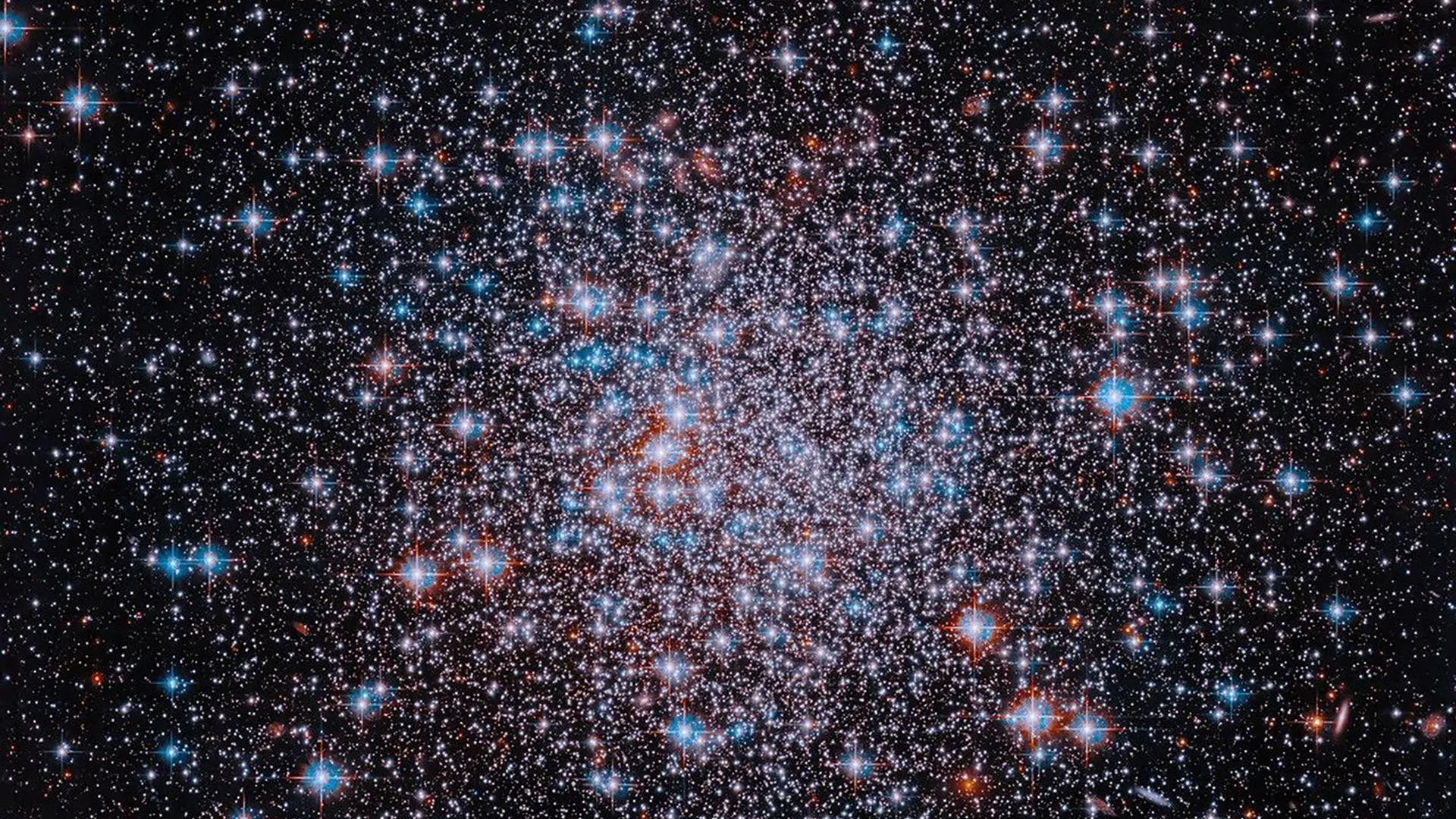
NASA has released a new Hubble Space Telescope image of NGC 6426, an ancient globular cluster whose stars appear in red, white and blue for the United States’ 250th anniversary. The agency said the cluster also gives astronomers a record of early cosmic chemistry, including how exploding stars helped seed later generations of stars with heavier elements.
The image shows stars in a dense field within the Milky Way’s outer halo, NASA said. Although the colors fit the Independence Day theme, the agency said they come from scientific imaging through Hubble filters rather than decoration alone.
An old cluster in the Milky Way halo
NGC 6426 is a globular cluster, a compact, gravity-bound sphere of stars, according to NASA. The agency said roughly 150 such clusters are known in the Milky Way.
NASA estimates NGC 6426 at about 13 billion years old. The universe is about 13.7 billion years old, according to the agency, placing the cluster’s formation early in cosmic history.
Globular clusters are useful to astronomers because many of their stars formed from the same original gas cloud, NASA said. That shared origin means the stars are generally similar in age, allowing researchers to compare their chemistry and evolution as a group.
What the colors show
NASA said Hubble recorded the scene across different wavelengths and that the final image maps those observations into visible colors. Blue corresponds to shorter wavelengths of visible light, while red includes longer visible wavelengths and some near-infrared light, according to the agency.
The color differences also reflect stellar temperature, NASA said. In the image, the bluer stars are hotter, while the redder stars are cooler.
The agency said the cluster’s patriotic look was one reason it was released for the anniversary, but its scientific value comes from the age and chemical makeup of its stars. Those properties let researchers examine material from a time when the universe contained mostly hydrogen and helium.
Clues from early stellar explosions
NASA said the stars in NGC 6426 have low metallicity, meaning they contain relatively small amounts of elements heavier than hydrogen and helium. Astronomers use that composition as evidence that the cluster preserves conditions from the young universe, when heavier elements were still being made inside stars.
The agency said scientists have also identified two chemically distinct groups of stars inside NGC 6426. That finding suggests a later population formed after earlier massive stars exploded as supernovae and enriched nearby gas with newly made heavy elements.
According to NASA, that same process helped change the universe over time by spreading the materials needed for planets and many elements now found throughout space. The cluster therefore offers a local example, inside the Milky Way, of a process that shaped later cosmic evolution.
Part of a wider Hubble study
NASA said the new view is part of continuing work on globular clusters in the Milky Way’s halo. By measuring their ages and chemical compositions, astronomers aim to refine their understanding of how the galaxy formed and changed across billions of years.
The Hubble Space Telescope has operated for more than 30 years, NASA said. Its observations are now complemented by the James Webb Space Telescope, which studies infrared light, and the Nancy Grace Roman Space Telescope is scheduled by NASA for a late-summer launch.
This story draws on original reporting from ScienceDaily.