
Hubble image shows thousands of young stars in nearby dwarf galaxy
NASA says LH 95 in the Large Magellanic Cloud offers a clear view of star formation across multiple generations.
By Lucas Ferreira · Science & Environment Writer
3 min read
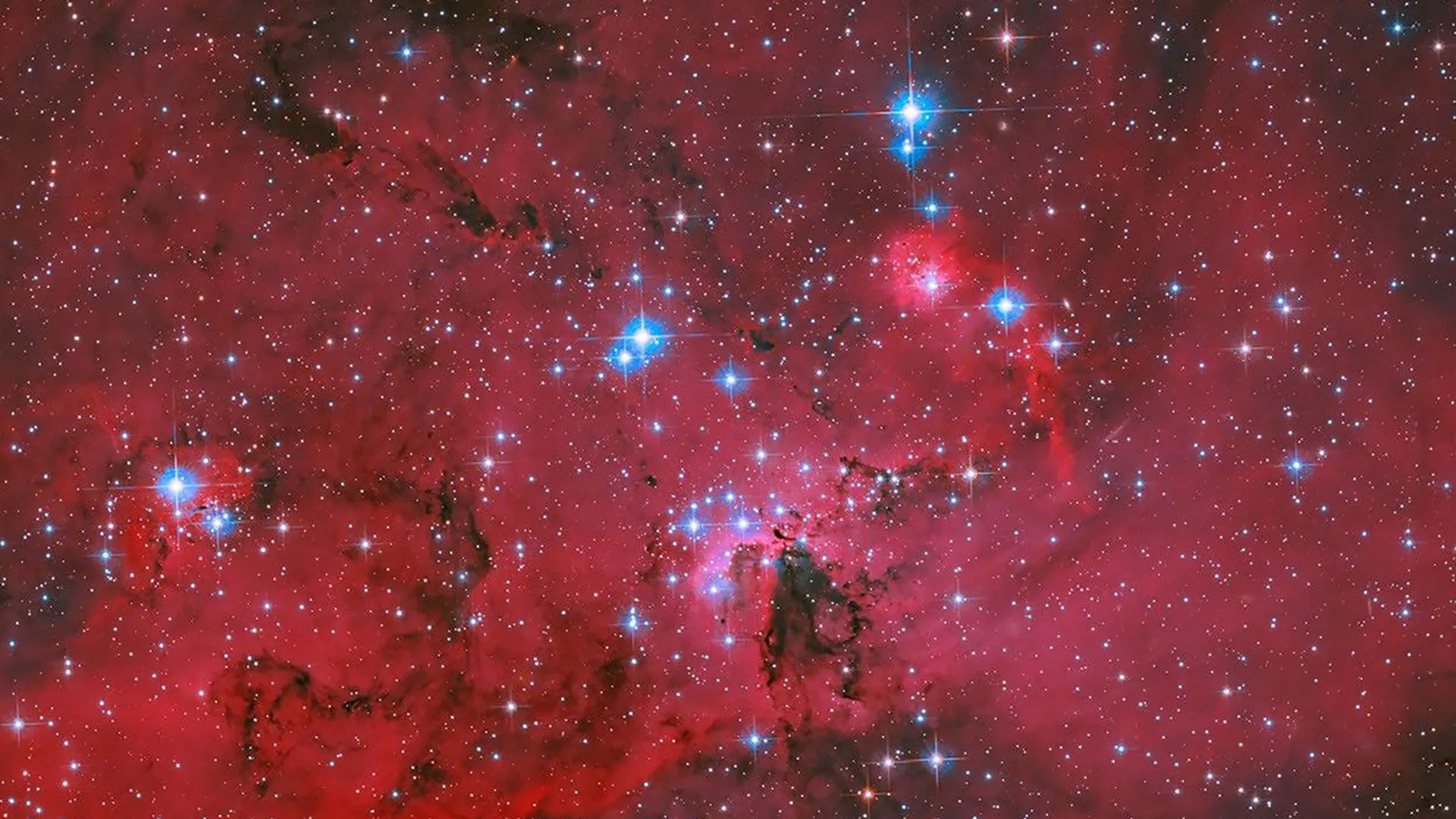
NASA has released a Hubble Space Telescope view of LH 95, a star-forming region in the Large Magellanic Cloud with about 2,500 young stars still developing. The observations matter because NASA says they show that some stars can keep taking in gas and dust for several million years before reaching the main stage of their lives.
LH 95 lies inside the Large Magellanic Cloud, a dwarf galaxy that orbits the Milky Way, according to NASA. The region contains low-mass stars that are still forming as well as hotter, heavier blue stars clustered in the same stellar association.
In the Hubble image, blue and white stars appear amid red clouds of gas. NASA says the red light comes from hydrogen-alpha emission, a marker astronomers use to identify active star-forming regions.
Heavy stars shape the nebula
NASA says the brightest blue stars in LH 95 have at least three times the mass of the Sun. Those stars pour ultraviolet radiation into nearby gas and send out stellar winds, heating the hydrogen around them and helping carve the surrounding nebula.
Dust also plays a visible role in the image. NASA says denser dust lanes remain as dark strands because they resist erosion better than the gas around them, creating contrast against the glowing hydrogen clouds.
The colors in the Hubble view do not represent a direct naked-eye view, according to NASA. Blue shows shorter visible wavelengths, while red includes longer visible wavelengths and some near-infrared light.
Young stars are still feeding
NASA says Hubble observations of LH 95 revealed thousands of pre-main-sequence stars. These objects have gathered most of their eventual mass but have not yet begun hydrogen fusion in their cores.
Pre-main-sequence stars form after gas clouds collapse under gravity, NASA says. They continue contracting until their cores become hot and dense enough for fusion, the process that marks the start of a star’s main-sequence life.
The LH 95 data also help scientists study accretion, the process by which young stars draw material from surrounding disks of gas and dust. NASA says the observations confirm that accretion slows as stars age, while also showing that the process can persist for millions of years.
Several stellar generations share one region
LH 95 did not form all its stars at once, according to NASA. The region contains stars of different ages, giving astronomers a chance to study several stages of stellar development in one place.
NASA says the most massive star visible in the region sits slightly left of center near the top of the image and has about 60 to 70 times the Sun’s mass. Although it is the region’s heaviest known star, NASA says it appears roughly 1 million years younger than many nearby stars, which are estimated at about 4 million years old.
Very massive stars burn through fuel quickly and can end as supernovae, NASA says. Such explosions spread heavy elements that can later become part of new generations of stars.
NASA describes LH 95 as especially useful because it is relatively nearby and less hidden by dust than comparable star-forming areas in the Milky Way. Hubble’s view is credited to NASA, ESA, N. Da Rio of the University of Virginia, G. De Marchi of the European Space Agency’s ESTEC site, D. Gouliermis of Heidelberg University, and image processing by Gladys Kober of NASA and the Catholic University of America.
This story draws on original reporting from ScienceDaily.