
Black hole study proposes tiny remnants could preserve lost information
A seven-dimensional gravity model suggests black holes may stop short of vanishing, leaving relics that store quantum information.
By Tom Brennan · Health & Medicine Correspondent
3 min read
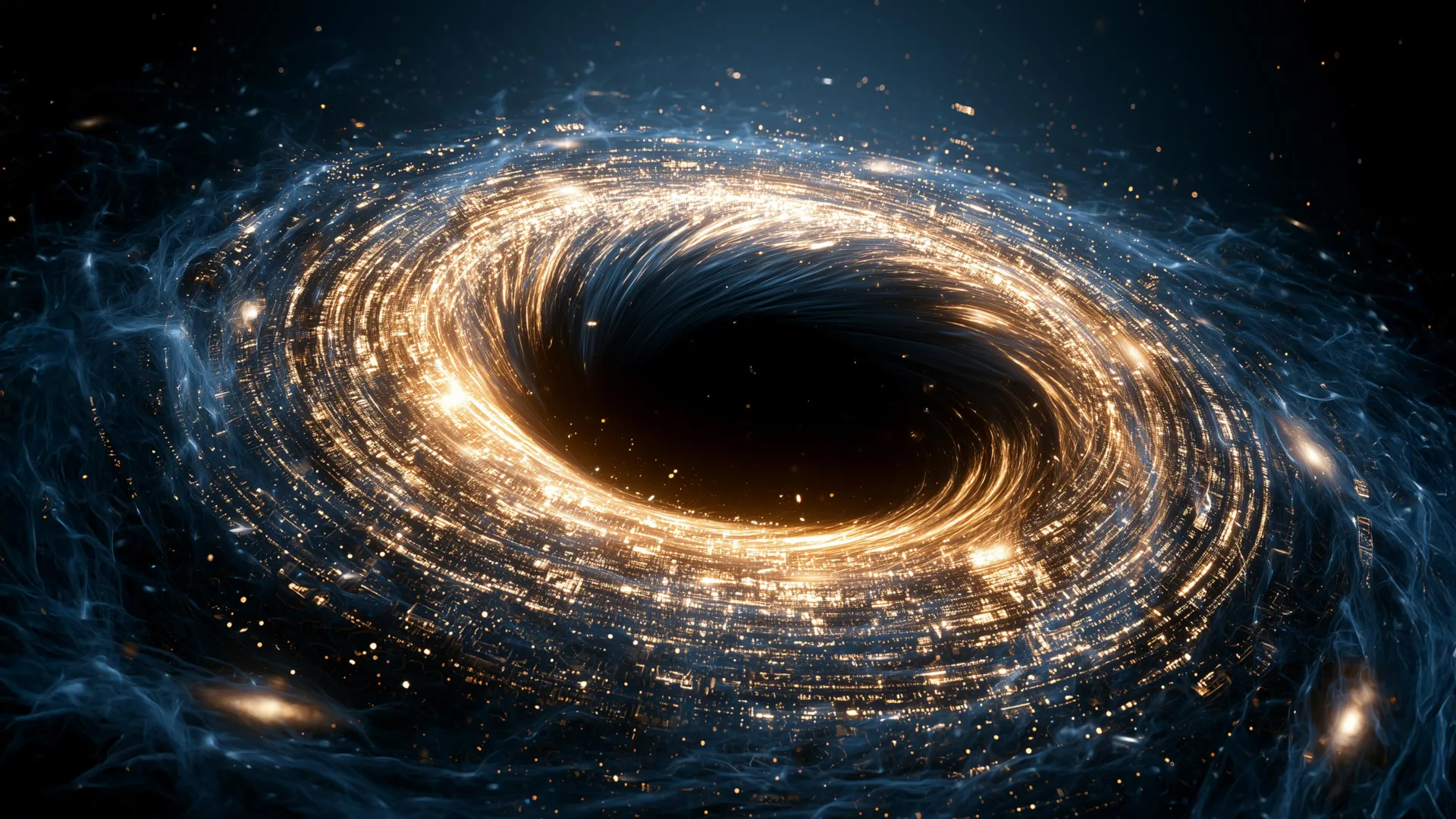
A new theoretical study proposes that evaporating black holes may leave behind stable microscopic remnants rather than disappearing completely. If correct, the model would address the black hole information paradox without requiring quantum information to be destroyed, according to researchers at the Institute of Experimental Physics SAS.
The work, led by Richard Pinčák and published in General Relativity and Gravitation, uses a seven-dimensional version of gravity to connect black hole physics with the geometry of spacetime. The same framework, the authors say, may also offer a geometric route to understanding why elementary particles have mass.
Why the paradox exists
The problem dates to Stephen Hawking’s 1970s calculations showing that black holes emit radiation and can lose energy over time. In that picture, a black hole eventually shrinks away.
Quantum mechanics, however, says information is preserved. If a black hole vanishes after swallowing matter, the information describing that matter appears to vanish with it. That conflict is known as the black hole information paradox.
Pinčák and colleagues propose a different endpoint. Their model says the final phase of evaporation can be halted by effects that appear at extreme densities, leaving a stable relic rather than an empty aftermath.
A role for twisting spacetime
The study uses Einstein-Cartan theory, a form of gravity that allows spacetime not only to curve but also to twist. That twisting is called torsion. The researchers formulate the theory in seven dimensions on a mathematical structure known as a G2-manifold with torsion.
According to the authors, torsion becomes significant near the Planck scale, where densities are far beyond ordinary physics. In their calculations, it produces a repulsive effect that can counter the final collapse and evaporation of a black hole.
The resulting remnant would have a predicted mass of about 9×10^-41 kilograms, according to the study. The researchers describe it as stable and capable of carrying information that would otherwise seem to be lost.
How information would be stored
The team argues that the remnant could preserve information through quasi-normal modes, or long-lived vibration patterns tied to its geometry. In the model, quantum information is encoded in persistent torsion-field vibrations inside the remnant.
For a black hole with the mass of the Sun, the researchers calculate that the remaining relic could store about 1.515×10^77 qubits. They say that capacity is enough to account for the information associated with the original black hole.
The study also links the seven-dimensional geometry to particle physics. When the model is reduced to the four dimensions experienced in ordinary spacetime, the authors say it naturally produces the electroweak scale, about 246 GeV, associated with the Higgs field and particle mass.
Possible tests
The proposed extra-dimensional particles, known as Kaluza-Klein excitations, would have masses around 8.6×10^15 GeV, the study says. That is far beyond the energy range of the Large Hadron Collider.
The authors still describe possible observational paths. They suggest stable Planck-scale relics could contribute to dark matter, and that their gravitational effects might offer evidence for the model. They also point to possible traces in the cosmic microwave background or primordial gravitational waves, because the energy scales involved belong to the early universe.
The proposal remains theoretical. Its significance, according to the Institute of Experimental Physics SAS, is that one geometric framework attempts to link black hole remnants, quantum information, extra dimensions and the Higgs mass problem.
This story draws on original reporting from ScienceDaily.