
Honey bees follow individual routes with centimeter-level precision
Drone tracking in Germany found foraging honey bees repeat personal routes, with trees improving precision and cornfields adding variation.
By Lucas Ferreira · Science & Environment Writer
3 min read
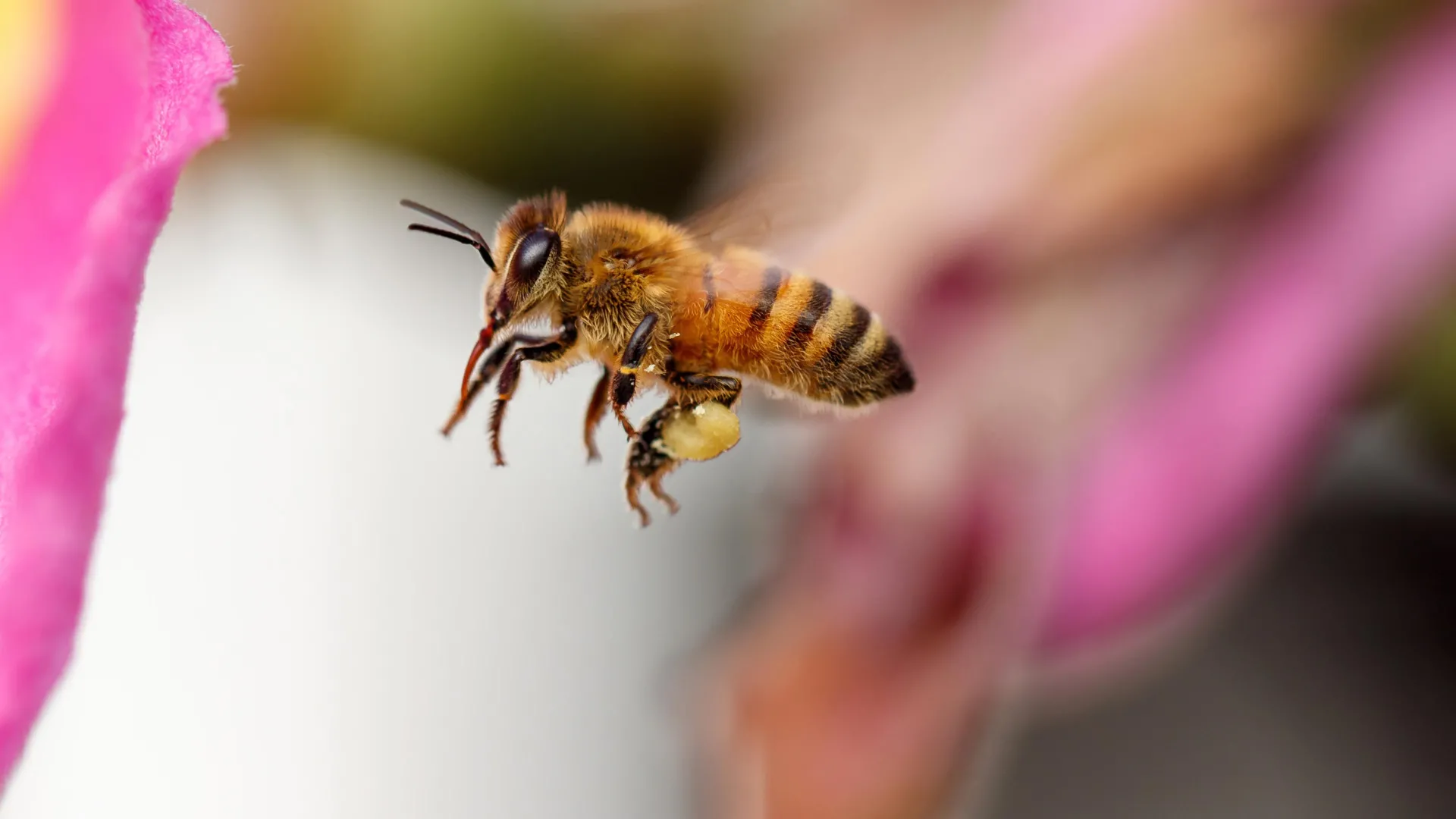
Researchers at the University of Freiburg tracked honey bees in open farmland and found that individual bees repeatedly used their own routes between a hive and a food site. The results, reported by the university, suggest bees can fly to familiar places with far more precision than their waggle-dance directions might imply.
The study was led by neurobiologist and behavioral biologist Andrew Straw and published in Current Biology by Rachael Stentiford, Michael J.M. Harrap, Victor V. Titov, Stephan Lochner and Straw. The team followed bees near Kaiserstuhl, Germany, as they traveled between a hive and food placed about 120 meters away, according to the University of Freiburg.
To record the flights, Straw’s group used a drone-based system called Fast Lock-On, or FLO, Tracking. The method involved placing a tiny reflective marker on each bee, while a computer mounted on the drone read reflected light and identified the insect within milliseconds, according to the university.
Landmarks tightened the flight paths
The researchers analyzed 255 flight paths through an agricultural area that included hedges, a cornfield and a tree between the hive and the food source. The tree blocked a straight route, giving the team a way to study how bees dealt with visual features in the area, the university said.
The bees did not all use one shared corridor. Instead, the research team found that each bee tended to repeat its own path on trips out to the food and back to the hive, according to the University of Freiburg.
Some bees flew so close to their earlier paths that the difference was only a few centimeters, Straw said in the university’s account of the findings. He said the recordings show that individual bees have preferred routes and can follow them with high accuracy.
The tightest repetition appeared near strong visual cues, especially the tree, according to the study summary from the university. Flights became more variable over the cornfield, where the surroundings offered fewer distinct features for the insects to use.
Straw said the results indicate that visible landmarks help bees keep their flight paths precise. The university said the findings also point to greater uncertainty in more uniform areas, such as the cornfield in the study site.
What it means for the waggle dance
The work also bears on the honey bee waggle dance, the well-known behavior that communicates the location of food to other bees in the colony. Straw said earlier research had shown that the dance does not give exact directional information.
For food sources about 100 meters away, the direction indicated in the waggle dance can be off by around 30 degrees, according to the University of Freiburg. The new tracking results suggest that this imprecision does not reflect a basic limit in the bees’ own flight ability.
Straw said individual bees flew to familiar destinations with much greater accuracy than their dances would suggest. Even where the tracked paths varied the most, the bees strayed from their own routes by only a few degrees, according to the university.
The study gives researchers a higher-resolution view of bee flight in natural settings than earlier methods allowed, according to Straw. By pairing drone tracking with marked insects, the team showed that foraging honey bees can combine personal route memory with visual cues in the terrain.
This story draws on original reporting from ScienceDaily.