
Graphene cavity boosts terahertz detector response
Researchers report a monolayer graphene device that uses acoustic plasmon resonances to detect terahertz radiation with an enhanced electrical response.
By Priya Raghavan · Science Reporter
3 min read
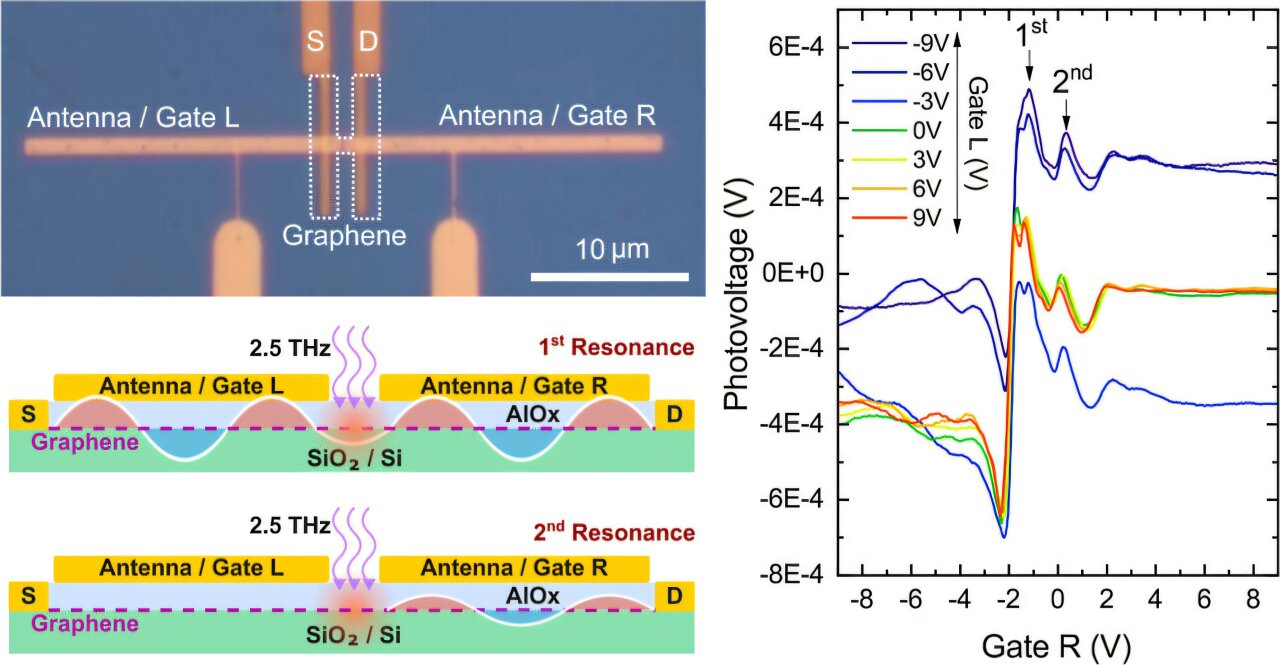
A research team led by ICFO has built a terahertz detector based on monolayer graphene that produces a strong electrical signal when hit by terahertz radiation under liquid nitrogen cooling. The work matters because terahertz light is being studied for uses ranging from noninvasive biomedical sensing to faster wireless data links, fields that need detectors that are sensitive, fast and practical to make.
The results were published in ACS Photonics by researchers from ICFO, the Instituto de Nanociencia y Materiales de Aragón, Universidad de Zaragoza, the University of Ioannina, Queen Mary University of London, the University of Manchester and the Catalan Institute of Nanoscience and Nanotechnology.
Terahertz light covers frequencies from 0.3 to 20 THz, according to ICFO. It can interact with materials without causing damage and can carry data faster than radio waves, making it a candidate for identifying biological tissue types and for high-speed communications.
Detector performance has remained a barrier, ICFO said. Devices that work quickly at room temperature can have high noise, while low-noise approaches may need cryogenic cooling, operate over limited frequency bands or respond more slowly.
How the graphene device works
The team’s design centers on a terahertz cavity formed through acoustic graphene plasmons. These are collective wave-like motions of electrons at graphene’s surface.
In the device, a terahertz antenna concentrates incoming radiation and launches those plasmons inside the graphene. The plasmons are trapped and form standing-wave resonances, in a similar broad sense to resonances in a musical instrument, according to ICFO.
The acoustic plasmons confine light into spaces far smaller than its wavelength, at the nanoscale. That stronger confinement increases the interaction between the terahertz field and the graphene, which raises absorption.
ICFO said the absorbed energy heats two regions of the graphene by different amounts. The device then converts that temperature difference into an electrical signal, providing the readout that terahertz light has been detected.
A route around a manufacturing hurdle
Graphene has drawn interest for terahertz detection because it can interact with a wide span of terahertz frequencies, generate current quickly when exposed to radiation and be tuned, according to the researchers. Its one-atom thickness, however, means it absorbs little free-space terahertz radiation unless the interaction is enhanced.
Earlier graphene plasmon approaches either gave too weak a response or required encapsulation with hexagonal boron nitride, ICFO said. That encapsulation step adds fabrication complexity and makes large-scale production harder and costlier.
ICREA Prof. Frank Koppens, who led the study, said the new plasmonic cavity produced a photoresponse 30% higher than the maximum conventional response without using hexagonal boron nitride encapsulation. ICFO said that could support compact, efficient sensors for identifying materials, since many chemicals absorb and emit light in the terahertz range.
Dr. Sebastián Castilla, a researcher on the study, attributed the result to graphene single crystals made by chemical vapor deposition and to the use of acoustic graphene plasmon cavity resonances to concentrate the incoming terahertz field.
The researchers said the approach could point to new graphene growth methods that cut plasmon losses further. ICFO said keeping acoustic graphene plasmons strong up to room temperature would be a milestone for terahertz sensing.
This story draws on original reporting from Phys.org.