
Goblin sharks recorded alive in their deep-sea habitat
Researchers documented two healthy goblin sharks in the Central Pacific, extending the species’ known range and setting a deeper record for mackerel sharks.
By Tom Brennan · Health & Medicine Correspondent
3 min read
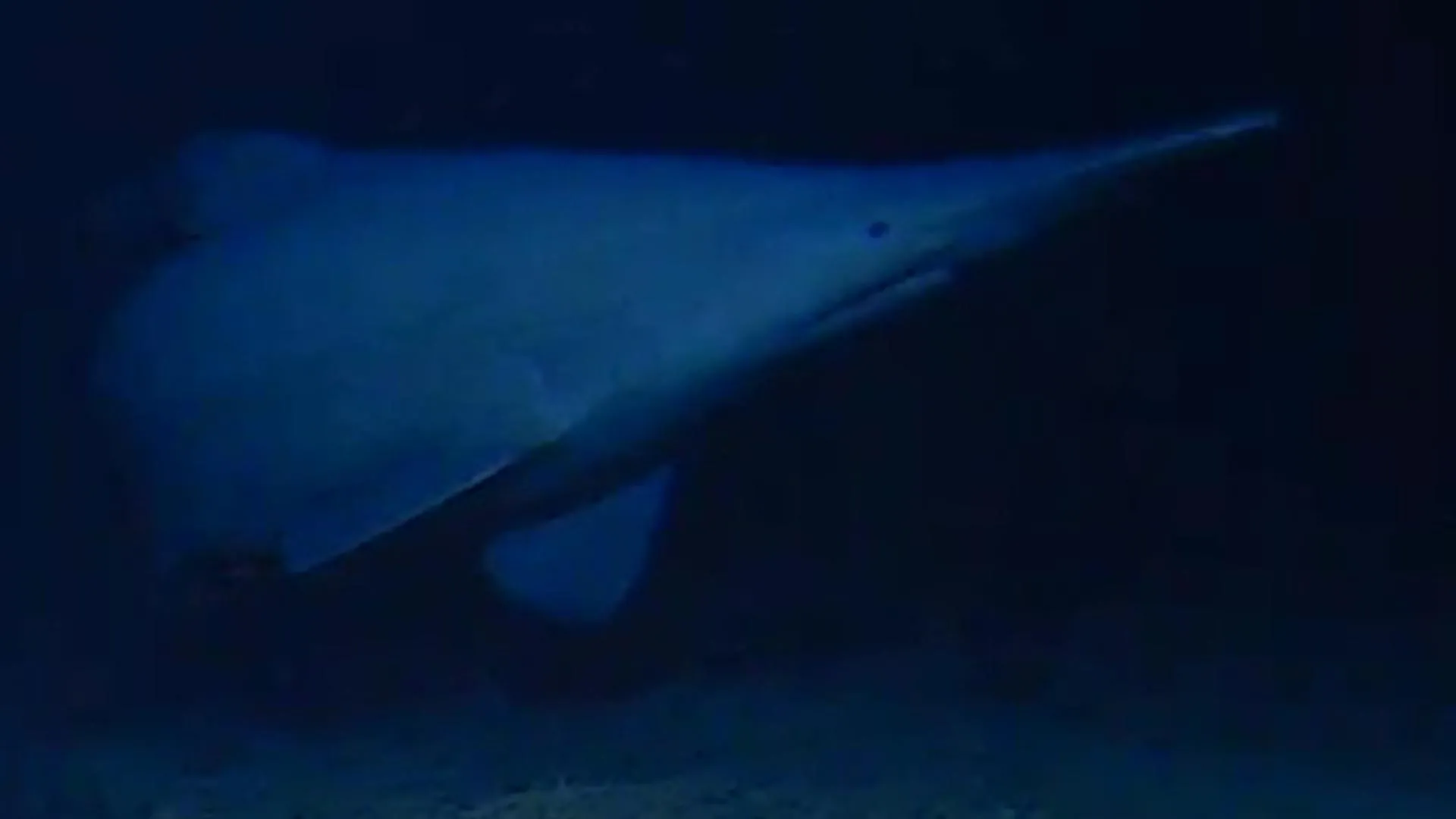
Researchers have recorded live goblin sharks swimming in their natural deep-ocean habitat, a milestone for a species usually known from animals hauled up by fishing gear. The observations matter because they extend where scientists know the rare shark lives and how deep members of its shark group can go, according to the University of Hawaii at Manoa.
The findings, led by a University of Hawaii at Manoa team and published in the Journal of Fish Biology, describe two healthy goblin sharks observed in the wild. One was recorded near an unnamed seamount northwest of Jarvis Island, and another was filmed on the slope of the Tonga Trench, the university said.
Goblin sharks, known scientifically as Mitsukurina owstoni, are the only living species in a shark family with a history reaching back about 125 million years, according to the university. Before these records, confirmed live observations had involved sharks caught unintentionally and brought to the surface, where the animals usually died soon afterward.
New range and depth records
Aaron Judah, the paper’s lead author and a doctoral candidate in the Deep-Sea Fish Ecology Lab and Deep-Sea Animal Research Center at UH Manoa, said the Tonga Trench record placed the shark nearly 700 meters deeper than its previously known depth range. Judah also said that sighting set a new depth mark for Lamniformes, the order of mackerel sharks that includes great whites, makos and basking sharks.
Before the two Central Pacific sightings, goblin sharks had been documented from more limited parts of the Pacific near the western United States, Australia and Japan, as well as small areas of the Atlantic and Indian oceans, according to the university. The Jarvis Island and Tonga Trench records add the Central Pacific to that known distribution.
The first of the two observations came from archived video, according to UH Manoa. Judah learned in 2025 that colleagues at the Deep-Sea Animal Research Center had flagged possible goblin shark footage from a 2019 Ocean Exploration Trust expedition aboard the E/V Nautilus.
That expedition studied deep-sea ecosystems around Kingman Reef, Palmyra Atoll and Jarvis Island inside the Pacific Remote Islands Marine National Monument, the university said. The remotely operated vehicle Hercules collected video during a livestreamed dive, and Judah later confirmed that the footage showed a goblin shark near the Jarvis Island seamount.
A second sighting in the Tonga Trench
The other record came in 2024 during an expedition to the Tonga Trench aboard the R/V Dagon, part of the Inkfish Open Ocean Expedition, according to the university. A baited camera on a bottom lander recorded a goblin shark moving freely along the trench slope.
Alan Jamieson, a study co-author and founding director of the Minderoo-UWA Deep-Sea Research Center, documented the 2024 sighting. Jamieson said he had not expected to see a living goblin shark in the deep sea and later learned that the Hawaii team had identified another one in earlier footage.
Judah said the records show the value of natural history work in the deep ocean, where many animals remain poorly understood. He also said the expanded range could help governments and regional managers include goblin sharks in biodiversity records and conservation planning for areas where the species had not previously been known.
This story draws on original reporting from ScienceDaily.