
Fast-spinning giant exoplanets complicate planet formation models
Keck Observatory measurements suggest giant planets can rotate faster than heavier brown dwarfs, pointing to magnetic fields and birth history.
By Priya Raghavan · Science Reporter
3 min read
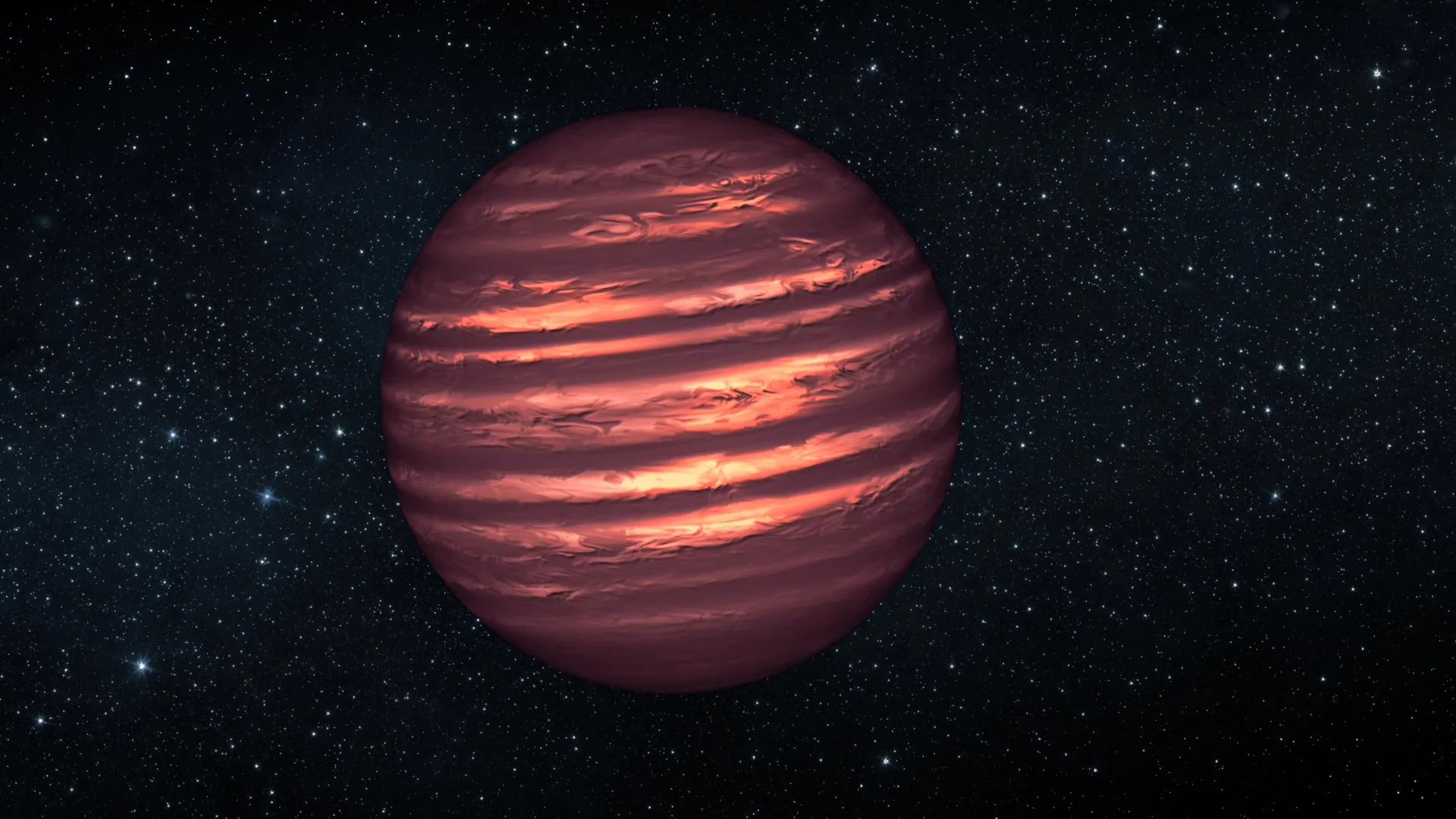
Astronomers using the W.M. Keck Observatory have measured the rotation of distant giant planets and brown dwarfs and found that heavier objects do not necessarily spin faster. The result matters because rotation can preserve clues about how planets and planet-like bodies formed, according to research published in The Astronomical Journal.
The work, described by Universe Today and based on observations from Maunakea, Hawaiʻi, tested a long-running idea that an object’s mass and spin should be closely connected. In our solar system, Jupiter and Saturn both turn once in roughly 10 hours, despite their size, and hold much of the system’s rotational energy.
The Keck survey examined 32 gas giants and brown dwarf companions orbiting other stars, including six planets larger than Jupiter and 25 brown dwarf companions, according to Universe Today. The team also added earlier rotation measurements from other studies, producing a selected comparison set of 43 stellar and substellar companions and giant planets, plus 54 free-floating brown dwarfs and planetary-mass objects.
What the measurements showed
After accounting for mass, radius and age, the researchers found that giant gas planets often rotate more quickly than brown dwarfs with greater mass, Universe Today reported. Brown dwarfs sit between planets and stars: they are more massive than planets but do not become ordinary stars.
The international team was led by researchers at Northwestern University’s Center for Interdisciplinary Exploration and Research in Astrophysics. Co-authors came from institutions including UC San Diego’s Center for Astrophysics and Space Sciences, Caltech, the W.M. Keck Observatory, Steward Observatory, NASA’s Jet Propulsion Laboratory and others, according to the journal listing.
Many of the worlds in the study orbit far from their stars, at distances of tens to hundreds of astronomical units, Universe Today reported. One astronomical unit is the average distance between Earth and the sun. Scientists are still studying whether such distant objects grow inside disks of gas and dust around young stars or form through a collapse process closer to how stars are born.
The team used the Keck Planet Imager and Characterizer, or KPIC, to separate the faint light of these planets and brown dwarfs from nearby starlight. As an object rotates, atmospheric features leave small changes in its spectrum; measuring that spectral broadening lets astronomers estimate spin speed, according to the Keck Observatory account.
Magnetic braking may explain the gap
One example cited by the researchers is the HR 8799 system. In that system, a gas giant about seven times Jupiter’s mass spins six times faster than a brown dwarf companion with about 24 Jupiter masses, according to Universe Today.
The researchers said early magnetic interactions may help explain the difference. A stronger magnetic field can couple more strongly with a surrounding circumplanetary disk and slow an object’s rotation, so the more massive brown dwarf may have shed more of its initial spin.
Dino Chih-Chun Hsu of Northwestern, the study’s lead author, said in a Keck Observatory release that spin measurements can help reconstruct the physical processes that shaped these objects long ago. Hsu also said the results point to both the planet’s mass and the mass ratio between planet and star as factors in the final spin rate.
The team plans to extend the work to free-floating planets, also known as rogue planets, and to study atmospheric chemistry, according to Universe Today. Future observations are expected to use Keck’s High-resolution Infrared Spectrograph for Exoplanet Characterization, or HISPEC, which is scheduled to begin operations in 2027.
Jason Wang, a Northwestern assistant professor and study co-author, said in the Keck release that HISPEC is designed with better sensitivity, higher spectral resolution and broader wavelength coverage than KPIC. He said the instrument should allow researchers to measure spins for more planets, including objects more similar to Jupiter.
This story draws on original reporting from ScienceDaily.