
Euclid view of the Milky Way center hides thousands of planets
ESA says Euclid captured tens of millions of stars in 26 hours, creating a galactic-center mosaic that can help reveal unseen worlds.
By Tom Brennan · Health & Medicine Correspondent
2 min read
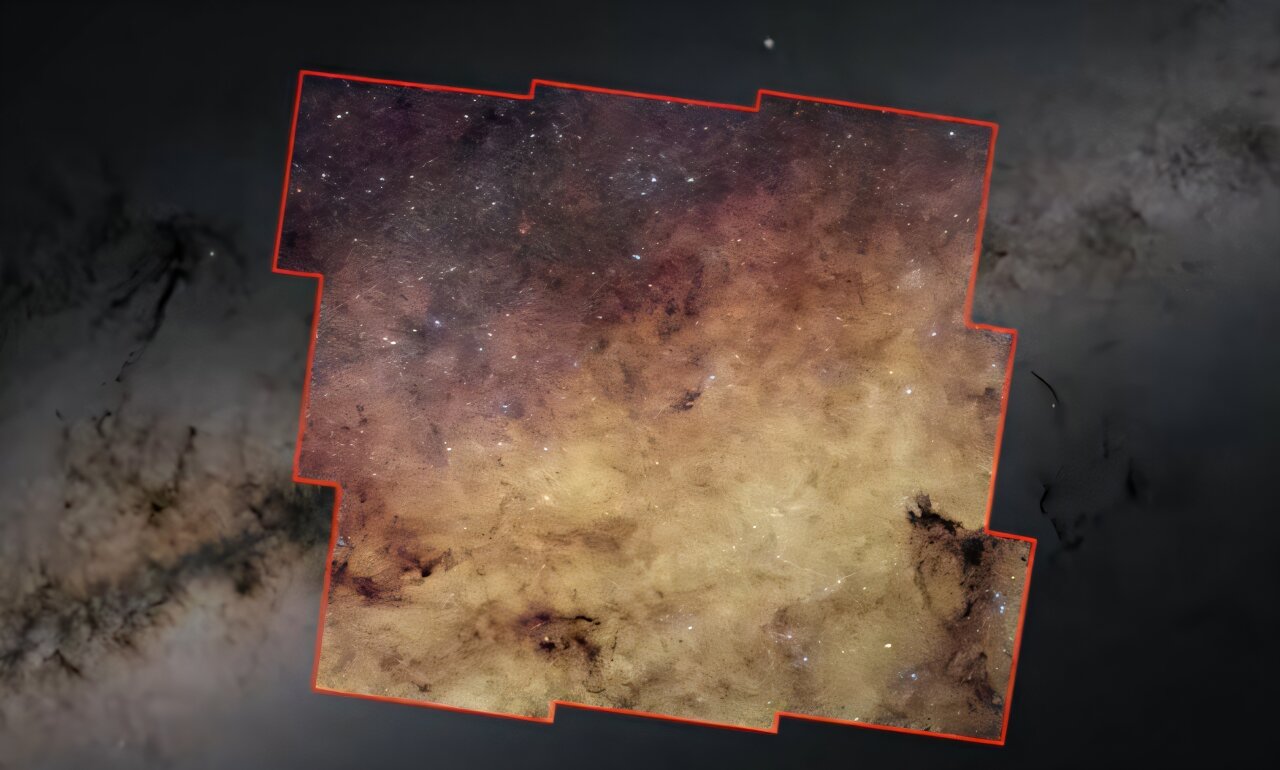
The European Space Agency says its Euclid space telescope has captured a dense view of the Milky Way’s center that contains tens of millions of stars and thousands of planets that are not directly visible. The image matters because ESA says it can serve both as a survey of stellar evolution and as a tool for finding distant worlds through gravity.
ESA said the mosaic was assembled from observations made over 26 hours. The agency described the view as a detailed look toward the center of the galaxy, three years after Euclid’s launch.
The field is crowded with stars, but ESA said the picture also traces different stages in the lives of stars. It includes dark clouds associated with star formation and older stellar populations packed into the Milky Way’s central bulge, according to the agency.
ESA said the planets in the image cannot be seen directly. Astronomers instead can use gravitational microlensing, a method that detects small and short-lived changes in light when stars pass in front of one another.
Those light changes can reveal the gravitational influence of planets, ESA said. The agency said the same technique can also help determine the masses of planets, even when the objects themselves remain hidden in the glare and crowding of the stellar field.
A dark-universe mission turns toward the galaxy
Euclid was designed to study dark matter and dark energy, according to ESA. Those two subjects remain the mission’s core purpose, but the agency said the telescope is also opening a way to study the Milky Way and the exoplanets within it.
The new view shows how an observatory built for cosmology can produce data useful for galactic astronomy. ESA said Euclid’s observations of the galactic center offer a map of star formation, older stellar populations and the gravitational signatures of planets that would otherwise escape direct detection.
The agency presented the release as a video and image centered on the Milky Way’s crowded core. ESA credited the Euclid telescope with capturing the mosaic and said the result gives astronomers a new way to search a bright, busy region of the sky for worlds revealed only by their effects on light.
This story draws on original reporting from Phys.org.