
New faint satellite near Andromeda may be 12.5 billion years old
Astronomers say Andromeda XXXVI is among the dimmest known companions of M31 and could help test models of early galaxy formation.
By Priya Raghavan · Science Reporter
3 min read
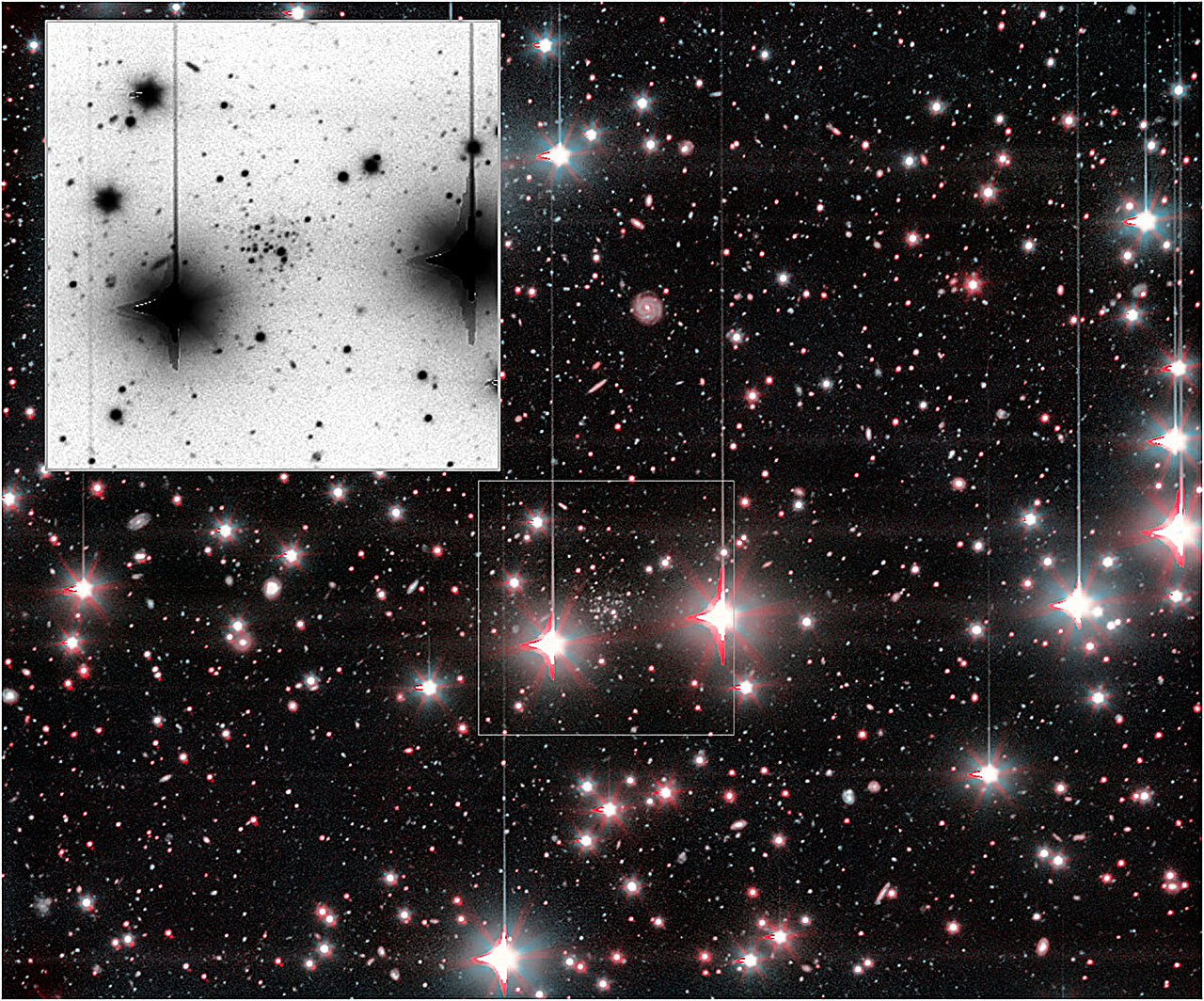
Astronomers have identified a new ultra-faint dwarf galaxy near Andromeda, the large spiral galaxy also known as M31, according to a study published in Astronomy & Astrophysics. The finding adds a scarce object to the census of Andromeda’s smallest companions, a group researchers use to study early galaxy formation and dark matter.
The newly reported galaxy, named Andromeda XXXVI or And XXXVI, appears to be one of the faintest satellite galaxies found around Andromeda so far, the study says. The research team estimates that it may be about 12.5 billion years old and very poor in heavy elements.
Joanna Sakowska of the Instituto de Astrofísica de Andalucía, the study’s lead author, said the age, distance and chemical makeup still need sharper measurements. According to Sakowska, observations with space telescopes such as Hubble will be needed to pin down those properties more precisely.
Why the discovery matters
Ultra-faint dwarf galaxies are among the smallest and least luminous galaxies known, according to the Leibniz Institute for Astrophysics Potsdam, which reported the findings. Because many formed early in cosmic history and are thought to contain large amounts of dark matter relative to their visible stars, astronomers treat them as records of conditions in the young universe.
Andromeda lies about 2.5 million light-years from Earth and is the nearest giant spiral galaxy to the Milky Way, according to the institute. Like the Milky Way, it is surrounded by smaller satellite galaxies held by its gravity.
Isabel Santos-Santos of the Leibniz Institute for Astrophysics Potsdam, a co-author of the study, said the standard Lambda Cold Dark Matter model predicts that galaxies such as Andromeda should have hundreds of small companions. Many are difficult to detect because they emit so little light, she said.
Sakowska said astronomers currently know of about 40 dwarf satellite galaxies around Andromeda, with roughly 15 of them classified as ultra-faint. Each additional discovery, she said, suggests that the known population may represent only a fraction of the faint satellites around M31.
How astronomers found it
Andromeda XXXVI was first noticed by Giuseppe Donatiello, an astrophotographer and amateur astronomer, while he examined images from the Pan-Andromeda Archaeological Survey, or PAndAS, the study says. That survey used the Canada-France-Hawaii Telescope.
In those images, the object showed up as a dim, diffuse feature in which some individual stars could already be separated, according to the researchers. It was later added to a list of galaxy candidates for follow-up observations.
The team then obtained director’s observing time on the Gran Telescopio Canarias and used the OSIRIS+ instrument to take deeper images. Those observations allowed the researchers to distinguish stars within the object’s faint glow, but Andromeda XXXVI remained difficult to study: the team identified only about 46 stars linked to it.
The study places Andromeda XXXVI at a projected distance of about 119 kiloparsecs from M31. The paper, “Andromeda XXXVI: Discovery of a new ultra-faint dwarf galaxy towards M31,” was authored by Sakowska and colleagues and published in Astronomy & Astrophysics with DOI 10.1051/0004-6361/202660151.
This story draws on original reporting from Phys.org.