
Evolutionary review links longer lives to late-life disease burden
Researchers say modern longevity exposes genetic trade-offs and late-acting mutations that natural selection did not strongly remove.
By Priya Raghavan · Science Reporter
3 min read
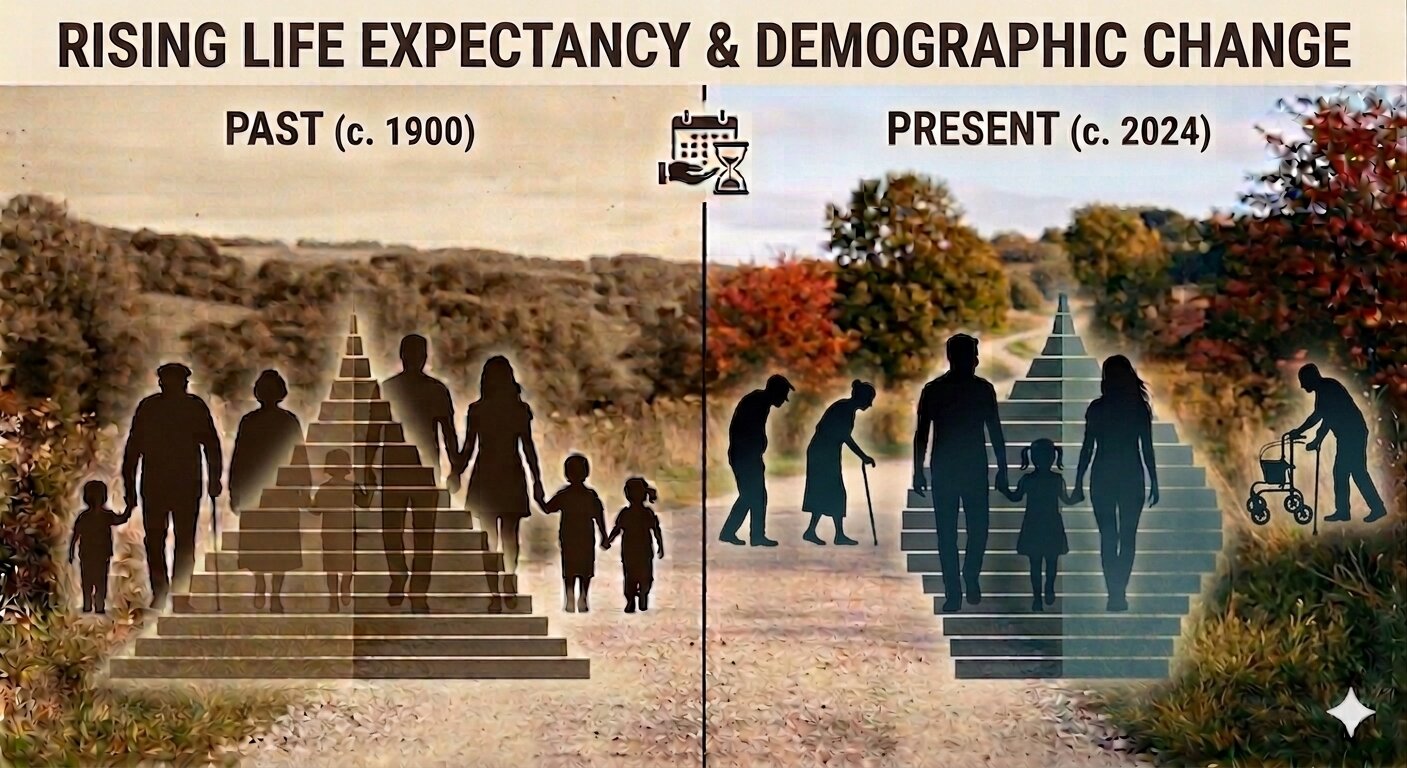
A new review in Nature Reviews Genetics argues that longer human lives are making the biological costs of aging more visible. The authors say many age-related diseases may reflect genetic and molecular systems shaped mainly by natural selection’s focus on early-life survival and reproduction.
The review was written by Handan Melike Dönertaş of the Leibniz Institute on Aging–Fritz Lipmann Institute in Jena and Linda Partridge of University College London, according to the institute. It brings together evolutionary theory, comparative genomics and large human genetics studies to examine why organisms age and why aging varies across people and species.
At the center of the argument is a concept known as the “selection shadow.” Classical evolutionary theory holds that natural selection is strongest on traits that affect reproduction, especially earlier in life. Traits or mutations that cause harm only in old age face weaker selection because many organisms historically did not survive or reproduce at those ages.
That weak pressure can allow harmful late-acting genetic variants to persist over evolutionary time, the review says. A related mechanism, antagonistic pleiotropy, describes genes that can be useful when an organism is young but damaging later in life.
Modern life changes the scale of aging
Dönertaş and Partridge argue that modern societies have changed the setting in which these old biological trade-offs play out. People now live longer, have fewer children and benefit from medical care that helps more people reach older ages, according to the Leibniz Institute on Aging.
The authors link this to the demographic transition, the shift from high birth and death rates to lower birth rates and longer life expectancy. Under those conditions, more people survive into the period when late-acting mutations, aging cells and youth-oriented biological pathways can contribute to disease.
The review does not argue that old age is now subject to the same level of natural selection as youth. Dönertaş and Partridge say longer survival can extend selection into later life, while reduced birth rates can weaken selection overall. The result, they argue, is that processes once mostly hidden by shorter lifespans now affect large populations.
Modern environments may also reveal trade-offs that were less apparent in the past. The institute said abundant food, reduced physical activity and contemporary medicine differ from the conditions in which human biology evolved.
Shared pathways behind diseases
The review describes aging as the product of multiple interacting forces, including genes, life history, environment and population structure. It points to conserved “hallmarks of aging,” including reduced DNA stability, mitochondrial decline, altered nutrient metabolism, damaged proteins and the buildup of aging cells.
Those processes are regulated by signaling systems such as insulin/IGF-1 and mTOR, which help control growth, energy use and repair. The authors say genomic evidence shows genes tied to aging and longevity are unusually conserved across humans and other animals.
That conservation matters for medicine, the authors argue, because many late-life diseases may share roots in the same ancient biological pathways. Cardiovascular disease and neurodegenerative disease are among the age-related conditions discussed by the institute.
Dönertaş said an evolutionary view can identify ancient pathways that remain active later in life and may contribute to disease, making them promising targets for intervention. Partridge said the aim should not be only longer life, but reducing the late-life costs of biology tuned by selection for early life, so more years are lived in good health.
The review also says aging is highly polygenic, meaning many genes each contribute small effects. The authors suggest future work could test how rising life expectancy, lower birth rates and aging populations influence cellular aging, tissue repair, metabolism and disease risk.
This story draws on original reporting from Phys.org.