
Euclid finds record-setting quasars from the young universe
Astronomers identified 31 early quasars, including two seen from when the universe was about 670 million years old.
By Tom Brennan · Health & Medicine Correspondent
4 min read
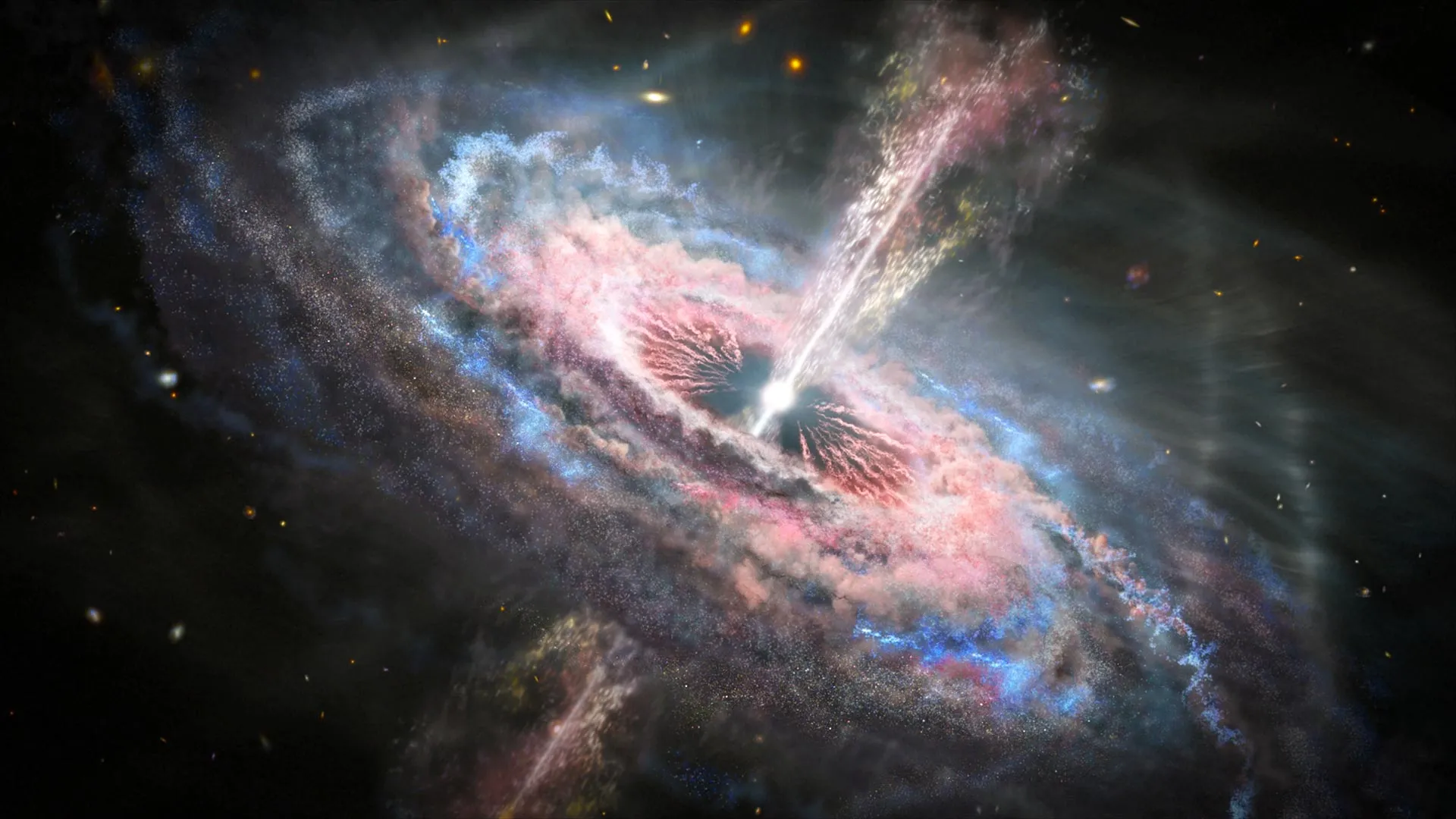
An international astronomy team has identified 31 ancient quasars, including the two earliest known, according to the University of California, Santa Barbara. The findings matter because the objects are powered by supermassive black holes that appear to have grown to enormous size within the first several hundred million years after the Big Bang.
The discoveries, reported in Astronomy & Astrophysics, came from data gathered by the European Space Agency’s Euclid space telescope. UC Santa Barbara said the two oldest examples have redshifts of 7.69 and 7.77, meaning astronomers see them as they were when the universe was about 670 million years old.
Quasars are intensely bright galactic centers fueled by matter falling into supermassive black holes. UC Santa Barbara said the newly identified objects were shining with about the light of a trillion suns, even though they existed when the universe was only about 5% of its current age.
Joseph Hennawi, a physics professor affiliated with UC Santa Barbara and Leiden University and a co-author of the study, said the objects offer some of the best evidence for studying how supermassive black holes formed. He said black holes with hundreds of millions to billions of solar masses were already present when the universe was still very young, and researchers do not yet understand how they grew so quickly.
Why the search is difficult
Astronomers have long looked for very early quasars because they can reveal how the first galaxies and large black holes developed, UC Santa Barbara said. But such objects are rare: at less than about 770 million years after the Big Bang, relatively few galaxies had become large enough to host them.
Their light also creates a detection problem. As the universe expands, light from distant quasars is stretched from ultraviolet wavelengths into the near infrared, where Earth’s atmosphere glows and makes faint signals harder to isolate from the ground.
Daming Yang, a doctoral student in Hennawi’s group at Leiden University and lead author of the study, said distant quasars can resemble large numbers of stars in the Milky Way and nearby galaxies in imaging surveys. He said researchers need observations that cover wide areas of sky while still reaching faint objects.
Euclid, launched in 2023, avoids much of the atmospheric interference by observing from space. According to UC Santa Barbara, its wide survey will eventually map more than one-third of the sky, giving astronomers a larger and deeper data set for finding rare early-universe objects.
More than doubling a rare sample
UC Santa Barbara said 14 of the 31 newly found quasars have redshifts of 7 or higher. It took more than a decade to find roughly the first 10 quasars in that range, while Euclid has found more than that in one year.
The university said the new discoveries include the earliest quasars yet identified, exceeding a previous record set by Hennawi’s research group in 2021. Researchers also examined the second oldest quasar in the set and found it in a dusty, gas-rich galaxy undergoing strong star formation.
The quasars come from the epoch of reionization, a period when the first stars and galaxies ionized the neutral hydrogen that filled space, according to UC Santa Barbara. Scientists use bright distant quasars as probes of that era because their light passes through intervening gas on its way to Earth.
Machine-learning tools helped researchers sort through tens of millions of astronomical sources, Hennawi said. His team developed several of the algorithms used in the work and also leads development of PypeIt, software used within the University of California system to process observations from the Keck telescopes.
Keck observations confirmed two-thirds of the new quasars, including the three most distant, according to UC Santa Barbara. The team now wants to find a quasar beyond redshift 8, which would place it within the universe’s first 630 million years.
Researchers have secured time on the James Webb Space Telescope to study many of the quasars in more detail. UC Santa Barbara said those observations are expected to measure black hole masses, examine surrounding gas chemistry and help trace reionization, while the Atacama Large Millimeter Array will study dust, gas and star formation in the host galaxies.
This story draws on original reporting from ScienceDaily.