
El Niño forms as forecasters warn of possible historic strength
NOAA says El Niño has arrived, with a 63% chance it becomes one of the strongest events in records dating to 1950.
By Priya Raghavan · Science Reporter
3 min read
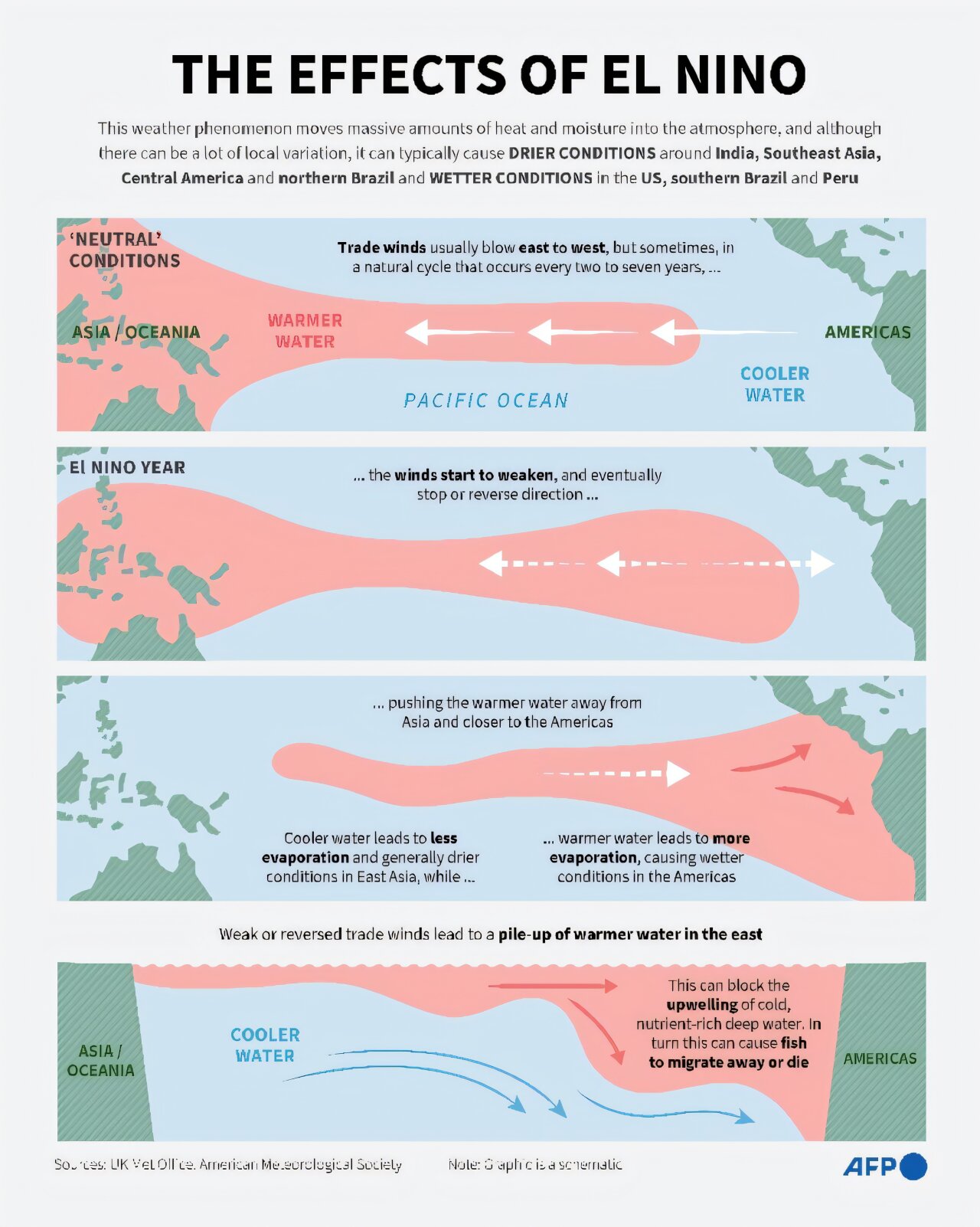
El Niño has developed in the equatorial Pacific, the U.S. National Oceanic and Atmospheric Administration said, raising the risk of disruptive heat, drought and flooding in several regions. NOAA scientists said the event could strengthen late this year, adding stress to a planet already warmed by fossil fuel pollution.
In its latest advisory, NOAA put the odds of a very strong El Niño during November through January at 63%. The agency said an event of that size would rank among the largest in the historical record dating back to 1950.
NOAA meteorologist Haley Thiem said in an agency explainer video that “El Niño is here, and it could be one for the history books.” Scientists cited by AFP said forecasts from other climate centers also point toward an unusually powerful event.
What El Niño can change
NOAA describes El Niño as a recurring climate pattern in which surface waters warm across the central and eastern equatorial Pacific Ocean. That ocean warming can alter winds and rainfall across the globe, producing uneven regional impacts rather than a single worldwide weather outcome.
Major El Niño episodes often bring drought to parts of the Amazon, Indonesia and Australia, according to the scientists cited by AFP. They can also disrupt India’s monsoon and shift rainfall patterns across tropical regions.
The pattern usually appears every two to seven years and often lasts about nine to 12 months, according to AFP. Although El Niño tends to reach peak strength near the end of a calendar year, heat stored in the oceans can keep influencing the atmosphere and push global temperatures higher the following year.
Marc Alessi of the Union of Concerned Scientists told AFP that fossil fuel-driven climate change and a possible “super El Niño” could help drive global temperatures to record levels. He said there is evidence that climate change caused by fossil fuels is making El Niño events more intense.
Warnings from vulnerable regions
Mohamed Adow, director of the Nairobi-based climate and energy think tank Power Shift Africa, told AFP that the forecast is alarming for people already exposed to food and water stress. He said El Niño can mean failed rains, crop losses, higher food prices and added pressure on families.
Governments in dry parts of Central America have raised alert levels because of El Niño, AFP reported. In the region known as the Dry Corridor, which includes parts of Guatemala, Honduras, El Salvador and Nicaragua, officials are worried about drought and food shortages.
Guatemala’s government says it has prepared 1.1 million rations for distribution in a possible food security emergency, according to AFP. Adow said East African communities that have already faced droughts and floods in recent years are also likely to be hit by extremes.
Carlo Buontempo, director of Europe’s Copernicus Climate Change Service, told AFP that current odds favor a moderate to strong event, and possibly a strong to record-breaking one. U.N. Secretary-General Antonio Guterres said earlier this month that likely intense El Niño conditions should be treated as an urgent climate warning.
Guterres said El Niño would “pour fuel on the fire of a warming world,” according to AFP. He called for cutting fossil fuel use, speeding the shift to renewable energy, protecting vulnerable communities and expanding early warning systems.
This story draws on original reporting from Phys.org.