
Study tests whether Earth microbes could have reached Europa
A new astrobiology paper calculates a route by which dust carrying bacteria could have traveled from Earth to Europa’s buried ocean.
By Lucas Ferreira · Science & Environment Writer
3 min read
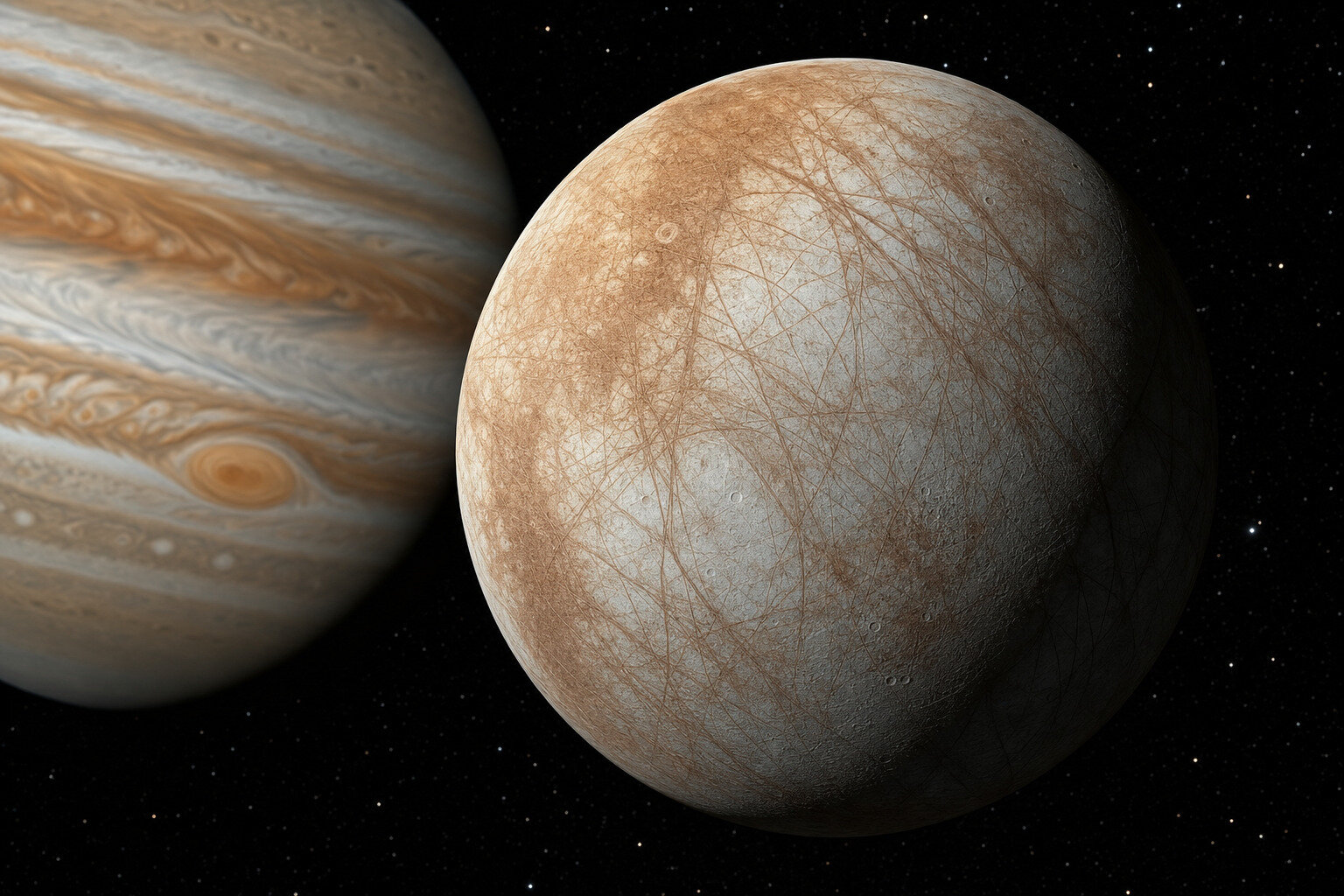
A new paper argues that Earth may have delivered bacteria-bearing dust to Europa, Jupiter’s icy moon, over billions of years. The idea matters for astrobiology because Europa’s subsurface ocean is considered one of the solar system’s leading places to search for life.
Zaza Osmanov of the Free University of Tbilisi set out the hypothesis in the International Journal of Astrobiology. According to the paper, tiny dust grains could have escaped Earth, traveled through the solar system and reached Europa without destroying all of the microbes they carried.
A reverse panspermia test
Osmanov frames the work as a version of “reverse panspermia,” according to Phys.org. Panspermia usually refers to life arriving on Earth from elsewhere; Osmanov’s question is whether Earth could have sent life outward.
In an earlier paper in the International Journal of Astronomy and Astrophysics, Osmanov calculated that dust grains could travel hundreds of parsecs through interstellar space over 5 billion years. He also estimated that particles leaving one planet could reach about 1,000 stellar systems, according to Phys.org.
The Europa study narrows that idea to one route: Earth to Europa. Osmanov divides the problem into whether microbe-carrying grains can leave Earth, whether any can land on Europa without being sterilized or destroyed, and whether they can pass through the moon’s ice into the ocean below.
How dust could make the trip
Osmanov focuses on grains roughly one micron wide, about the size of some bacteria. In his model, bacteria would need to stay below about 300 Kelvin, or 27 degrees Celsius, to remain viable during the journey.
According to Osmanov’s calculations, atmospheric turbulence and collisions with cosmic dust could lift grains high in Earth’s atmosphere and give them enough speed to escape. At an altitude of 150 kilometers, he calculates a maximum speed of 14 kilometers per second, above Earth’s 11.2-kilometer-per-second escape velocity.
Once far from Earth, the grains would move at about 8.4 kilometers per second, Osmanov calculates. He then models the effects of solar radiation pressure, Jupiter’s gravity and drag from the interplanetary medium, finding that a grain could arrive near Jupiter at 20.1 kilometers per second.
Europa’s surface poses the hardest part of the trip. Using the grains’ heat capacity, Osmanov finds that only particles striking at an angle of about 1 degree relative to the surface would survive impact, leaving about three in every 1,000 bacteria packets intact.
Billions of years of chances
Osmanov estimates that about 5 x 10^18 particles per second could be ejected from Earth in all directions through collisions with cosmic dust in the atmosphere. From geometry, he calculates that roughly 300 million Earth-origin particles per second should reach Europa’s surface.
The paper also relies on earlier studies of Europa’s ice. Osmanov cites research indicating that bacteria on the surface would be deactivated in about 10,000 years, and that 20% to 40% of Europa’s ice, dated at 30 million to 80 million years old, has been fractured by tidal heating and friction from Jupiter.
He also cites simulations finding that some icy regions could melt through in about 1,000 years, while wider openings tens of kilometers across could form in about 10,000 years. In Osmanov’s scenario, those processes could allow surviving bacteria to move from the surface to the ocean.
Combining the estimates, Osmanov concludes that about (3-8) x 10^23 particles could have reached conditions relevant to Europa’s ocean over the period considered. He writes that the result supports the likelihood of life in Europa’s subsurface ocean if its biology and chemistry can support organisms that began on Earth.
This story draws on original reporting from Phys.org.