
Study outlines infrared clues for finding possible Dyson swarms
A new paper says red dwarfs and white dwarfs could be prime targets in searches for hypothetical star-powered alien technology.
By Priya Raghavan · Science Reporter
3 min read
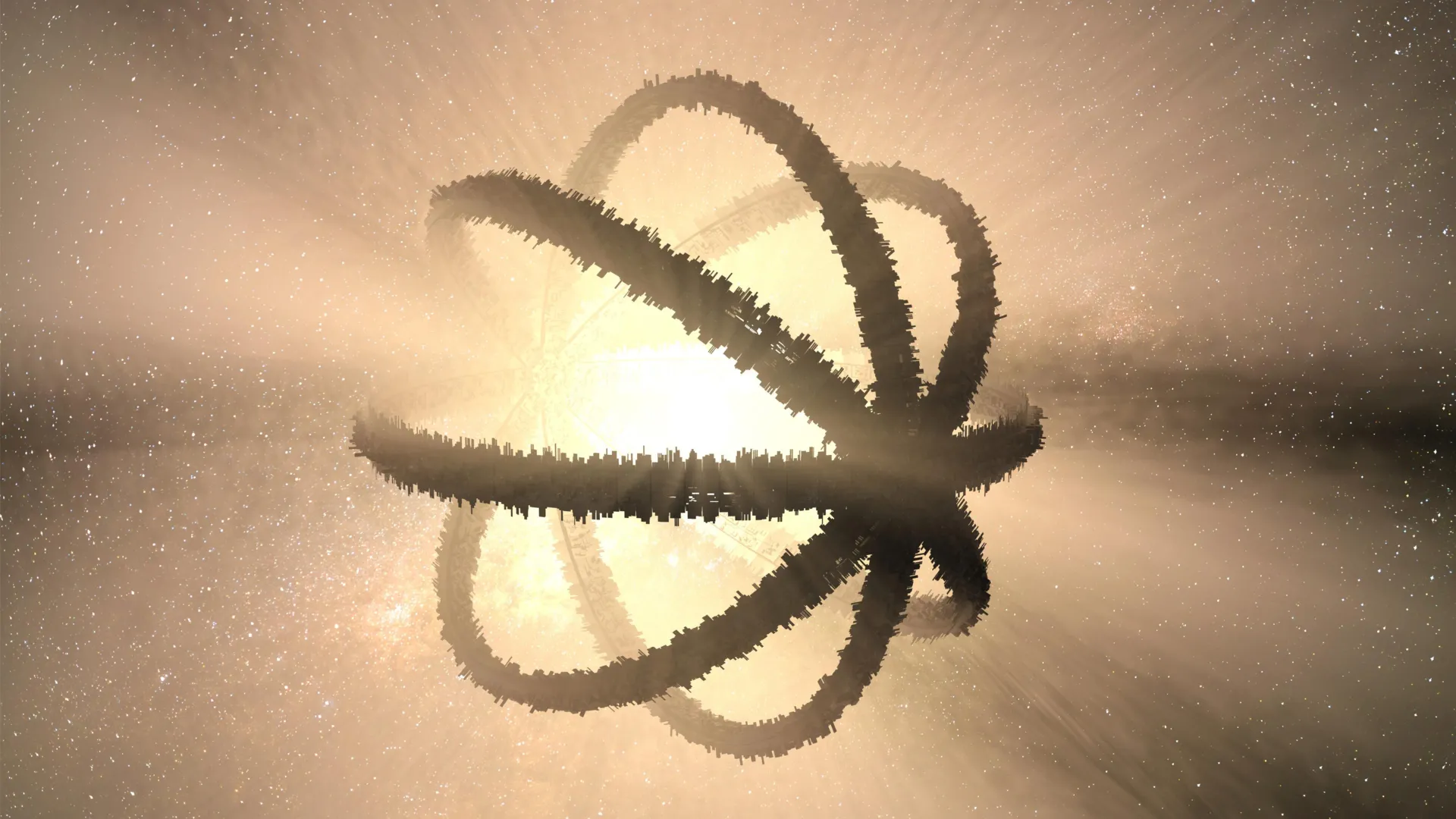
A new study proposes ways astronomers could identify a hypothetical Dyson swarm, a vast collection of orbiting structures built to collect a star’s energy. Universe Today reports that the work points to red dwarfs and white dwarfs as especially useful places to look because such systems could appear as extremely cold infrared objects rather than ordinary visible stars.
The study, by Amirnezam Amiri of the University of Arkansas, is available as an arXiv preprint and is scheduled for publication in Universe, according to Universe Today. The paper revisits an idea first suggested by physicist Freeman Dyson in 1960: that an advanced civilization might surround a star with technology to harvest much of its output.
Researchers now tend to describe the concept as a swarm rather than a solid shell, Universe Today reports. A rigid sphere around a star would require unrealistic amounts of material, while many separate collectors in orbit would be more plausible under the assumptions considered in the study.
Why small stars stand out
Amiri’s study identifies red dwarfs as strong candidates for this kind of search. Universe Today reports that red dwarfs are small, cool and common in the Milky Way, and that they burn fuel slowly enough to last for trillions of years.
The paper says a Dyson swarm around a red dwarf could orbit at roughly 0.05 to 0.3 astronomical units, a much smaller scale than a comparable structure around a Sun-like star. That would reduce the amount of material needed, according to the study.
White dwarfs could offer another practical target. Universe Today describes them as dense remnants of Sun-like stars that have exhausted their fuel and shrunk to about 1% of their former size. Because they are compact, the study says, a swarm could orbit only a few million kilometers above the surface while drawing on a steady energy source for billions of years.
The infrared signature
The main observational clue would be heat. According to the study, a Dyson swarm that absorbed most visible starlight would still need to emit energy, but it would radiate that waste heat in the infrared.
That would change where the object appears on the Hertzsprung-Russell diagram, which astronomers use to compare stellar luminosity and temperature. Universe Today reports that the object’s total energy output would remain about the same, but its apparent temperature would shift far lower.
The paper gives a red dwarf as an example. A typical red dwarf has a surface temperature near 3,000 kelvin, while a surrounding Dyson structure could have an effective temperature as low as 50 kelvin, according to Universe Today. The report says known natural stars do not occupy that part of the diagram.
Amiri’s study also suggests astronomers should look for spectra that lack the dust signatures seen around some ordinary stars. Universe Today reports that a swarm made of radiator panels would not resemble a dusty disk and could produce a cleaner infrared signal.
Searches already under way
Brightness changes could provide another clue. If a swarm consisted of many orbiting collectors with gaps or uneven density, the study says it might create unusual light-curve patterns that differ from known stellar behavior.
Universe Today reports that the James Webb Space Telescope is well suited to this work because of its infrared capabilities, while older surveys such as WISE also contribute data. In May 2024, Project Hephaistos researchers reported seven possible Dyson sphere candidates associated with red dwarfs after reviewing a catalog of about 5 million stars, according to the report.
One candidate was later explained by a background supermassive black hole aligned with the target, Universe Today reports. The report says five candidates still deserve further study, while none has been confirmed as alien technology.
Amiri’s paper does not claim Dyson swarms have been found. It lays out observational tests that could help astronomers separate unusual infrared sources from natural objects if such searches find more candidates.
This story draws on original reporting from ScienceDaily.