
Dying sun-like stars may get thousands of small recoil kicks
A Caltech model links uneven mass loss in aging red giants to the motions seen in white dwarfs and some disrupted binary stars.
By Priya Raghavan · Science Reporter
3 min read
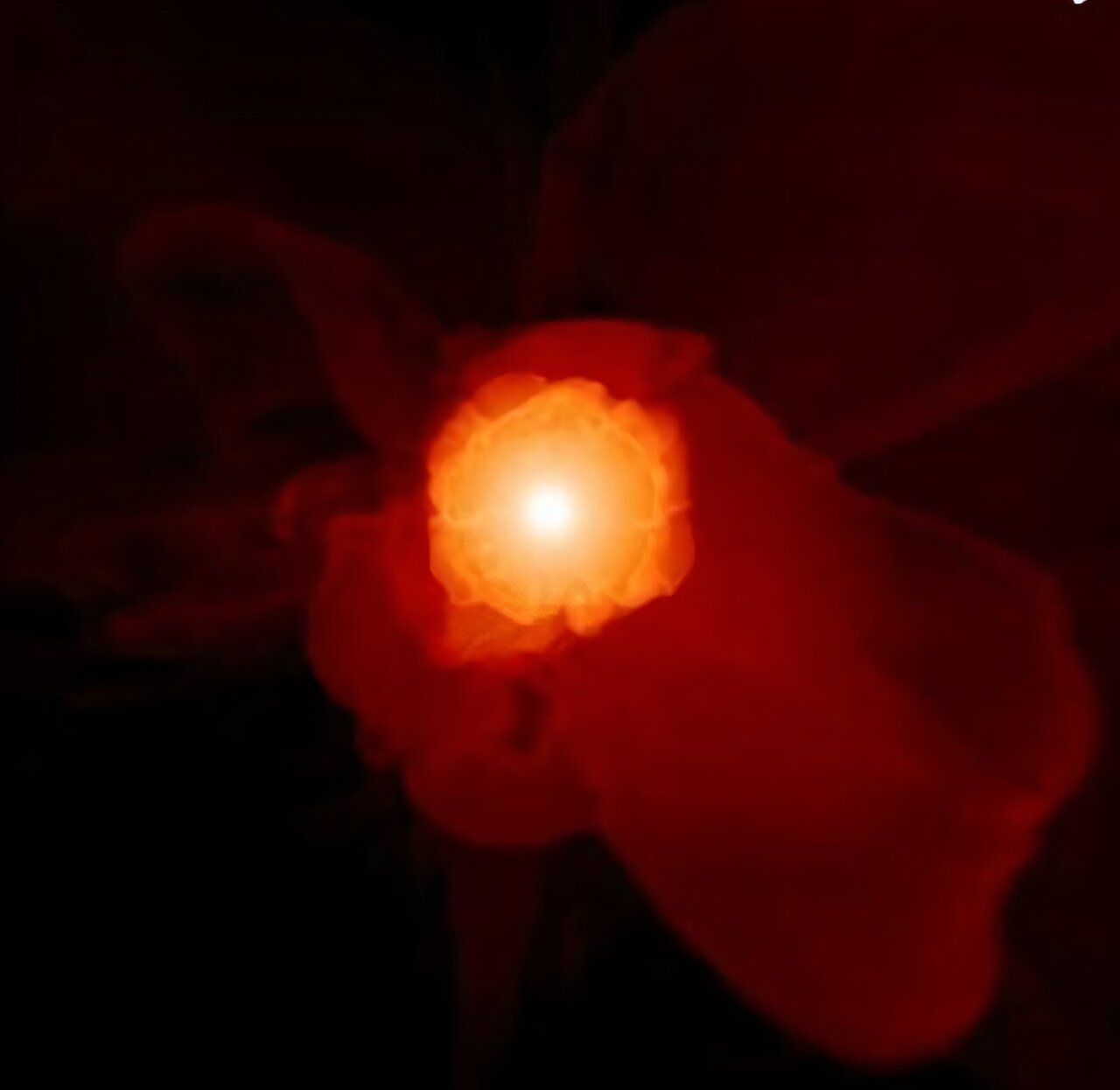
Sun-like stars may stagger through their final stages under thousands of small recoil pushes, according to a new model from Caltech theoretical astrophysicist Jim Fuller. The work offers a physical explanation for why some white dwarfs appear to move fast enough to split apart wide stellar pairs.
Fuller presented the results at the 248th meeting of the American Astronomical Society in Pasadena, Caltech said. The study, titled “White Dwarf Kicks via Episodic Mass Ejection from Red Giant Stars,” has been submitted to the Proceedings of the Astronomical Society of the Pacific, according to Caltech.
Stars with masses similar to the sun swell into red giants late in life, Caltech said. Their outer layers leak into space while their cores shrink into white dwarfs, a common endpoint for stars across the universe.
Fuller’s model focuses on the last phase before that transformation. According to Caltech, it proposes that clumps of material leave the bloated star unevenly, so each ejection gives the star a small shove in the opposite direction.
Small pushes that add up
Fuller’s calculations indicate that a dying red giant could receive about 10,000 such kicks over hundreds of thousands of years, Caltech said. Each individual push would move the star at only a few meters per second, which Fuller compared to a slow human jogging pace.
The ejections occur in random directions, but the total effect does not cancel out perfectly, according to the study. Fuller’s model treats the accumulated motion as a random walk, a mathematical process in which many random steps leave an object displaced from where it started.
By the end of the process, the model predicts a net motion in a random direction of about one kilometer per second, Caltech said. That is much weaker than the recoil produced when a massive star explodes as a supernova, but it could still matter for fragile stellar systems.
Astronomers had previously suspected that white dwarfs receive modest kicks, Caltech said. The case has been harder to explain than supernova recoil because sun-like stars do not end their lives in a blast.
Binary stars offer a clue
Fuller built the model partly on observations by Kareem El-Badry, a Caltech assistant professor of astronomy. El-Badry found that very widely separated binary stars become less common after one member of the pair turns into a white dwarf, according to Caltech.
The interpretation cited by Caltech is that a net kick of about one kilometer per second can disrupt the loose orbit of a wide binary. Fuller said that if the binary’s orbital speed is lower than the kick speed, the two stars can become gravitationally unbound.
Fuller also drew on computer simulations showing that convective material in aging red giants can be expelled unevenly, Caltech said. His model connects those asymmetric mass-loss events to the inferred white dwarf kicks.
El-Badry said, according to Caltech, that he was pleased to see a physical model that could account for an observation that had puzzled him for years.
The model makes another prediction: in some binary systems, kicks to a dying red giant with a companion could drive the stars into a collision and produce an explosion, Caltech said. Fuller’s proposal could be tested if astronomers find evidence for such stellar mergers in future observations.
This story draws on original reporting from Phys.org.