
Astronomers detect powerful black hole wind in distant quasar
X-ray observations reveal two high-speed gas streams from WISSH13, a quasar seen about 2 billion years after the Big Bang.
By Priya Raghavan · Science Reporter
3 min read
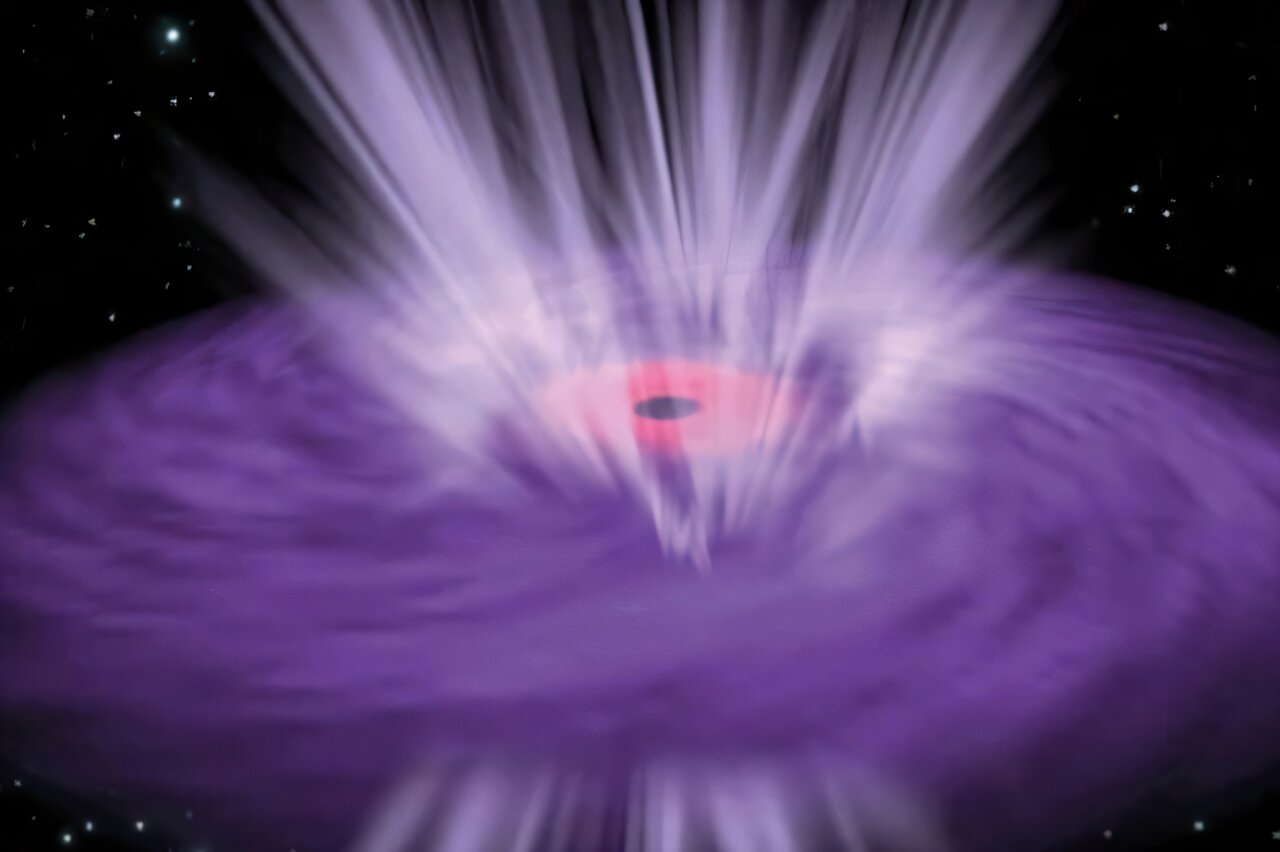
Astronomers have identified one of the strongest ultra-fast outflows yet reported from a distant supermassive black hole. The finding matters because such winds are thought to shape how black holes and their host galaxies grow during an early, busy period of cosmic history.
The detection comes from a team led by Giorgio Lanzuisi of INAF Bologna, which studied the quasar WISSH13 using the XMM-Newton and NuSTAR X-ray observatories. The results were posted June 3 on the arXiv preprint server, and the study has been submitted to Astronomy & Astrophysics and is under minor revision, according to the report.
Ultra-fast outflows, often shortened to UFOs in astronomy, are winds of gas moving at more than 10% of the speed of light. Researchers consider them a possible way for feeding black holes to push energy into nearby gas, heat it and reduce star formation in their galaxies.
WISSH13 sits at a redshift of 3.294, so astronomers see it as it appeared roughly 2 billion years after the Big Bang. The central black hole is estimated by the research team to be about 2 billion times the mass of the sun and to be accreting material at an exceptional rate, shining about three times brighter than expected for a black hole of that mass.
Two wind speeds in one system
The team combined new XMM-Newton and NuSTAR data from October 2024 with an older XMM-Newton observation from 2017. In the resulting X-ray spectrum, the researchers found two absorption features that they interpret as signatures of highly ionized iron in fast-moving gas.
According to the study, the features point to two parts of the same outflow. One component is moving at roughly 10% of the speed of light, while the other is traveling at about 30% of light speed.
The slower component appeared in both the 2017 and 2024 observations, which the team said suggests it may persist over long periods. The faster component was present only in the newer data, indicating it may be launched in shorter episodes.
The researchers describe the system as a stratified wind. Their interpretation matches theoretical models in which a rapid inner stream, or spine, rises from the innermost accretion disk and is surrounded by a slower sheath that begins farther from the black hole.
A rare view without gravitational lensing
The WISSH13 observation is part of WISSHFUL, an XMM-Newton multi-year program designed to study 15 hyper-luminous quasars from the era known as cosmic noon. That period, roughly 1.6 billion to 3.5 billion years after the Big Bang, is when black holes and galaxies are believed to have been growing at high rates.
Many earlier high-redshift detections of ultra-fast outflows relied on gravitational lensing, in which a foreground galaxy magnifies a more distant quasar. The WISSH13 case is different because the quasar is not lensed, and the team reports it as the highest-redshift UFO yet detected from a non-lensed quasar.
The study estimates that the two wind components eject about 21 and 24 solar masses of material per year. The researchers said those rates place the outflows among the most massive and energetic known examples of their kind.
Despite that power, the team found that the WISSH13 wind follows scaling relations seen in lower-redshift active galaxies. The researchers said future X-ray missions, including the planned NewAthena observatory, should help identify similar winds in distant quasars.
This story draws on original reporting from Phys.org.