
Automated method measures defects in diamond semiconductors
Rice University researchers say a Python workflow can speed analysis of crystal defects in diamond and other wide-bandgap semiconductors.
By Priya Raghavan · Science Reporter
3 min read
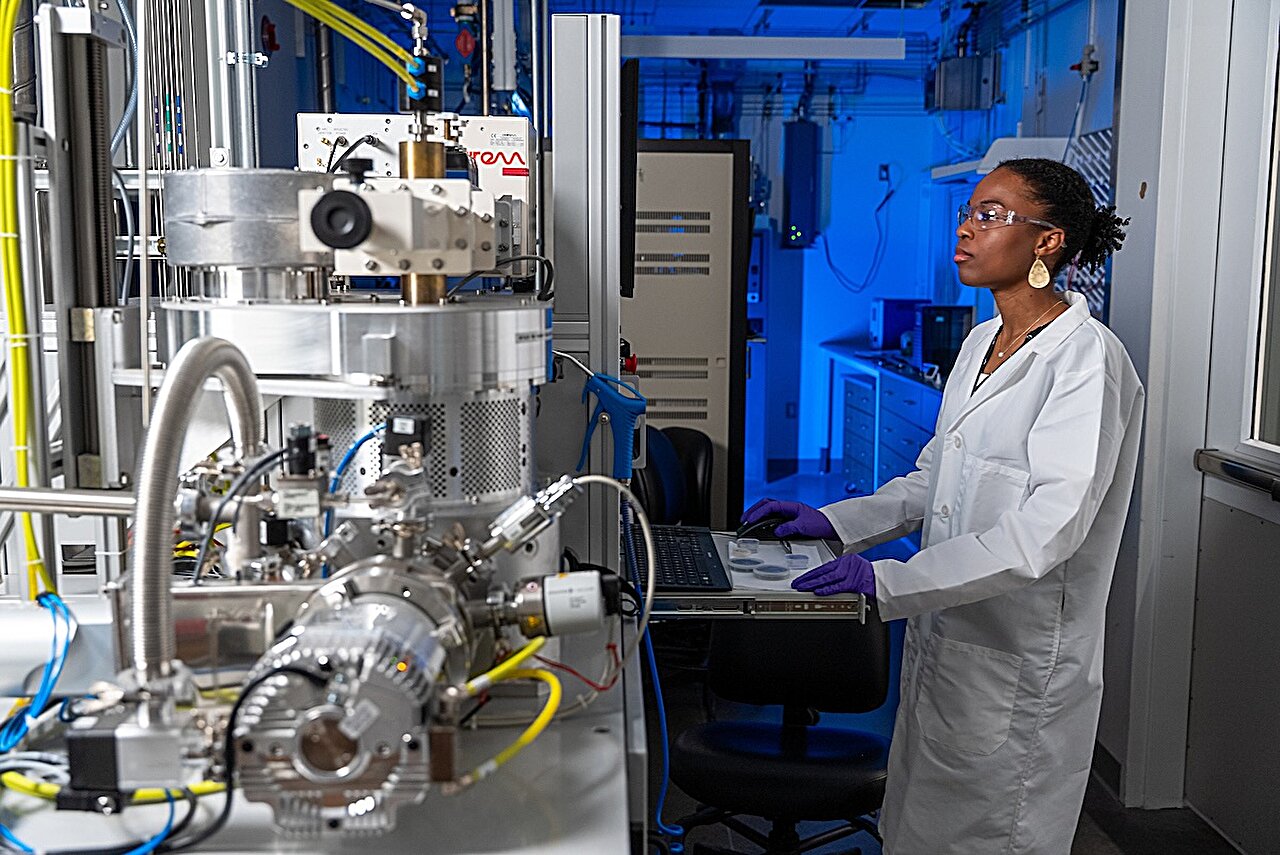
Rice University materials scientists have built an automated way to measure microscopic defects in diamond and related semiconductor materials, the university said. The work could help researchers and manufacturers assess materials used in high-power electronics, communications hardware and quantum devices more quickly.
The method centers on a custom Python software tool that analyzes high-resolution X-ray diffraction data, according to Rice. That technique uses X-rays to examine the internal crystal structure of a material, and the new workflow reads diffraction patterns to identify dislocations and other irregularities in the atomic lattice.
The study was published in Advanced Materials. Rice said the tool calculates dislocation density, a measure of defects that can affect how well a semiconductor performs.
Xiang Zhang, an assistant research professor of materials science and nanoengineering at Rice and a corresponding author of the study, said dislocations can interfere with the movement of charge and heat through a material. According to Zhang, those effects can influence device efficiency, reliability and the difficulty of producing devices at scale.
The researchers designed the framework for diamond and other wide-bandgap semiconductors, Rice said. Those materials can withstand higher heat and electrical stress than silicon, making them candidates for electric vehicle power systems, grid equipment, advanced communications systems and quantum technologies.
Diamond is a major target for that work because synthetic diamond production has improved, according to Rice. Tia Gray, the study’s first author and a Rice doctoral alumna now working as a National Research Council postdoctoral associate at the U.S. Naval Research Laboratory, said diamond is being considered for future high-power electronics, radio-frequency communications and quantum technologies because it can endure heat and strong electrical conditions better than many conventional semiconductors.
Gray said diamond’s usefulness depends heavily on crystal quality. Rice said that quality has been hard to measure because some existing approaches are slow, difficult to scale or reliant on manual analysis.
According to the university, X-ray-based methods are already common for other semiconductor materials, but applying similar analysis to diamond has been harder. Rice attributed that difficulty to diamond’s crystal structure and the way defects behave in the material.
To test the workflow, the researchers examined four commercially available grades of single-crystal diamond that were expected to have different levels of crystal quality, Rice said. The automated analysis separated the materials clearly, with electronic-grade diamond showing the lowest defect density and the most uniform crystal quality.
Heteroepitaxial diamond, which Rice described as diamond grown on a nondiamond substrate, showed the highest defect density and the most structural disorder. The university said validation with different techniques produced consistent trends, supporting the method’s reliability.
The team also used the workflow on gallium nitride, Rice said. Gallium nitride is another advanced semiconductor used in power electronics and radio-frequency devices, and the test showed the approach can be adapted to different crystal structures and growth methods.
Rice said the researchers plan to refine the method and broaden the range of materials and defect types it can analyze. Pulickel Ajayan, Rice’s Benjamin M. and Mary Greenwood Anderson Professor of Engineering and a co-corresponding author, said faster and more reproducible defect evaluation could support improvements in diamond materials for next-generation electronic and quantum devices.
This story draws on original reporting from Phys.org.