
Cosmic memory theory links information to dark matter and black holes
Researchers propose that spacetime stores quantum traces of events, a framework they say could help explain several open problems in physics.
By Lucas Ferreira · Science & Environment Writer
3 min read
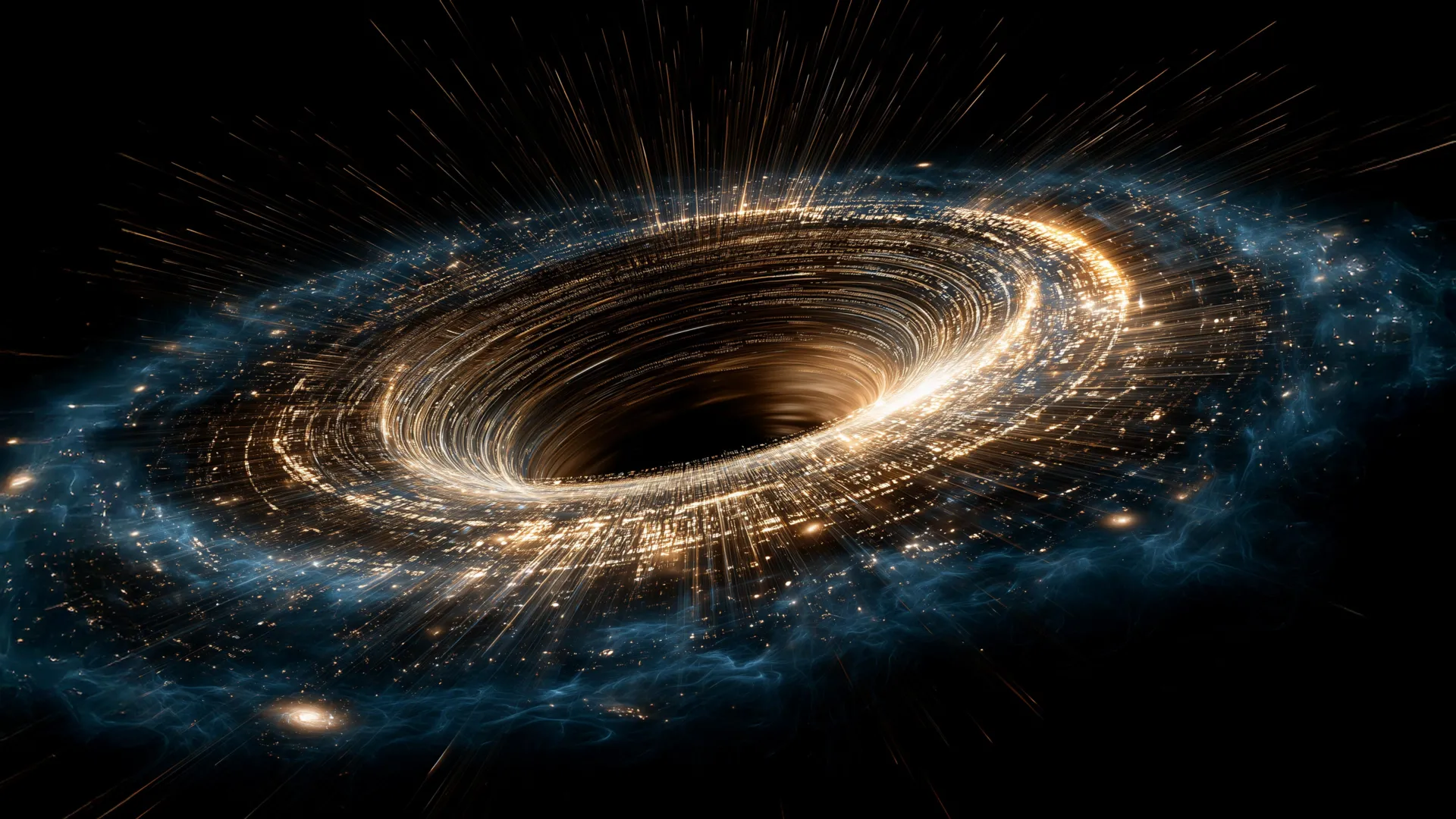
A proposed physics framework treats information as a basic ingredient of the universe and says spacetime may store quantum records of events. If supported by further evidence, the idea could offer new approaches to black holes, dark matter, dark energy and the long-term fate of the cosmos.
Florian Neukart, an assistant professor of physics at Leiden University, described the framework in The Conversation. Neukart said he and colleagues call it the quantum memory matrix, or QMM, and have explored it across several papers, including work published in Entropy and other studies that are under peer review.
The proposal starts from a long-running problem in physics: general relativity and quantum mechanics each work well in their own domains, yet clash in extreme settings. Neukart said those tensions appear in questions involving black holes, the early universe and the unseen components that dominate cosmological models.
Spacetime as a record
According to Neukart, QMM assumes spacetime is made of discrete cells rather than a smooth continuum. In the model, each cell can register a quantum trace when a particle passes through or when a force acts locally.
The researchers describe that process through an “imprint operator,” a reversible mathematical rule meant to preserve information. Neukart said the team first applied the idea to gravity, then extended the same general picture to nuclear forces and, in a paper still being reviewed, to electromagnetism.
The framework is aimed in part at the black hole information paradox. Relativity suggests material crossing a black hole’s boundary is lost from the outside universe, while quantum theory requires information to be conserved, according to Neukart.
QMM offers a possible resolution by placing the record outside the vanished matter itself. Neukart said the surrounding spacetime cells would carry imprints of infalling material, so information would remain encoded even as a black hole later evaporates.
Dark matter, dark energy and cosmic cycles
Neukart said the work led the researchers to a broader idea they call geometry-information duality. In that view, spacetime’s shape depends not only on mass and energy, as in Einstein’s theory, but also on the distribution of quantum information, including entanglement.
In one study that Neukart said is under peer review, clusters of spacetime imprints behaved in calculations like dark matter. The model produced gravitational clustering and galaxy motion effects without adding a new type of particle, according to his account.
Another study, published in the journal Physics, links the framework to dark energy. Neukart said that when spacetime cells become saturated and cannot store new independent information, they contribute residual spacetime energy with the same mathematical form as the cosmological constant used to describe accelerated cosmic expansion.
The team has also applied the idea to the universe’s history. Neukart said a paper accepted by The Journal of Cosmology and Astroparticle Physics points to a cyclic cosmos, in which expansion and contraction repeat until spacetime’s information capacity is filled.
Using observational comparisons, the researchers estimate that the universe has passed through three or four such cycles and has fewer than 10 left, Neukart said. In that model, the cosmos has an “informational age” of about 62 billion years, compared with the 13.8 billion years usually assigned to the current expansion phase.
Early quantum-computer tests
Neukart said parts of QMM have been tested on current quantum computers by treating qubits as stand-ins for spacetime cells. Using imprint and retrieval procedures based on the framework, the team recovered original quantum states with more than 90% accuracy, he said.
The researchers also reported that combining imprinting with standard error-correction methods reduced logical errors. Neukart said that result suggests the framework could have practical uses in quantum computing, even as its larger cosmological claims remain to be tested.
This story draws on original reporting from ScienceDaily.