
Cold-atom experiment measures time from within a quantum system
A University of Birmingham physicist used ultracold atoms to test whether time can arise from internal changes rather than an external clock.
By Lucas Ferreira · Science & Environment Writer
3 min read
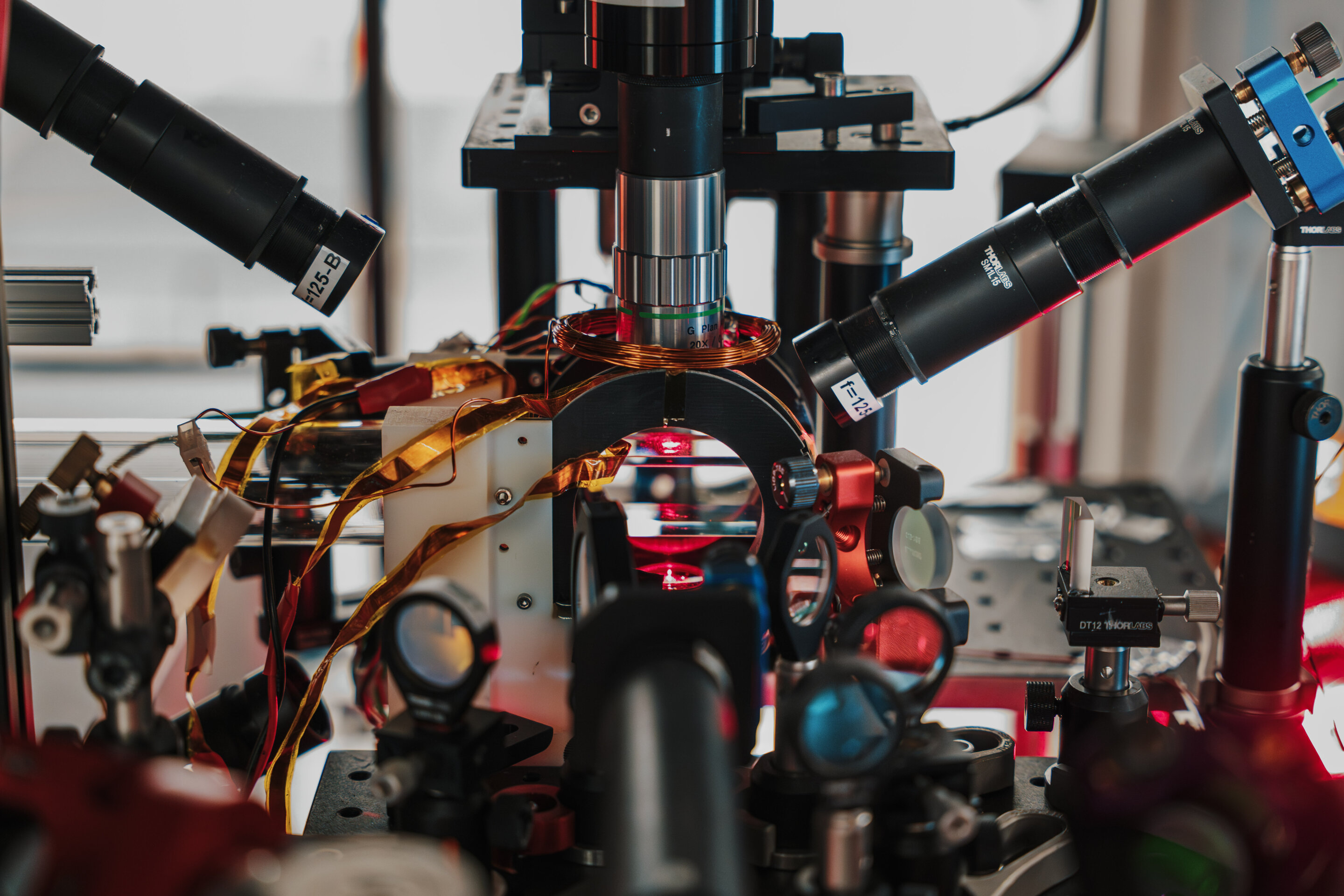
University of Birmingham physicist Giovanni Barontini has reported a cold-atom experiment that measures a form of time without relying on a laboratory clock. The work, published in Physical Review Research, matters because it gives researchers a controlled way to test ideas about time that usually belong to quantum cosmology and gravity.
According to the University of Birmingham, Barontini built what the university described as a “mini-universe” using 24,000 ultracold atoms. The atoms were cooled to a few billionths of a degree above absolute zero and held in an isolated quantum system.
The experiment addresses a problem raised by theories such as the Wheeler-DeWitt equation, the university said. In that view, the universe has no external clock and can be treated as a single quantum state, so any sense of before and after must come from relationships inside the system.
How the experiment was set up
Barontini used two laser beams with different frequencies to create a thin barrier inside the atomic cloud, according to the University of Birmingham. That divided the system into an observed “bright” region and an unobserved “dark” region.
The university said the bright region repeatedly expanded and contracted, creating a laboratory analogue of expansion and collapse. In the experiment, researchers could reconstruct the order of events from changes inside the system rather than from a clock outside it.
Atoms were able to move between the bright and dark regions while the overall system remained sealed off from the outside, according to the university. Barontini’s paper reports that the relevant measure of time came from how the spread, or entropy, of atoms changed within the bright sector.
Entropic time
Barontini called the effect “entropic time,” according to the University of Birmingham. When the distribution of atoms in the bright region changed as atoms moved in or out, the system registered forward motion in this internal time; when the distribution did not change, that internal time stopped.
The university said the experiment showed three features of this form of time:
- It moved in a single direction, giving the system an arrow of time.
- It placed events in the correct order even as the bright region expanded and contracted.
- It changed pace depending on how entropy shifted through the system.
Barontini said in the university statement that some theories, especially in quantum gravity, do not treat time as a built-in feature, even though daily experience runs from past to future. He said the study provides controlled experimental evidence that time can be defined through changes within a system rather than by an external ticking clock.
According to the university, the study also showed that a version of the Schrödinger equation can be written using entropic time. That means researchers can still make predictions about how a quantum system’s probability cloud changes.
The University of Birmingham said the approach creates a test bed for ideas about quantum cosmology and gravity. The university said future extensions could involve more complex systems, laboratory studies linked to Big Bang and Big Crunch physics, simulations of black holes, or tests of competing explanations for how time emerges.
This story draws on original reporting from Phys.org.