
Bumblebee mouth movements may reveal inner states, study finds
Researchers say bumblebees' tongue-like movements after tasting sugar or salt may offer clues about their physiological state.
By Priya Raghavan · Science Reporter
3 min read
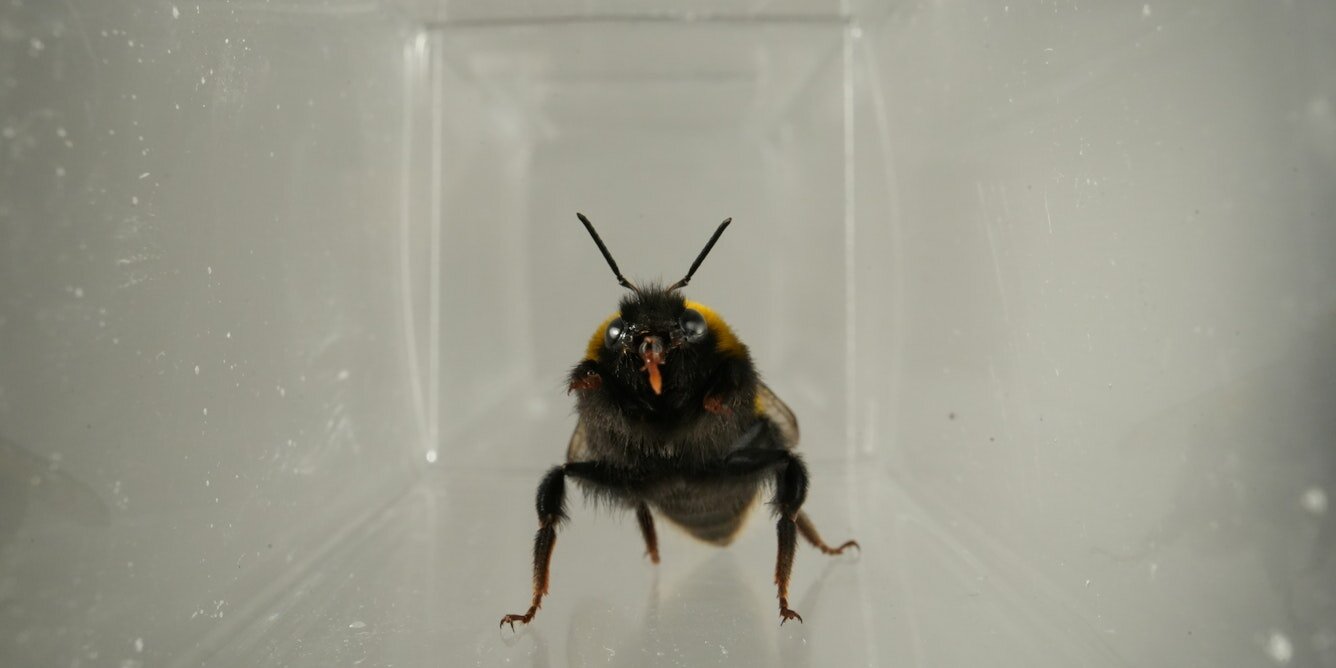
Bumblebees may show taste-related mouth movements that reflect more than automatic reactions, according to research published in the Proceedings of the National Academy of Sciences. The findings add evidence to a growing debate over whether insects have subjective internal states, researcher Andrew Barron wrote in The Conversation.
The study, carried out by Barron and colleagues at Southern Medical University in Guangzhou, China, examined how bumblebees used their glossa, a long tongue-like mouthpart, after sampling different liquids. The researchers reported that the bees reacted differently to sugar water and dilute salty water, and that those reactions changed when the bees' physical condition or neurochemistry changed.
How the bees responded to taste
In one experiment, researchers offered individual bumblebees tiny drops of sugar water from a pipette. Barron wrote that a bee extended its glossa to drink, then continued moving it in and out after the droplet was gone.
When offered a dilute salty solution, the bees sampled it, then moved away while shaking their heads and wiping the glossa, according to Barron. The contrast suggested that the insects' mouth movements might be readable in a way broadly comparable to taste-linked expressions in mammals, though the study did not conclude that bees feel emotions as humans do.
Barron placed the work in a longer scientific tradition, noting that Charles Darwin discussed animal expressions and emotion in the 19th century. He also cited research by psychologist and neuroscientist Kent Berridge and colleagues showing similar taste responses in newborn humans and young rats when given sweet or bitter substances.
Researchers tested other explanations
The team then asked whether the bee responses were fixed chemical reactions to sugar and salt. To test that, researchers briefly warmed bees to 40°C, or 104°F, which Barron said did not harm them but left them dehydrated in a way comparable to activity on a hot day.
After that treatment, bees given dilute salty water drank it and showed the glossa movements they had previously shown after sugar, according to the study account. Barron wrote that this result indicated the response depended on the bee's physiological state, rather than only on the chemistry of the liquid.
The researchers also changed bee neurochemistry. Barron wrote that bees treated with octopamine and dopamine became more responsive to sugar but did not show the same post-drinking glossa protrusions after sucrose.
Bees treated with an endocannabinoid showed stronger post-drinking glossa protrusions, while not becoming more reactive to sugar, according to Barron. He said that pattern suggested the glossa movement was separate from a basic sugar response and could be altered by specific neurochemical changes.
The study does not prove that bees experience liking or disliking as emotions, Barron wrote. He said it supports the narrower conclusion that the insects' mouth movements gave researchers a way to infer an internal physiological state.
Barron argued that the work may help researchers study insect inner life more directly. The paper was published July 7 in Proceedings of the National Academy of Sciences.
This story draws on original reporting from Phys.org.