
Seasonal plankton bloom paints the Black Sea turquoise from orbit
NASA imagery shows a spring-summer coccolithophore bloom brightening the Black Sea and tracing currents through the Bosphorus.
By Priya Raghavan · Science Reporter
3 min read
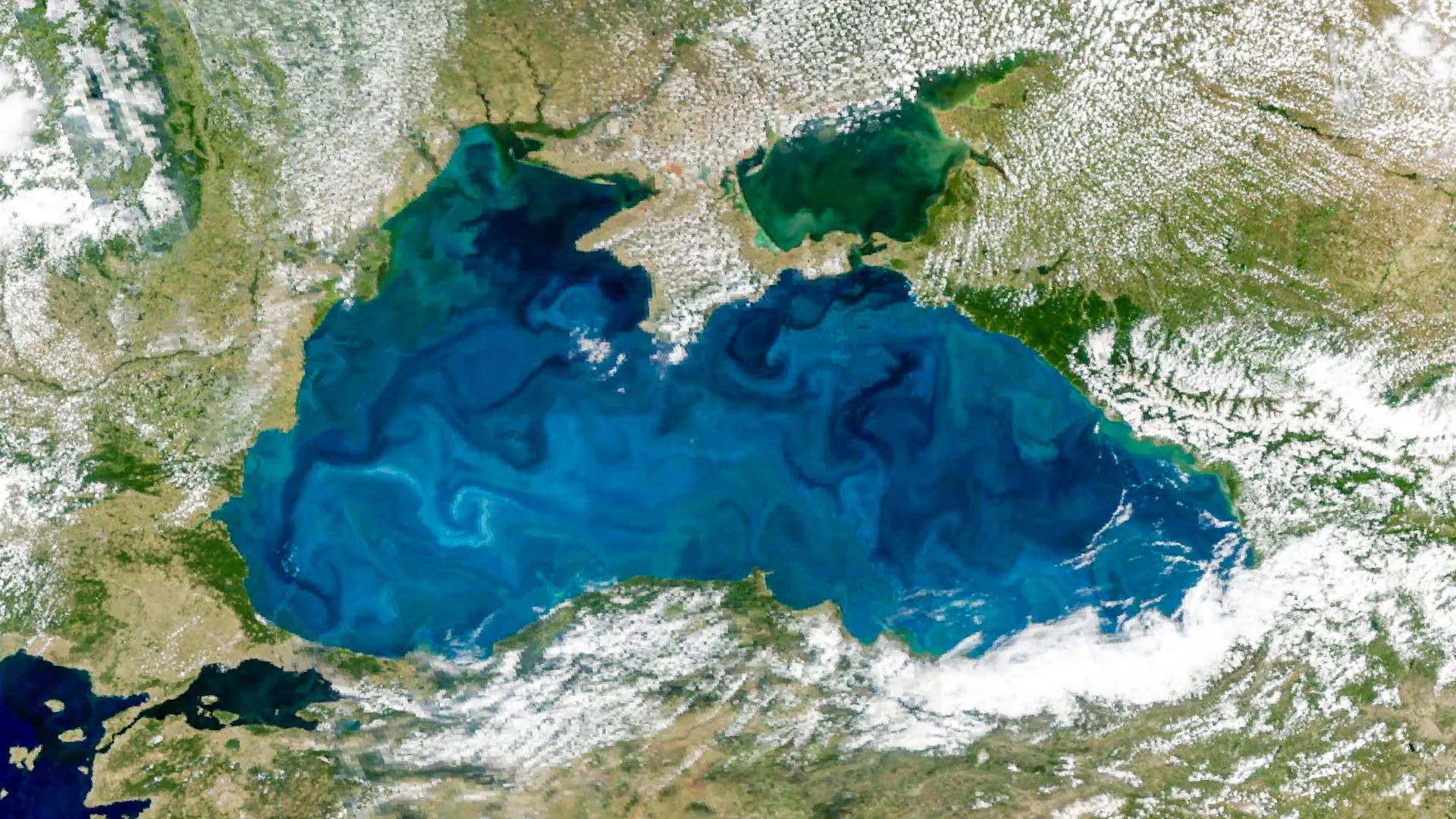
NASA’s PACE satellite recorded wide areas of the Black Sea glowing turquoise on June 22, a seasonal color shift driven by microscopic marine life. NASA Earth Observatory said the image shows how a bloom of phytoplankton can become large enough to change the appearance of a sea from orbit.
The Black Sea sits between Europe and Asia and connects to the Mediterranean through a chain of waterways. Although it is known for dark waters, NASA Earth Observatory said parts of the sea often brighten in spring and summer when certain plankton populations grow quickly.
The June 22 view came from the Ocean Color Instrument aboard PACE, short for Plankton, Aerosol, Cloud, ocean Ecosystem. NASA Earth Observatory said the instrument captured the milky blue-green tint across the sea during the seasonal bloom.
What caused the color
Scientists cited by NASA Earth Observatory link the turquoise water to coccolithophores, a type of phytoplankton covered with plates made of calcium carbonate. When these organisms multiply in large numbers in late spring and early summer, their bright shells scatter sunlight and make the surface water appear pale blue.
NASA Earth Observatory said that effect can be strong enough for satellites to detect. Individual coccolithophores cannot be seen by eye, but dense blooms can alter the color of large ocean areas.
Other kinds of algae can change the Black Sea’s appearance in different seasons. NASA Earth Observatory said diatoms, which have silica shells, tend to make the water look darker rather than brighter when they become more abundant.
Bloom reached the Bosphorus
The bloom also showed up in the Bosphorus, the narrow strait through Istanbul that links the Black Sea with the Sea of Marmara, according to NASA Earth Observatory. An astronaut on the International Space Station photographed the waterway on May 27, nearly a month before PACE collected its broader view.
NASA Earth Observatory said the astronaut image showed phytoplankton marking swirling currents on both sides of the channel. The agency noted that the photograph was taken by a member of the Expedition 74 crew with a Nikon Z9 camera using a 50 millimeter focal length.
The astronaut photograph, identified by NASA as ISS074-E-619520, was cropped, contrast-enhanced and corrected for lens artifacts, according to NASA Earth Observatory. The image came through the ISS Crew Earth Observations Facility and the Earth Science and Remote Sensing Unit at NASA Johnson Space Center.
Why scientists watch blooms from space
NASA Earth Observatory said satellite views offer scientists a practical way to track marine ecosystems, especially in places where collecting water samples can be difficult. The agency produced the Black Sea satellite image using PACE data from NASA EOSDIS LANCE, GIBS/Worldview and the NASA Ocean Biology Distributed Active Archive Center.
Coccolithophores also have a role in Earth’s carbon cycle, according to NASA Earth Observatory. As they grow, they take up carbon from the atmosphere and surrounding water; after they die, some of that carbon sinks to the seafloor and can remain stored for long periods.
NASA Earth Observatory said astronauts regularly photograph Earth through the International Space Station Program and the ISS National Lab. Those images are used to support scientific research and are made available to researchers and the public.
This story draws on original reporting from ScienceDaily.