
Axolotl skin scaffold speeds burn healing in mice, study finds
Taiwan researchers report that a cell-free material made from axolotl skin helped mouse burn wounds close faster with fewer scarring signals.
By Lucas Ferreira · Science & Environment Writer
3 min read
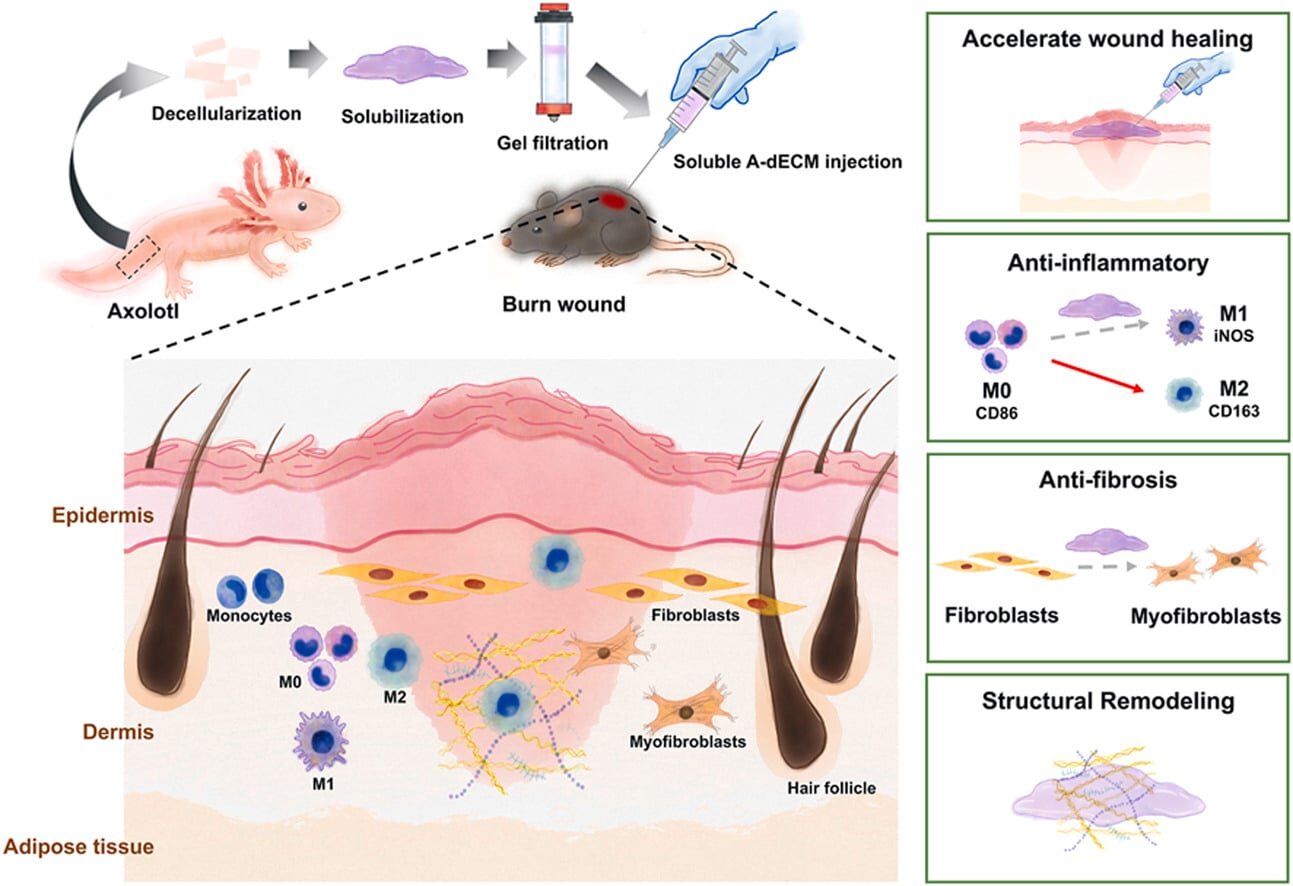
Researchers in Taiwan have made a wound-healing material from axolotl skin that helped mouse burn injuries close faster and showed signs of less fibrotic scarring, National Taiwan University said. The work points to a possible biomaterial strategy for hard-to-heal wounds, though the university said it has not been tested as a human treatment.
The study, published in Materials Today Bio, used axolotls as a model because the salamanders can repair severe injuries with little or no scarring, according to National Taiwan University. Rather than moving living axolotl cells into wounds, the team removed cells from the animals’ skin and kept the extracellular matrix, the biological framework that surrounds cells.
That framework can carry physical and chemical cues that affect how cells move, grow and rebuild tissue, the university said. The researchers designed the material as a scaffold that could influence mammalian wound repair without relying on transplanted living cells.
Testing a cell-free scaffold
According to National Taiwan University, the team first checked that the decellularization process had removed most cellular material while preserving key structural parts of axolotl skin. The researchers also separated out portions of the material that appeared less helpful for skin cell growth.
After that refinement, the axolotl-derived material supported human skin cells in laboratory tests, the university said. The team then applied the material in a mouse model of burn wounds and compared the results with saline-treated wounds and wounds treated with mouse-derived material.
In those mouse experiments, National Taiwan University said the axolotl-based scaffold was linked to quicker wound closure and improved rebuilding of the outer skin layer. At later stages, treated wounds had more orderly collagen and skin structure, according to the university’s summary of the study.
Lower inflammation and scarring markers
The reported effects went beyond wound coverage. National Taiwan University said the material reduced signals tied to inflammation and fibrosis, including markers associated with scar-forming cells.
The study also found lower pro-inflammatory immune activity and more signals associated with repair-supporting immune responses, according to the university. The researchers interpreted those changes as evidence that the scaffold helped shape the wound environment, rather than acting only as a filler.
Scarring remains a common problem after burns, surgery, trauma and chronic wounds, National Taiwan University said. In adult mammals, injury often brings inflammation, activation of scar-producing cells and disorganized collagen deposition, which can close tissue but leave it stiffer and less like normal skin.
The university cautioned that the findings remain early. The work so far involved cells and mice, and researchers still need to study long-term safety, dosing, production at scale and whether similar results can occur in human wounds.
Nai-Chen Cheng, co-corresponding author and chief and professor of plastic surgery at National Taiwan University, said the team hopes that lessons from an animal that avoids scarring can help guide human wounds toward more complete repair.
This story draws on original reporting from Phys.org.