
Autonomous lab finds catalysts that can shift chemical outputs
Flex-Cat used robotics and AI to run 680 experiments and identify catalysts that can favor different aldehyde products under changed conditions.
By Priya Raghavan · Science Reporter
3 min read
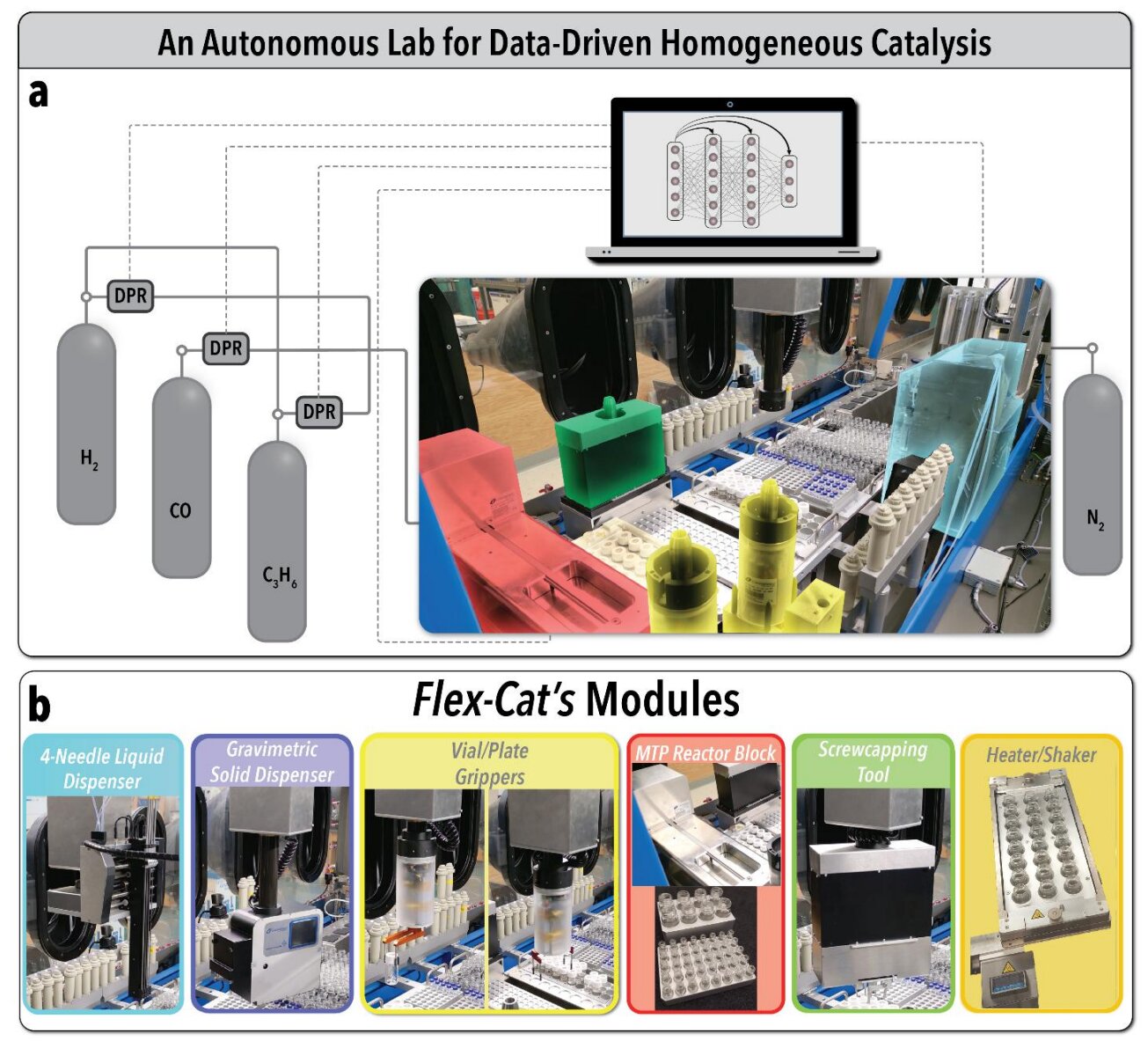
A self-driving chemistry platform has identified catalyst systems that can be adjusted to favor different chemical products, according to researchers at North Carolina State University. The work could speed the search for catalysts used in making chemicals for plastics, medicines, fuels and other industrial products.
The platform, called Flex-Cat, is described in a peer-reviewed paper in Nature Communications. The system combines robotic catalyst preparation, high-pressure reactors, automated product analysis and artificial intelligence to choose experiments, test them and use the results to select the next round.
Milad Abolhasani, a chemical and biomolecular engineering professor at NC State and a co-corresponding author of the study, said catalyst discovery requires more than finding a promising material. Temperature, pressure and concentration also affect whether a catalyst works efficiently and steers a reaction toward the desired product, creating a large set of possible experiments.
Testing an industrial reaction
The research team used Flex-Cat to study hydroformylation, a reaction used to turn simple feedstocks into aldehydes. Those compounds are building blocks for products including plastics, surfactants and solvents, according to the study.
A central problem in hydroformylation is selectivity. The reaction can produce aldehyde isomers, which have the same atoms arranged in different ways and can have different uses. The researchers said chemists often need to favor one isomer over another by matching catalyst structure with reaction conditions.
In the study, Flex-Cat ran 680 experiments involving 16 chemically varied phosphorus-based ligands. Those ligands were used to adjust the behavior of a rhodium catalyst in the reaction, according to the paper.
The autonomous work was split into three optimization campaigns. One sought conditions favoring a branched aldehyde product, another targeted a linear aldehyde product, and a third searched for catalyst systems that could switch product preference when reaction conditions changed.
Activity gains and switchable behavior
The researchers reported that Flex-Cat found catalyst and condition pairings that raised catalyst activity by more than 2.5 times. The system also broadened the range of product selectivity available in the reaction and found ligands that could be directed toward different products under different operating conditions.
Alexander Miller, a chemistry professor at the University of North Carolina at Chapel Hill and co-corresponding author, said the platform helped connect catalyst structure and reaction conditions to selectivity. That kind of information can guide the design of future catalysts, according to the research team.
Damon Billodeaux, a group leader and technology manager at Eastman, said the work addresses questions relevant to industrial catalysis. He said rapid identification of catalyst systems that perform well and can be adjusted could support more efficient and flexible chemical manufacturing.
The team also analyzed the dataset generated by Flex-Cat to identify design patterns. According to the paper, ligand structure affected both selectivity and how readily catalyst behavior could be changed by conditions.
Abolhasani said the broader value of the platform is its ability to map complex catalyst systems and quickly identify useful regions for chemical process development. The study, “An autonomous lab for data-driven homogeneous catalysis,” was authored by J. A. Bennett and colleagues and published in Nature Communications.
This story draws on original reporting from Phys.org.