
Astronomers confirm two ultra-light planets orbiting distant star
The Jupiter-sized worlds orbit TOI-791 and rank among the rare super-puff planets with densities lower than cotton candy.
By Lucas Ferreira · Science & Environment Writer
4 min read
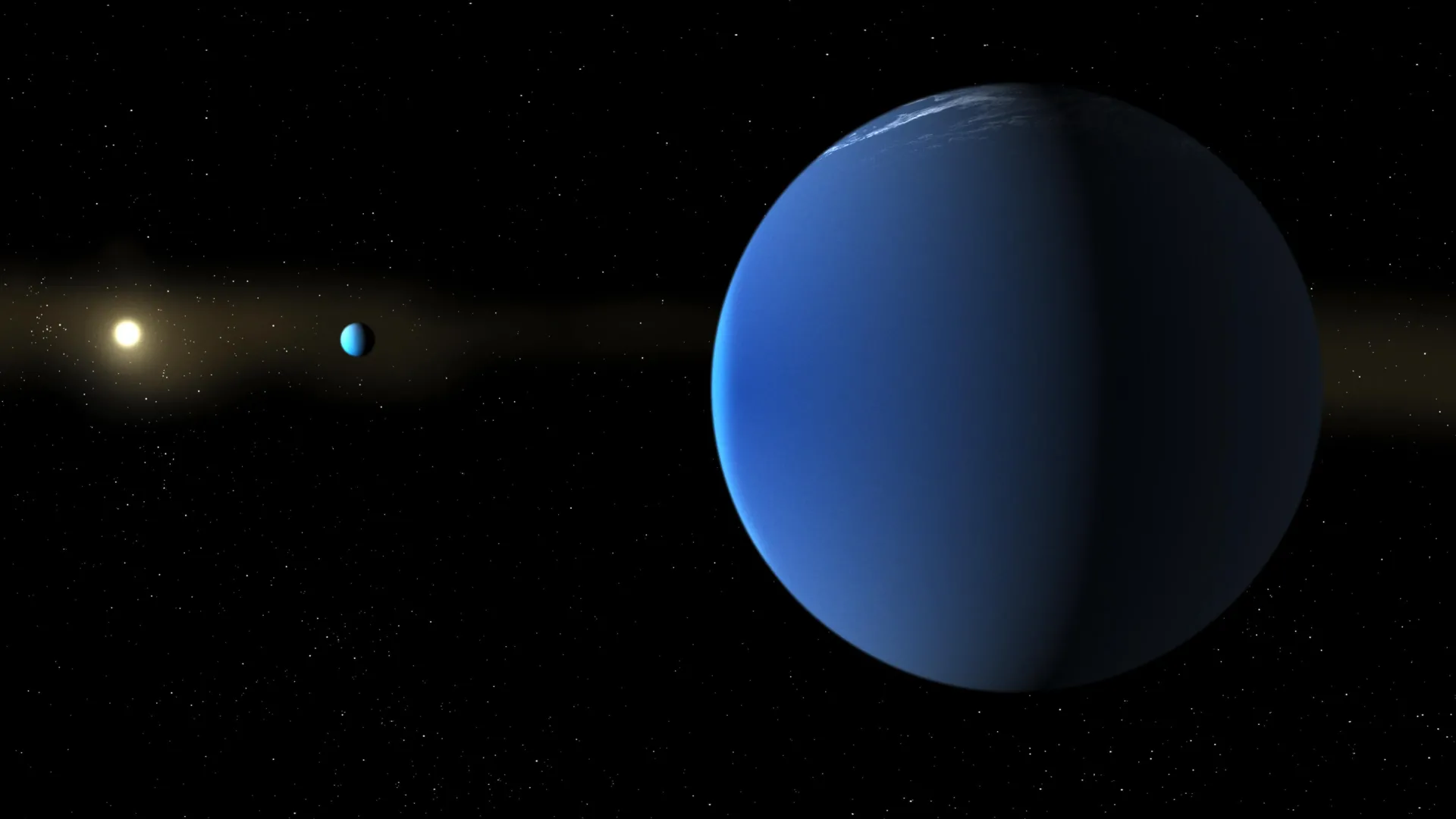
Astronomers have confirmed two unusually low-density planets orbiting a star about 1,110 light years from Earth, according to the University of Oxford. The findings matter because such “super-puff” worlds are rare, and finding two in the same system gives researchers a clearer test case for how oversized, lightweight planets form.
The planets, named TOI-791 b and TOI-791 c, circle an F7-type dwarf star in the southern constellation Volans. An international team led by the University of Oxford, with researchers from Université Côte d’Azur/Observatoire de la Côte d’Azur and the University of Birmingham, reported the results in Monthly Notices of the Royal Astronomical Society.
Both planets are roughly as large as Jupiter, according to the Oxford announcement, but carry far less mass for their size. TOI-791 b has a density of 0.038 grams per cubic centimeter, while TOI-791 c has a density of 0.047 grams per cubic centimeter.
For comparison, the researchers said Jupiter’s average density is 1.33 grams per cubic centimeter, making it about 28 to 35 times denser than the two newly confirmed worlds. Cotton candy has a typical density of about 0.05 grams per cubic centimeter, and Earth averages 5.5 grams per cubic centimeter.
A rare orbital pairing
The researchers think the two planets formed from the same young disc of gas and dust around their star, according to Oxford. They also occupy an uncommon orbital pattern known as a 5:3 mean-motion resonance: the inner planet makes five trips around the star in nearly the same time the outer planet makes three.
That arrangement lets the planets tug on each other as they orbit. The team measured small shifts in the timing of their transits, the moments when the planets pass in front of the star and slightly dim its light.
Oxford said only four other known planetary systems contain more than one super-puff planet. Dr. George Dransfield of the University of Oxford’s Department of Physics, lead author of the study, said the pair’s low densities make the system valuable for studying planet formation and evolution.
Citizen scientists and Antarctic observations
Volunteers with the Planet Hunters TESS citizen-science project first identified TOI-791 b as a possible planet in 2019 and TOI-791 c in 2023, according to the researchers. The project reviews observations from NASA’s Transiting Exoplanet Survey Satellite, known as TESS, to look for signs of planets.
The team then combined observations from telescopes around the world to work out the planets’ sizes and masses. A transit shows a planet’s size through the amount of starlight it blocks, while the timing variations caused by planetary gravity helped the researchers estimate mass.
The confirmation drew on eight years of data, including observations from the ASTEP telescope at Concordia Station in Antarctica. The telescope is operated jointly by Université Côte d’Azur/Observatoire de la Côte d’Azur researchers and international partners.
Antarctica’s long winter darkness helped astronomers follow the planets’ long transits without interruption, according to the research team. Each transit lasted more than 11 hours, and the researchers said they were the longest continuous planetary transits ever fully observed from the ground.
Why the planets may be so puffy
Scientists are still testing explanations for super-puff planets. One leading idea, according to the Oxford announcement, is that they have large hydrogen- and helium-rich atmospheres that make up a substantial share of their total mass.
Researchers think those atmospheres may have built up when the planets were farther from their star, in colder parts of the protoplanetary disc where gas could gather quickly around a solid core. Future observations are planned to test that and other formation models.
Professor Amaury Triaud of the University of Birmingham, UK principal investigator of ASTEP and a co-author of the study, said the team plans to seek space-based observations with the James Webb Space Telescope. According to Triaud, those observations could look for carbon-, nitrogen- and oxygen-bearing molecules in the planets’ extended atmospheres.
Professor Tristan Guillot of Université Côte d’Azur, ASTEP principal investigator and a study co-author, said the discovery depended on combining space-based data, Antarctic observations and telescope measurements from several continents.
This story draws on original reporting from ScienceDaily.