
Asteroid impacts may have helped make early Earth habitable
Southwest Research Institute models suggest ancient impacts fractured Earth’s crust, creating hot-water systems that could have supported prebiotic chemistry.
By Priya Raghavan · Science Reporter
3 min read
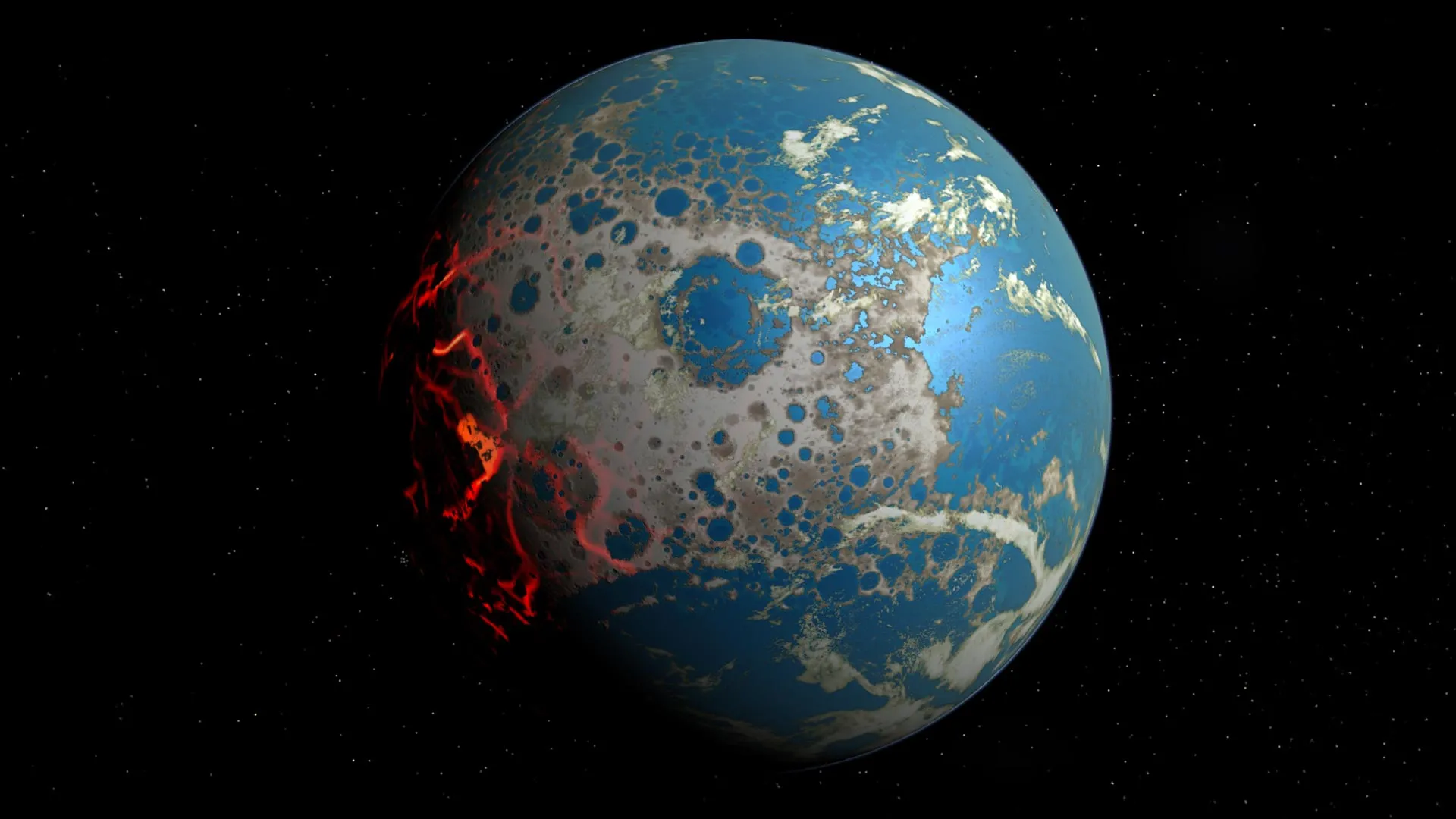
Ancient asteroid strikes may have helped prepare early Earth for life by opening pathways for hot water beneath the surface, according to new research from Southwest Research Institute. The finding matters because hydrothermal systems are considered possible settings for the chemistry that preceded biology.
The study, published in AGU Advances, used computer models to estimate how repeated impacts changed the young planet’s crust. Southwest Research Institute said the simulations show collisions broke large volumes of rock, making the upper crust more permeable and allowing water to move through heated underground zones.
Earth formed about 4.5 billion years ago and then went through a period of heavy asteroid bombardment, according to the institute. Those impacts blasted, melted and fractured surface and subsurface rock, while heat from the collisions and Earth’s interior could have driven circulating hydrothermal fluids.
Models link impacts to hot-water systems
Lead author Amanda Alexander of Southwest Research Institute said the modeling offers a new way to study the earliest environments where life may have arisen. She said asteroid bombardment is often discussed for its destructive role, such as in the dinosaur extinction, but it may also have created places where prebiotic chemistry could occur.
The research team modeled impacts across a range of asteroid sizes and speeds, along with different crust compositions and temperature conditions, according to Southwest Research Institute. The work used shock physics simulations to examine how fast-moving impacts fracture rock and create connected spaces through which fluids can travel.
The institute described the study as the first comprehensive effort to measure impact-generated permeability in early Earth’s crust. Permeability is central to the question because fluids need connected pathways to circulate through rock and form hydrothermal systems.
Southwest Research Institute said the amount of fractured, permeable crust depended mainly on impact energy, which was controlled by asteroid size and speed. The degree of permeability inside those fractured areas was affected by the crust’s composition and the planet’s geothermal gradient, according to the researchers.
Yellowstone comparison
The simulations indicate that one large impact during the bombardment era could have produced as much as 100 times the hydrothermal activity now found in the Yellowstone National Park region, according to Southwest Research Institute. Yellowstone is used as a modern comparison because it contains extensive hot-water and geyser systems.
Alexander said that because life could have originated or developed in hydrothermal environments, researchers need to measure how often and how widely impacts created such systems. She also said more work is needed to define the properties of those ancient hot-water environments.
Using a model of Earth’s bombardment history, the researchers estimated that the upper 5 miles, or 8 kilometers, of Earth’s crust was likely highly permeable about 4.3 billion years ago. They also estimated that a substantial part of that volume may have stayed permeable until about 3.5 billion years ago.
The paper, “Widespread Impact-Induced Crustal Permeability on the Early Earth,” was written by A. M. Alexander, S. Marchi and B. C. Johnson and published in AGU Advances. Southwest Research Institute said the results point to asteroid impacts as a major driver of hydrothermal changes near Earth’s surface, with consequences for the planet’s early geochemical development.
This story draws on original reporting from ScienceDaily.