
Ancient fruit diet linked to manakins’ courtship dances
A genomic study reports that fruit-eating adaptations appeared before manakins evolved their elaborate mating displays.
By Tom Brennan · Health & Medicine Correspondent
3 min read
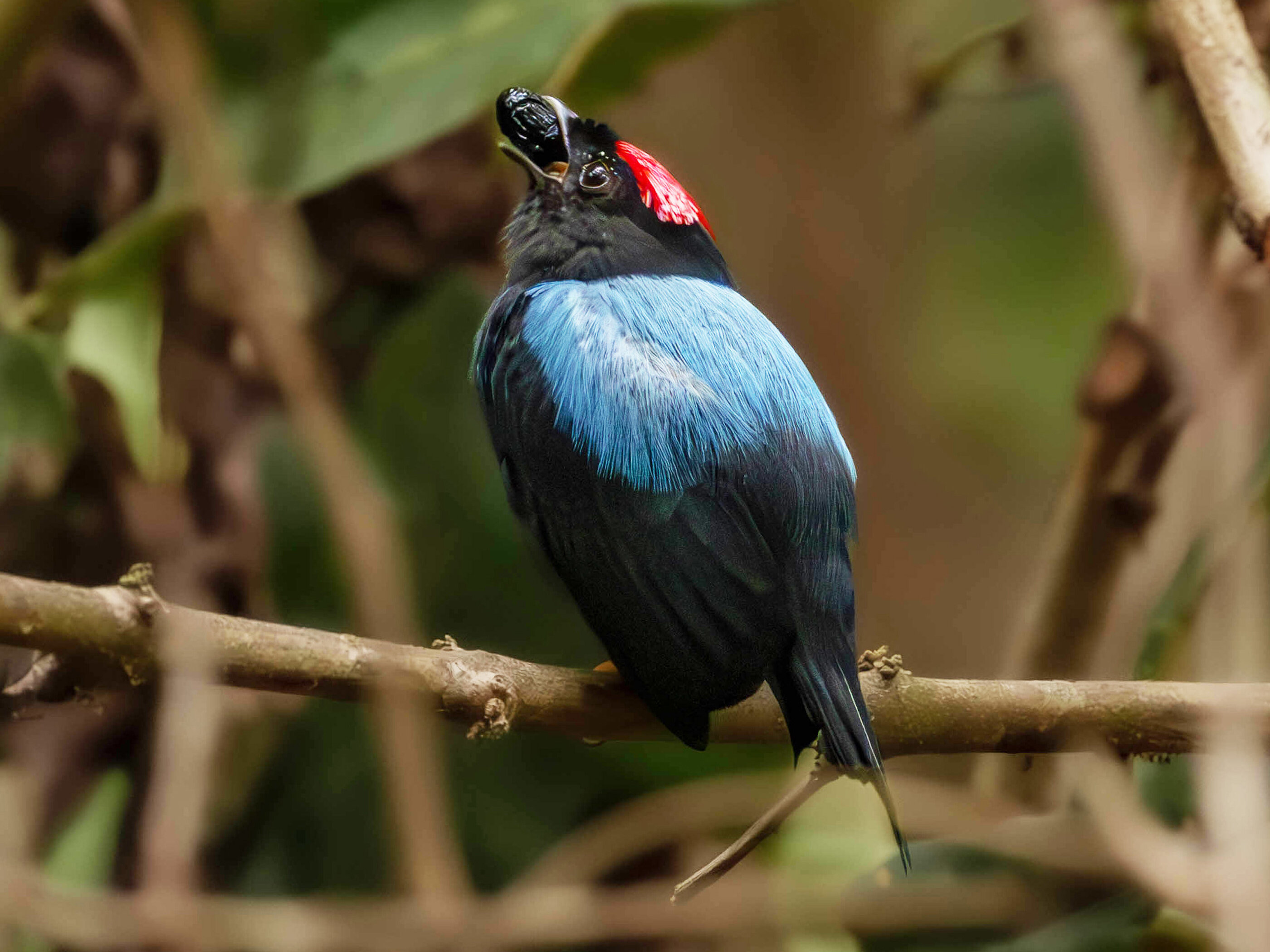
Manakins’ high-speed courtship displays may trace back to a much older shift in what the birds eat, according to a study published in Current Biology. The finding matters because it links one of the animal kingdom’s more elaborate mating systems to earlier changes in taste and digestion.
Researchers led by Chris Balakrishnan of East Carolina University, Yasuka Toda of the Institute of Science Tokyo and Meiji University, and Maude Baldwin of the Max Planck Institute for Biological Intelligence examined lek-mating manakins with an international team of nearly 60 scientists, according to the Max Planck Society.
Male manakins, small tropical birds found in Central and South American rainforests, are known for communal display grounds where they court females. According to the Max Planck Society, males in some species clear display courts, perform rapid acrobatics, snap their wings and join other males in coordinated routines.
The study reports that the birds’ genomes carry signs of strong sexual selection, the evolutionary process in which mate choice favors certain traits across generations. The researchers also found changes tied to fruit taste and fruit digestion, then used family-tree analysis, genome-wide comparisons and laboratory tests to estimate when those traits appeared.
Dietary changes came first
According to the Max Planck Society, the team mapped the traits across more than 1,300 related bird species. That analysis suggested the dietary adaptations arose deep in manakin ancestry before the later evolution of the birds’ elaborate displays and mating behavior.
The sequence is central to the paper’s argument. The researchers report that a fruit-rich diet may have helped support the energy demands of male displays and the breeding system in which females raise young without male help.
Manakin performances are physically demanding, according to the Max Planck Society. In some species, male wing muscles rank among the fastest-contracting known in nature, and a displaying male’s heart rate can climb from rest toward its limit in seconds.
Some males may spend as much as 90% of daylight hours displaying for much of the year, the Max Planck Society said. The study links that energetic behavior to a diet based substantially on fruit.
Sweet taste and digestion
The researchers found that manakins regained the ability to sense sweetness, according to lab tests in cultured cells described by the Max Planck Society. Earlier work by Baldwin and Toda had found that hummingbirds, songbirds and woodpeckers independently re-evolved sweet taste through changes to a savory-taste receptor.
The new study adds manakins to that group, but reports that they altered a different part of the receptor than songbirds did. According to Toda’s team, that means separate bird lineages reached a similar sensory result through different molecular changes.
The study also points to a digestive enzyme: lactase. Although lactase is best known in mammals for breaking down milk sugar, the Max Planck Society said the enzyme can also act on some plant compounds in unripe fruit, producing substances that hinder sugar absorption.
According to the researchers, manakins have lost much of that enzyme’s activity. Meng-Ching Ko of the Max Planck Institute for Biological Intelligence, who led the digestion analysis, said the reduced activity may help the birds handle compounds in unripe fruit and take in more usable energy.
The paper, titled “Genomic and physiological changes in a sexually selected and frugivorous bird radiation,” was published in Current Biology. The Max Planck Society said related recent studies in PNAS, Molecular Ecology and Science Advances have examined manakin plumage, social-behavior brain regions and genes expressed in their fast muscles.
This story draws on original reporting from Phys.org.