
AI tool speeds simulations of heavy elements born in star mergers
GSI/FAIR researchers say RHINE can model nuclear heating in neutron star merger simulations with far less computing effort.
By Tom Brennan · Health & Medicine Correspondent
3 min read
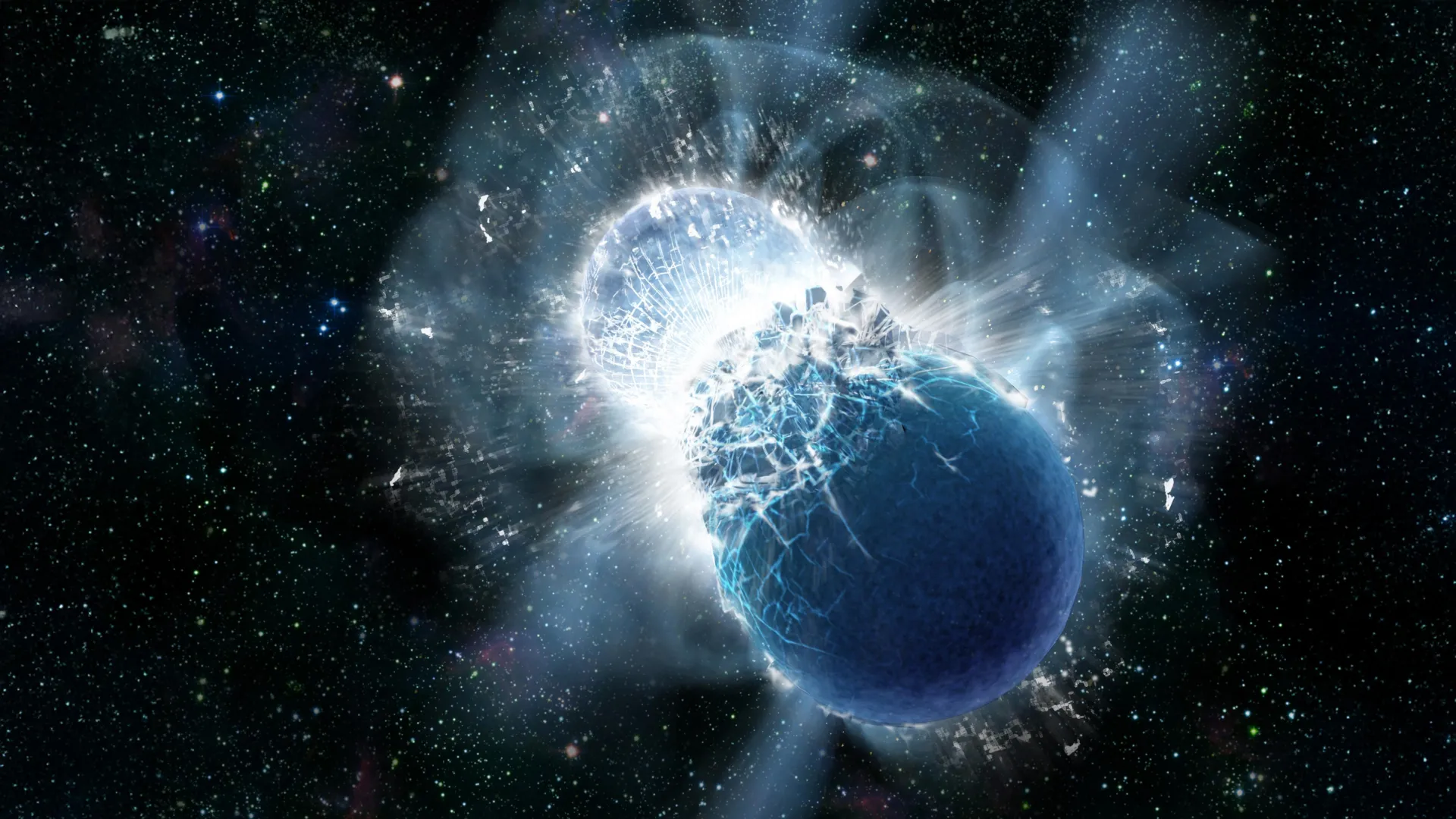
Researchers at GSI/FAIR say they have built an artificial intelligence model that can make simulations of neutron star mergers faster and more detailed. The work matters because those mergers are among the cosmic events thought to produce many of the universe’s heaviest elements.
The model, called RHINE, was developed by an international team and described in Physical Review D, according to GSI Helmholtzzentrum für Schwerionenforschung GmbH. The name stands for r-process heating implementation in hydrodynamic simulations with neural networks.
GSI said the tool uses machine learning to estimate energy released during nuclear reactions while larger hydrodynamic simulations are running. That shortcut is designed to reduce the computing burden that has limited how fully researchers can model these events.
How the model works
According to GSI, many heavy elements form during violent stellar events such as supernovae and neutron star mergers. These events can drive rapid neutron capture, or the r-process, in which atomic nuclei quickly absorb free neutrons.
GSI said some of those neutrons then turn into protons, allowing nuclei to become heavier and helping create many heavy elements found in nature. Modeling that chain of reactions is difficult because a complete treatment requires large nuclear reaction networks and extensive computing power.
Oliver Just, first author of the study and a researcher in GSI/FAIR’s Nuclear Astrophysics & Structure department, said researchers often simplify such models because tracking all parameters demands large computing resources. He said RHINE offers a more efficient alternative by using artificial intelligence.
The system relies on a deep learning neural network, according to GSI. Researchers first trained the machine-learning models on a large set of reference calculations that used complete nuclear reaction networks.
After training, the models were inserted into running hydrodynamic simulations to approximate r-process heating rates, GSI said. Zewei Xiong, a GSI/FAIR scientist and one of the developers of the machine-learning models, said the approach reproduced the reference data closely in detailed comparisons.
Why heating matters
The energy released by r-process reactions affects how matter moves after a stellar explosion, according to GSI. In neutron star mergers, that heating can influence the speed of ejected material and the light that follows.
GSI said the visible glow from a neutron star merger is observed as a kilonova. The researchers concluded from their results that r-process heating should be treated more carefully in future modeling.
The team said RHINE could allow more detailed simulations while requiring less computing time. GSI said that may help researchers compare future experiments at the FAIR facility with astronomical observations of neutron star mergers and other stellar explosions.
The research was conducted by Oliver Just, Zewei Xiong and Gabriel Martínez-Pinedo, according to the journal reference. GSI said the project was co-funded, among others, by the European Research Council.
The RHINE source code has been made publicly available through Zenodo, according to GSI. The study, “r-process heating implementation in hydrodynamic simulations with neural networks,” was published in Physical Review D.
This story draws on original reporting from ScienceDaily.