
Hayabusa 2 images asteroid Torifune during close flyby
JAXA’s extended asteroid mission has returned close-up views of Torifune, confirming the near-Earth asteroid is a contact binary.
By Lucas Ferreira · Science & Environment Writer
3 min read
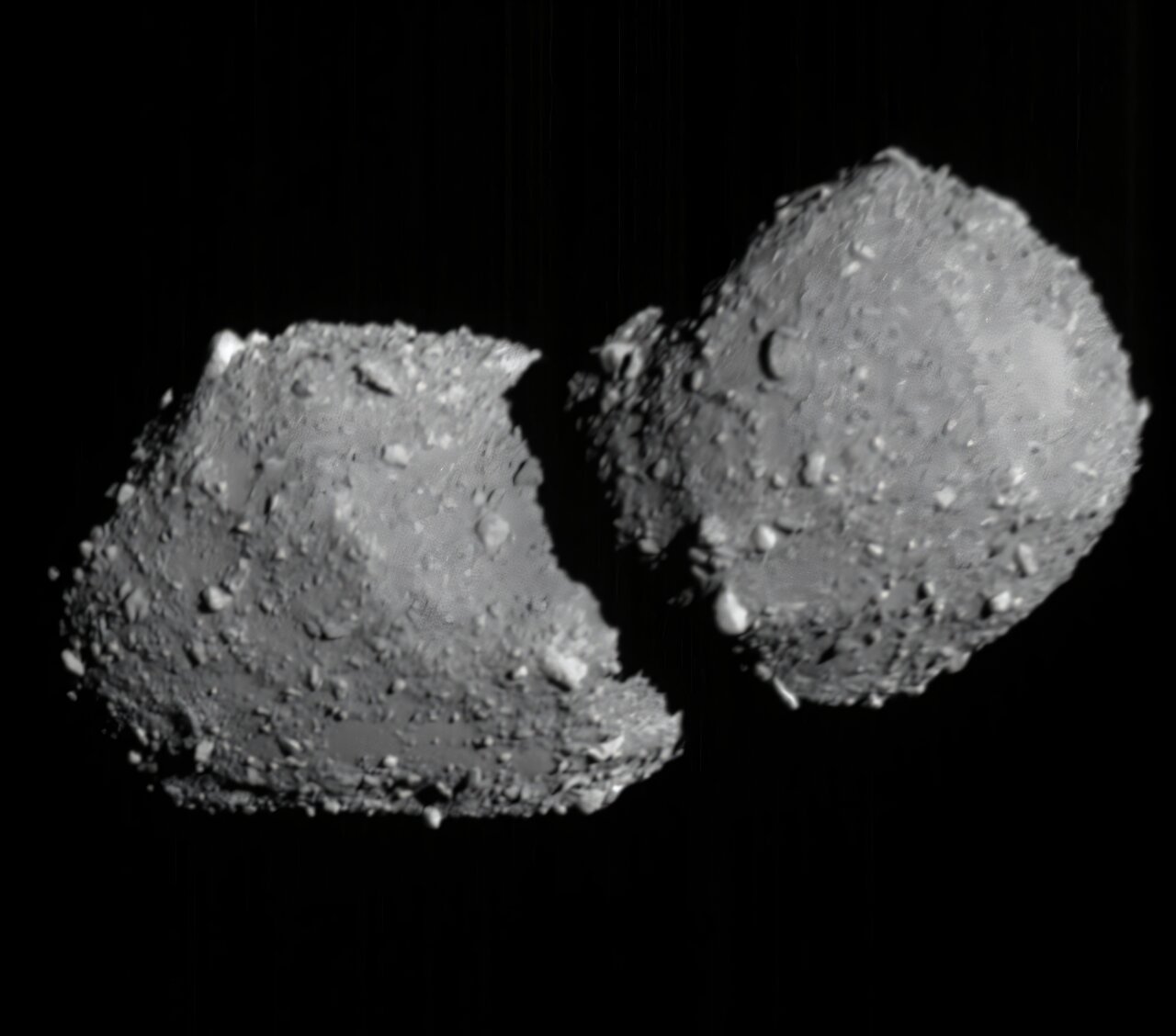
Japan’s Hayabusa 2 spacecraft has completed a close pass of asteroid Torifune, returning images that confirm the object is made from two once-separate bodies joined together. The flyby gives scientists a rare close look at a near-Earth asteroid while the spacecraft continues an extended mission toward a much smaller target.
According to JAXA material reported by Universe Today, Hayabusa 2 passed within about 800 meters, or 2,625 feet, of Torifune on July 5. The spacecraft used its Optical Navigation Camera-Telescopic, known as ONC-T, to capture images showing surface detail and the asteroid’s contact-binary shape.
Ground observations had already indicated that Torifune was elongated, Universe Today reported. The new spacecraft images confirmed that the asteroid consists of a pair of bodies that once orbited a shared center of mass before coming together.
An extended mission after Ryugu
Hayabusa 2 is best known for its earlier mission to asteroid Ryugu. JAXA’s probe reached Ryugu in June 2018, studied it for about a year and a half, and returned a sample to Earth in December 2020, according to Universe Today.
After that mission, JAXA sent the spacecraft onward to additional targets, though the extended mission is not planned to bring back another sample. Its main future destination is 1998 KY26, a near-Earth object only about 11 meters, or 36 feet, across.
Torifune, formally known as 98943 Torifune, served as an intermediate target on that route. Universe Today reported that ground-based observations classify it as a near-Earth asteroid about 450 meters, or 1,476 feet, in diameter.
The asteroid is an S-type object, meaning it is stony or siliceous. Universe Today reported that S-type asteroids are high-density bodies and make up about 17% of known asteroids, making them the second most common class after carbon-rich C-type asteroids.
Fast pass with limited fuel
Hayabusa 2 began observing Torifune in June using ONC-T. JAXA’s spacecraft directly imaged the asteroid on June 20 for navigation before the closer encounter in early July, according to Universe Today.
About an hour before closest approach, the spacecraft also turned several other instruments toward Torifune. Universe Today identified them as the NIRS3 near-infrared spectrometer, the TIR thermal infrared imager and the LIDAR range-finding system.
The encounter posed technical constraints because Hayabusa 2 was moving at a relative speed of 5 kilometers per second, or 3.1 miles per second. Universe Today reported that the spacecraft has less than half of its xenon propellant left, enough to power its ion thrusters to Torifune and then to 1998 KY26, but not enough for extra maneuvers.
Not all data from the Torifune flyby has reached Earth yet, so JAXA’s findings remain preliminary. Universe Today reported that JAXA is expected to release more results after additional data are downlinked and analyzed.
Next stops for Hayabusa 2
Hayabusa 2’s next major trajectory event is an Earth flyby scheduled for December 2027, followed by another Earth swingby in June 2028. Those passes are intended to set up the spacecraft’s arrival at 1998 KY26 in July 2031, according to Universe Today.
The nature of 1998 KY26 remains uncertain. Universe Today reported that optical and radar observations suggest it may be water-rich, while its fast rotation indicates it is likely a single solid piece rather than a loose rubble-pile asteroid.
The object may also be an X-type asteroid, a broad category for bodies that can look similar through telescopes despite having different compositions. Hayabusa 2’s future encounter is expected to give researchers a closer view of one of the smallest near-Earth objects visited by a spacecraft.
This story draws on original reporting from Phys.org.