
AI shortcut may speed search for new physics, with a blind spot
A cosmology study found transfer learning can cut costly simulations, but prior training may make AI miss signals outside the standard model.
By Tom Brennan · Health & Medicine Correspondent
3 min read
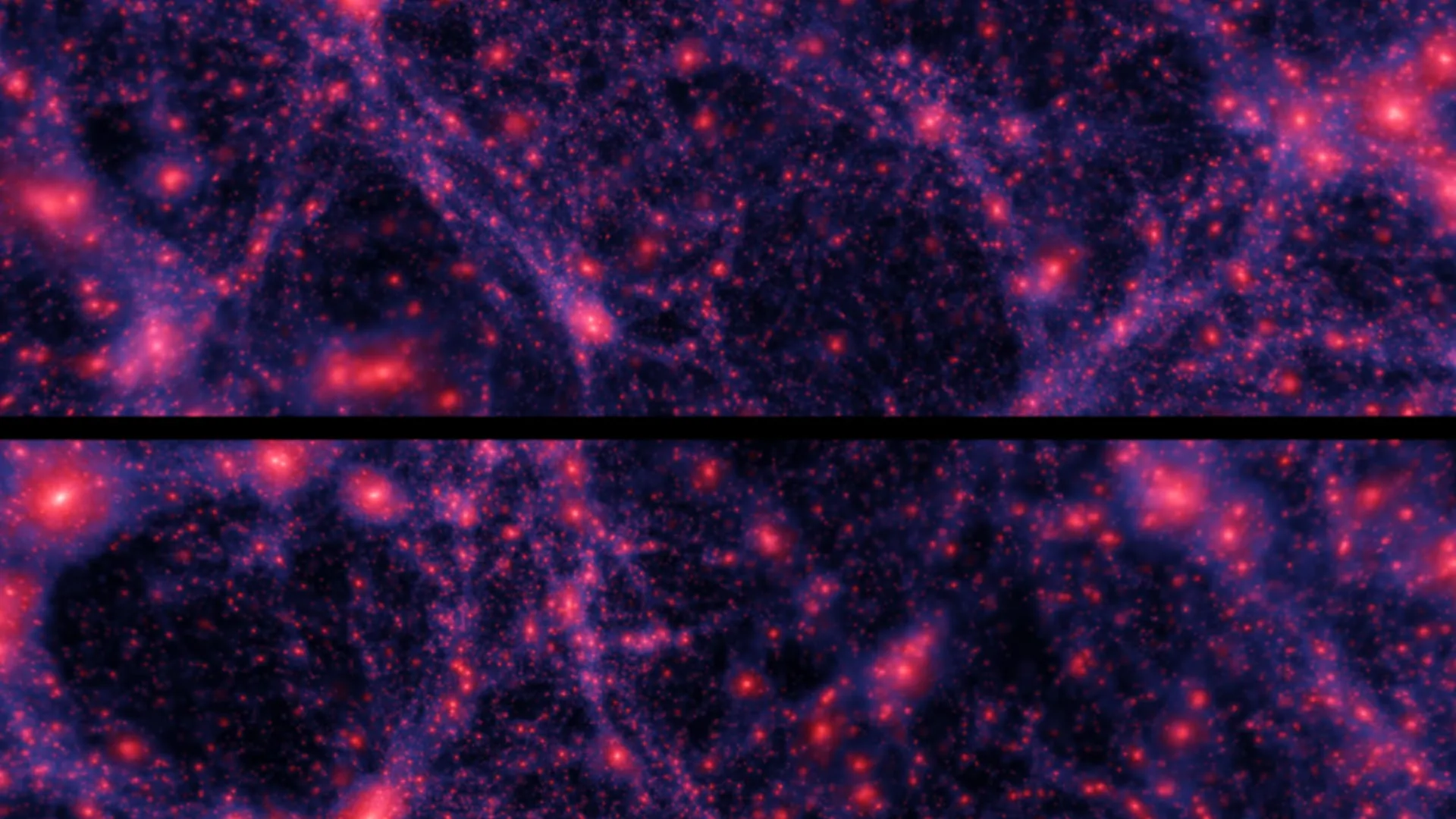
A machine-learning method could make the hunt for new physics in cosmology far cheaper, researchers reported, by reducing the need for costly simulations. The same shortcut can also mislead an AI system when unfamiliar physics resembles patterns it learned from the standard model, according to Sissa Medialab.
The study examined transfer learning, a technique in which an AI model trained on one task applies that training to a related task. Sissa Medialab said the work, titled “Transfer Learning Beyond the Standard Model,” was carried out by Veena Krishnaraj, Adrian E. Bayer, Christian Kragh Jespersen and Peter Melchior and published in the Journal of Cosmology and Astroparticle Physics.
Training on simpler universes
Cosmologists often test ideas by generating large sets of simulated universes under different physical assumptions. Sissa Medialab said those simulations can demand substantial computing power, especially when researchers explore theories beyond the standard cosmological model.
The standard model, known as ΛCDM, describes many large-scale features of the universe, including cosmic expansion and the distribution of galaxies. Scientists continue to test alternatives or extensions because observations have raised questions involving possible effects such as massive neutrinos, modified gravity and evolving dark energy, according to Sissa Medialab.
In the new work, the researchers first trained a neural network on simpler ΛCDM simulations, then gave it additional training on more complex simulations that included possible new physics. Bayer, a cosmologist at the Flatiron Institute and Princeton University and a co-author of the study, described the method as a shortcut that gives the AI an initial understanding before it works on more demanding models, according to Sissa Medialab.
The approach produced large efficiency gains in some tests. Sissa Medialab said transfer learning reduced the number of expensive simulations needed by more than a factor of 10 in certain cases.
Prior training can get in the way
The researchers also found a drawback called negative transfer. In that situation, earlier training can steer an AI system toward a familiar explanation even when the data reflect a different physical cause.
Sissa Medialab said the issue appeared in simulations involving massive neutrinos. Some signals linked to neutrino mass resemble changes in σ8, a ΛCDM parameter that measures how strongly matter clusters across the universe.
Because those effects can look similar in the simulated data, the pretrained neural network initially struggled to separate them. Krishnaraj, the study’s first author and an undergraduate student at Princeton University, said the negative transfer seen in the study was tied to physical degeneracies in the model, according to Sissa Medialab.
That finding points to a central problem for AI-assisted cosmology: different physical processes can leave similar observational traces. If an AI system has learned one explanation especially well, it may need careful retraining or safeguards before it can recognize a genuinely different one.
Next test is real data
Sissa Medialab said the method has so far been tested only with simulations. The next step is to apply it to real astronomical observations.
The research team said transfer learning could help future cosmological surveys, which are expected to gather highly precise data on the universe. The study suggests that AI may help researchers search faster, while also showing why models trained on familiar physics need close checks when scientists use them to look for something new.
This story draws on original reporting from ScienceDaily.